Setting Up a High-Performing, Value-Adding PMO
To establish a Portfolio, Programme or Project Management Office (PMO) that delivers tangible value to the business, organisations must focus on strategic alignment, robust processes and stakeholder engagement. A high-performing PMO acts as a catalyst for effective project delivery, driving accountability, optimising resources, and aligning projects with business objectives. Below are some key steps to set up and run a PMO that will add significant value:
1. Align the PMO with Organisational Strategy
Define the PMO’s Purpose: Clearly articulate the PMO’s role – whether it’s overseeing portfolio management, ensuring governance, or driving digital transformation. Align its objectives with the organisation’s strategic goals, such as improving time-to-market, reducing costs, or enhancing customer satisfaction.
Engage Leadership: Secure executive sponsorship to ensure the PMO has the authority and resources to influence decision-making. Regular communication with C-suite stakeholders helps maintain alignment and demonstrates value through measurable outcomes.
Tailor the Operating Model: Choose a PMO model (supportive, controlling, or directive) that suits the organisation’s culture and maturity. For example, a supportive PMO provides templates and best practices, while a directive PMO takes full control of delivery. In the case of integration programmes below, an Integration PMO should be set up to act as the ‘integration engine’ in line with a directive model.
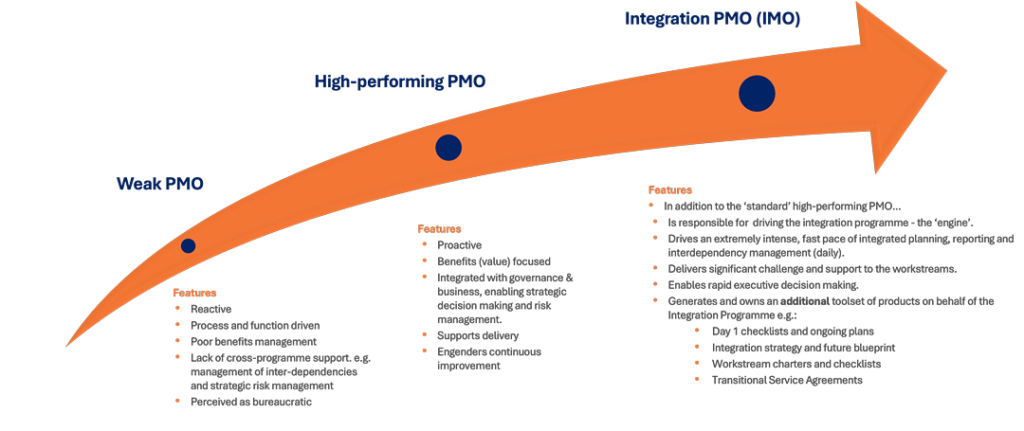
Figure 1 Example: The Advanced Needs of an Integration Management Office (IMO)
2. Establish Robust Governance and Processes
Standardise Frameworks: Implement consistent methodologies (e.g., PRINCE2, Agile, PMI’s PMBOK, or Namaste Management’s Integration Playbook) to streamline project execution. Standardised templates for project charters, risk logs, and status reports improve efficiency and reporting.
Define KPIs and Metrics: Track key performance indicators such as project completion rates, budget adherence, and stakeholder satisfaction. Use these metrics to demonstrate the PMO’s impact and identify areas for improvement.
Implement Governance Structures: Create clear decision-making protocols, including escalation paths and approval processes, to ensure accountability and timely resolution of issues.
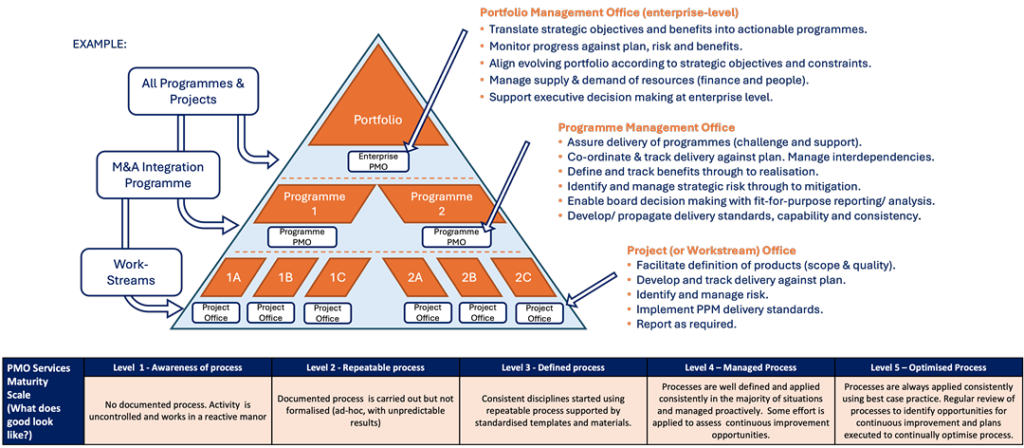
Figure 2 PMOs at Different Levels of the Organisation
3. Leverage Digital Tools and Data-Driven Insights
Adopt Digital PPM Tools: Invest in Project and Portfolio Management (PPM) software (e.g., Clarity, Power Framework, Teamwork or Smartsheet) to enable real-time tracking, resource allocation, and risk management. These tools provide a single source of truth for project data, and can be integrated with existing financial, ERP and other systems to further drive their effectiveness, improving data quality & latency.
Build Data Literacy: Train PMO staff and project teams on interpreting data and using dashboards effectively. This ensures insights are actionable and drive better decision-making.
Focus on Data Quality: Establish processes to maintain data accuracy, consistency, and timeliness. Regular audits and data validation checks prevent “garbage in, garbage out” scenarios.
4. Foster a Culture of Collaboration and Continuous Improvement
Upskill Teams: Provide training on digital tools, project management methodologies, and data analytics to empower teams. A skilled workforce is critical to maximising the PMO’s value.
Promote Stakeholder Buy-In: Engage project managers, sponsors, and teams early to build trust and demonstrate the PMO’s role in facilitating success, not adding bureaucracy.
Drive Continuous Improvement: Regularly assess the PMO’s maturity using frameworks like P3M3. Use findings to refine processes, optimise tool usage, and scale capabilities.
5. Measure and Communicate Value: Highlight successes, such as cost savings, reduced delays, or improved project success rates, to build credibility with stakeholders.
Report Regularly: Use dashboards and concise reports to communicate progress to executives and teams. Tailor reports to address specific stakeholder needs, ensuring relevance and clarity.
Position as a Strategic Partner: Evolve the PMO from a support function to a strategic driver of transformation by aligning its efforts with business priorities and demonstrating measurable ROI.
By focusing on these steps, organisations can transform their PMO into a high-performing, value-adding entity that drives project success and earns the trust of business leaders.
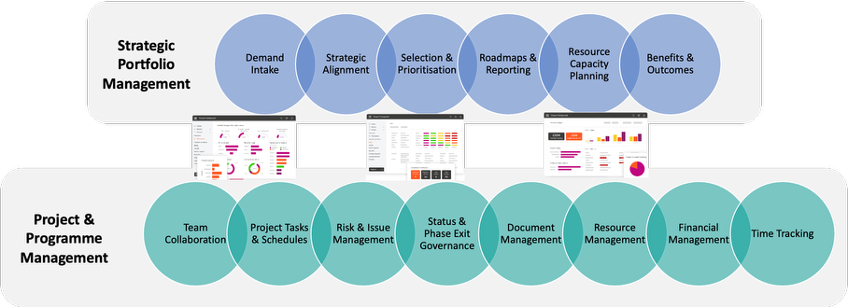
Figure 3 Key PPM Capabilities that PMOs Need to Support
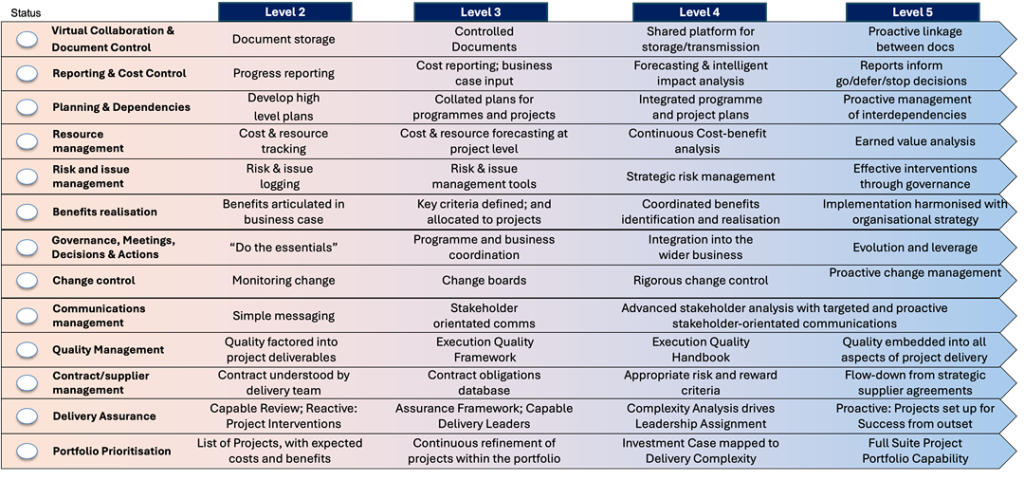
Figure 4 PMO Capabilities at Different Levels of Maturity
Future Trends in Digital PMO: Why Experience Matters
Organisations continue to waste significant amounts of time and money on ineffective project delivery; latest industry studies suggest only 47% of projects meet time, cost, and quality objectives. Despite significant investment, many PMOs driving project delivery still struggle to prove their value; only 1 in 5 business leaders fully acknowledge their PMO for delivering value.
At the same time, the business environment is growing more complex and fast-paced, making traditional PMOs—which rely heavily on manual processes, disconnected systems, and “gut feel” decision-making—obsolete.
A PMO that can join all the dots generated by projects effectively can create a string of valuable insights that enable better decision-making and investment choices. The use of digital tools to enhance project, programme, and portfolio delivery (or ‘Digital PMO’) can represent a step change in transforming an organisation’s change delivery capability.
A Digital PMO leverages digital tools, software, and data analytics to streamline project management processes in areas such as planning, cost control, risk management, and team collaboration to improve efficiency and productivity. Benefits include enhancing project visibility through real-time data tracking & dashboards (providing a single integrated source of truth), improving decision-making with data-driven insights, increasing accuracy in resource allocation, and creating the ability to proactively identify and mitigate potential issues. All of this can generate improved project outcomes, reduce delays, and drive cost savings.
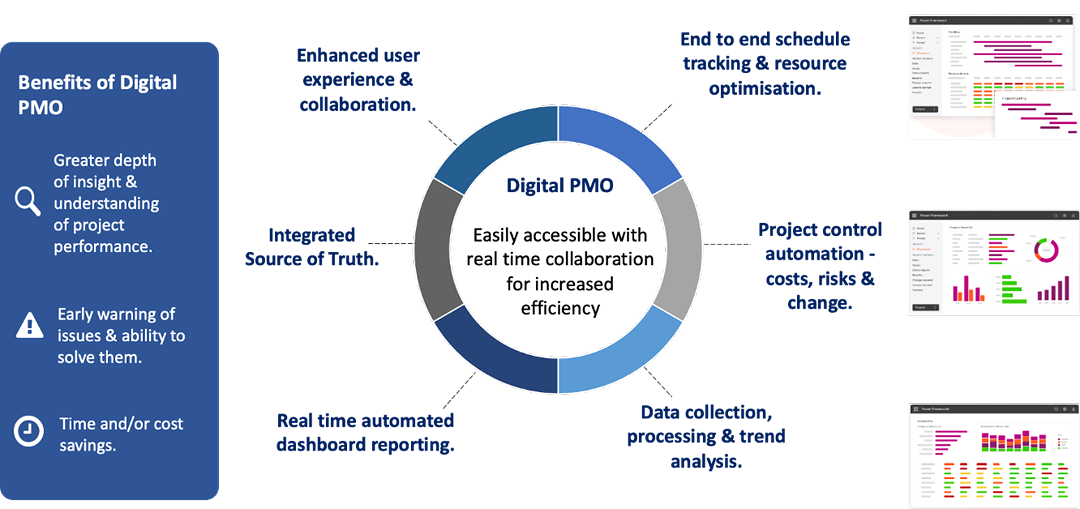
Figure 5 The Benefits of a Digital PMO
Digital PPM tools can automate and enhance processes at project, programme, and portfolio level. This can cover the whole lifecycle of a project from the initial idea incepted into governance, through to strategic alignment, building the business case, the investment decision, delivering the project, deployment, go live, and subsequent benefits realisation.
Organisations leveraging a data-driven approach have reported sizeable improvements in key areas, notably forecast accuracy. One large Transport Infrastructure firm related how its rate of capital investment programme delivery improved by more than 20% in 2 years because of better understanding of schedule and cost performance. This served to significantly enhance the credibility of its PMO.
Adoption of digital PPM tooling needs to be complemented by robust portfolio governance and controls. Organisations should make refinements to the latter if required based on an understanding of current and target maturity levels. Effective training & upskilling of teams on data-driven approaches & data literacy is a key enabler. It’s not enough to just publish some dashboards to an Executive team – you also need to help them understand how they can interact with the reports to provide them with the info they need.
The larger and more complex the datasets that underpin data-driven decision-making processes, the higher the risk of data quality issues that can significantly impact project outcomes—constant focus is required on data accuracy, consistency, completeness, and timeliness. The old principle ‘garbage in, garbage out’ still applies; PPM tooling is only as good as the data held within it.
The Role of AI and Predictive Analytics
Increasingly, generative AI is leveraged on top of PPM toolsets to unlock even greater performance improvements. Sponsors and Exec teams can interrogate enterprise PPM datasets via AI assistants for actionable insights (‘ask me anything’) while Project Managers can request automated narrative generation, and benefit from AI making automated suggestions on what might be relevant risks, mitigation plans, and lessons learned for their prospective projects. The PMO can run automated quality & compliance checks on plans, RAIDs, etc., that can also drive up the quality of PPM data.
In the construction sector, predictive AI is driving further efficiency gains; the product nPlan can produce a work breakdown structure in 30 minutes for a large-scale project, as it has been trained on a dataset of 750,000 historical schedules representing over $2Tn of construction spend. Increasingly for large-scale linear projects, full AI-powered end-to-end automated project control platforms are coming to the fore, such as Nodes and Links, which uses predictive AI to run QRSA risk simulations and CO2 modelling to assess and measure carbon impact.
Why Experience Is Essential
To unlock the full potential of Digital PMO, organisations need to have the right project and portfolio management expertise onboard that can:
- Assess Digital PMO Maturity: Benchmark against industry best practice approaches.
- Design and Implement Tailored Solutions: Avoid unnecessary customisation but ensure digital tool alignment with organisational goals.
- Manage Change & Drive Adoption: Ensure teams understand the benefits and are upskilled in digital tooling to embrace data-driven decision-making.
- Continuously Improve & Scale: Through “Digital PMO as a Service,” providing ongoing optimisation and managed support.
Organisations that embrace the shift to Digital PMO can not only see gains in delivery performance but, in time, reposition their PMOs to be respected as data-driven engines of transformation rather than cost centres.