
Introduction
To prepare a world-class business case that gains Board approval, a consultant or leader must deliver structured, compelling evidence for investment – meticulously blending financial rigour, strategic alignment, and pragmatic delivery plans. Drawing upon the Namaste Management Shop templates as a gold standard, this article explores expert practice in crafting persuasive business cases that secure confidence and commitment for your project idea.
The Purpose of a Board-Ready Business Case
A business case is more than a funding request – it is a decision document, synthesizing the rationale, risks, and rewards for an investment exceeding typical thresholds (e.g., £50k for capital or Phase 2/3 projects). Its goal is to help Boards or Steering Committees allocate capital efficiently, ensuring the project delivers true business value, aligns with strategy, and is feasible in execution.
Essential Structure for Impact
The Namaste template structures the case into logical, self-contained sections. A world-class document should address each area with clarity, coherence, and brevity – removing superfluous narrative, opaque jargon, or fuzzy assumptions. The following headings frame a robust Board submission:
- Approval Requested
- Business Signoff
- Summary Financial Information
- Project Overview and Option Analysis
- Detailed Cost and Benefit Breakdown
- Timing and Milestones
- Governance and Organisation
- Project Risks and Dependencies
- Assumptions and Exclusions
- Appendices (for alternatives and supporting analysis).
This modular approach ensures that each core Board concern – strategic fit, financials, execution risk, and governance – is answered distinctly and concisely.
- Approval Requested: Be Exact
Begin with a clear, tightly worded statement of the approval required. Define exactly what spending (and over what timeframe) is being requested, and, critically, the benefits this investment will deliver – detailing cash values and time horizons. Boards value transparency and specificity at the outset.
Example: “Approval is sought for a spend of £X on a project to deliver £Y in synergy benefits in FY26 and £Z in recurring savings by year three, mitigating risk of £W in potential losses.”
- Business Signoff: Secure Sponsorship
No business case reaches approval without written signoff from key roles:
- Executive Sponsor (strategic fit and cross-division alignment),
- Project Lead (ownership and resource readiness),
- Finance (PL/capex/exceptionals validation),
- Technology (for IT-dependent cases),
- PMO (integration with broader programmes).
These confirmations demonstrate both cross-functional buy-in and readiness, hugely enhancing Board reassurance.
- Financial Summary: Focused & Transparent
The summary financial table is extracted directly from the supporting financials Excel. It should highlight for the recommended scenario:
- Total costs of delivery and operation (exclusive of VAT)
- Benefits – revenue uplifts, cost savings, synergies – over a default three-year NPV/IRR period
- Investment metrics: IRR, NPV, Payback
- Sensitivity of outcomes to key variable changes
Financial clarity is vital – opaque models or speculative returns erode trust. For investments with longer benefit profiles, provide robust justification and supplement calculations as required.
Key Calculations:
- NPV (Net Present Value): All cashflows (benefits minus costs) discounted at the Board’s standard or risk-adjusted hurdle rate—usually around 20% for robust comparison.
- IRR (Internal Rate of Return): The discount rate that would yield a zero NPV—demonstrating the expected return relative to company hurdles.
- Payback: Speed to recoup the initial outlay.
Always supplement numbers with commentary on the key drivers, risks, and variables that could materially swing these outcomes.
- Project Overview and Option Analysis
Succinctly set context for the project – why now, strategic fit, end-user/stakeholder impact, and what change the investment will catalyse. Critically, provide analysis of at least three options:
- Do nothing (baseline/risks of inaction)
- Recommended option (with rationale)
- One realistic alternative
Each option should be summarised in comparable form, with supporting financial tables and a clear rationale for the recommended choice.
Strategic, Economic, Financial, Commercial, and Management Cases
The best business cases explicitly cover:
- Strategic Case: Alignment with business and IT strategies
- Economic Case: Value appraisal of each option
- Funding Case: Affordability profile and source
- Commercial Case: Viability of supplier/procurement arrangements (if relevant)
- Management Case: Capacity, capability, timeline, and risk of execution.
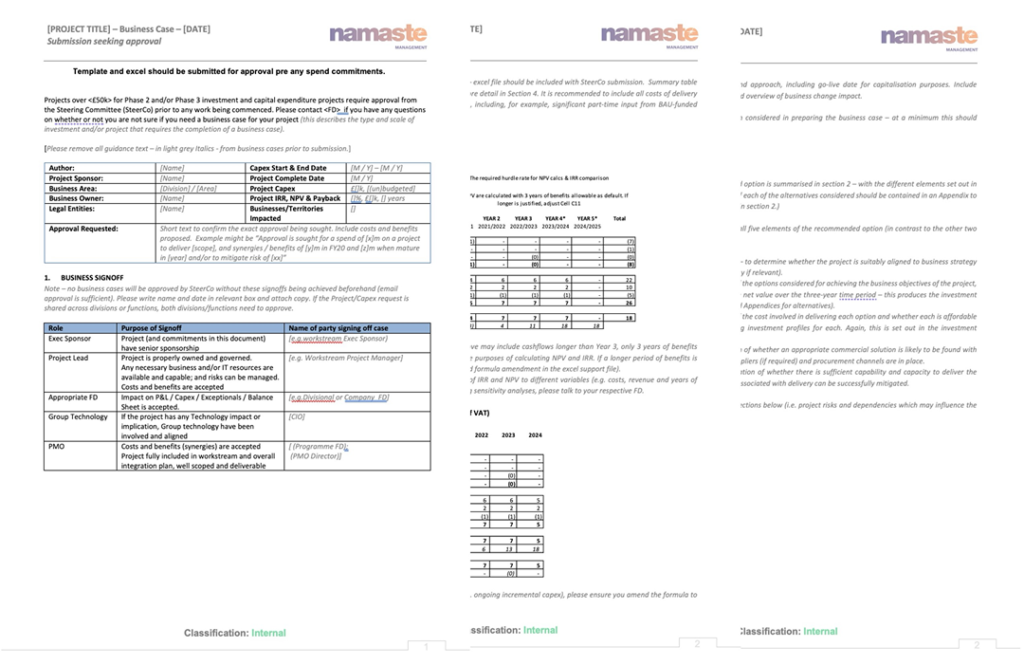
Figure 1 Namaste Management Business Case Template
Download: Namaste Management Business Case Template.
- Costs and Benefits Breakdown
Provide granular breakdowns—exclusive of VAT—of all relevant costs:
- One-off delivery costs (implementation, training, setup)
- Ongoing operating costs (maintenance, support, contract fees)
- End-of-life costs (decommissioning, transition)
- Negative synergies (new costs/offsets)
Synergies and benefits should be:
- Explicit
- Quantified line-by-line: revenue increases, cost savings, risk mitigations
- Split by financial year for Board evaluation.
- Timing and Key Milestones
A Board-ready business case provides a clear timeline (possibly as a Gantt chart), with tangible milestones – demonstrating realistic planning and ensuring early visibility of project health. Key milestones may include:
- Approval to proceed
- Go/No-Go decision gates
- Major design, build, and deployment phases
- Benefit “go-live” (start of value delivery)
- Final completion and review
Ensure dates are specific and each milestone is measurable.
- Governance and Organisation
Set out the project leadership, delivery team structure, and how the project will be governed – ideally visually, with an organogram detailing lines of responsibility and escalation. Explicitly state governance forums and reporting lines to the Board or Steering Committee.
- Project Risks and Mitigation
Detail the key risks – prioritising those with greatest impact or likelihood. For each, include:
- Description
- Impact summary (financial and non-financial)
- Mitigation plan and ownership
- Cost of mitigation where significant
- Target completion date for mitigation
High-quality cases are both honest in acknowledging risk and credible in managing it, rather than glossing over uncertainty.
- Dependencies, Assumptions, and Exclusions
Highlight project dependencies – on other initiatives, regulatory outcomes, or external parties—and summary of critical assumptions underlying the plan. Exclusions should be stated explicitly, framing Board expectations and avoiding assumptions that can later derail outcomes.
- Appendices: Support and Detail
Provide supporting analyses for alternative options, scenario testing, blueprint outlines, or technology architecture diagrams. While the main case should be concise, appendices enable detail-hungry reviewers to interrogate methodology and assumptions.
Best Practices in Board-Ready Business Case Writing
Use Clear, Executive-Friendly Language
- Concise: State only what matters for the decision; edit ruthlessly.
- Structured: Align headings and structure exactly to template expectations; executives know what to look for.
- Evidenced: Support every claim or forecast with data—preferably drawn directly from accepted templates or validated sources.
Articulate Value and Risk With Confidence
Boards need to believe not just the numbers, but also that the team can deliver the promised value and manage downside. Use historic case evidence or scenario analysis to show both experience and contingency planning. Where sensitivity analysis is not automated in the model, provide scenario commentary on the impact of ±10–20% changes in key variables.
Secure Stakeholder Sign-Off Early
Prior to submission, ensure every major business function—Finance, Technology, Operations—has provided explicit written signoff. Pre-emptive alignment boosts Board confidence and avoids rework or embarrassing deferrals at decision meetings.
Integrate Financial and Narrative Cases
Ensure consistency between narrative sections (option analysis, risk, dependencies) and the numbers in your Financials Excel supporting file. All assumptions should align, and any gap requires a clear, documented rationale.
Case Example: Hypothetical Transformation Programme
Suppose proposing a technology upgrade with a £1.5m up-front cost, projected recurring benefits of £800k per annum across cost savings, risk mitigation, and new capability synergies. Using the framework:
- Approval requested: £1.5m capex, targeting delivery of £800k in annual recurring savings.
- Executive sponsor: Group COO; Finance signoff obtained.
- Financial summary: NPV = £725k at 20% discount rate; IRR = 27%; payback = 2 years.
- Options: Do nothing (obsolescence and risk exposure); recommended (modernise core platforms, totalling >£2.5m NPV benefit net of risk); alternative (extend legacy support at higher cost).
- Milestones: Approval (Q1), Design Complete (Q2), Go-live (Q3 next year).
- Risks: Integration delay (owned by PMO); data migration failure (CIO); mitigation plans detailed.
Visual Aids: Diagrams and Tables
- Use organograms for governance.
- Incorporate milestone Gantt charts and financial summary tables.
- Present a side-by-side options table, and traffic-light heatmaps for risk ratings.
Conclusion
A Board-ready business case blends clarity, rigour, and stakeholder confidence – building an unassailable platform for decisive investment. With the Namaste templates as a guide, every section, calculation, and assumption should be robustly justified, clearly presented, and aligned with Board expectations. The winning submission is as analytical as it is succinct, as visionary as it is grounded in delivery reality. Adopt this approach, and Boards will see not just a project, but a well-managed, value accretive opportunity.
Download: Namaste Business Case Template, which includes guidance on structure, content, and Board expectations, as well as Business Case Financials Template, summary tables and analytical calculations.