
The OGC definition of a portfolio is the totality of an organisation’s investment (or a segment thereof) in the changes required to achieve its strategic objectives.
Portfolio management describes the management of an organisation’s portfolio of business change initiatives. It is a coordinated collection of strategic processes and decisions that together enable the most effective balance of organisational change and business as usual. When successfully applied, it increases the return on investment (ROI) across the whole portfolio and can therefore act as a ‘force multiplier’.
Effective portfolio management leads to processes and behaviours that enable successful delivery across an organisation’s entire change investment, and it ensures that:
- change initiatives address and achieve strategic objectives
- maximum business value is realised and at an early stage, whilst risks are managed
- the total change investment is coherent, prioritised and scrutinised
- the broad allocation of skilled change resources is optimised
- new initiatives can be evaluated against strategic objectives, business value and current commitments
- demands from change initiatives on the operational business can be managed and coordinated at an organisational level.
Organisations may choose to subdivide their portfolio or manage only a portion of it. This is often done in relation to a financial portfolio, a buildings and accommodation portfolio or an IT-enabled business change portfolio, for example.
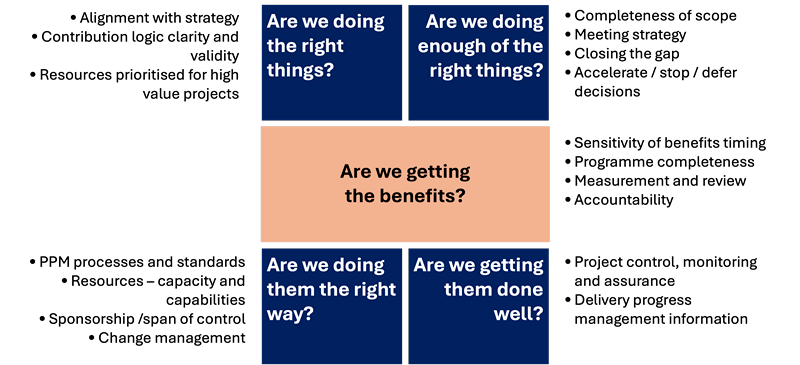
Figure 1 Key Portfolio Management Elements to Consider
In our experience, portfolio management must be enabled through having the right interfaces with key internal functions, namely: strategy development, financial planning/management and project/programme management. If these interfaces are insufficiently strong then the leveraging effect will not be apparent. Providing the enabling conditions are in place, the ‘force multiplier’ effect can be gradually built up by the incremental adoption of portfolio management principles over time. Building the functions takes a short time. There are no short cuts, however, to embedding the principles within the organisation. It takes time but the rewards are worth it.
Characteristics of portfolio management
Good portfolio management will be expected to have the following characteristics:
- Focus will be on leadership and alignment with organisational strategy
- Visions and blueprints will cover the entire, defined organisation
- Timescales for the portfolio may be vague, flexible and long term
- Risk will be viewed from a strategic perspective and in a business continuity context
- Integrity of the entire business transformation is managed through programmes and projects and business as usual
- Benefits orientation will be towards the organisational benefits that affect all areas and are linked to strategic organisational goals
- Stakeholder engagement will have a strategic and external focus
- Governance requires the setting of policies and standards
- Quality will be viewed from the perspective of portfolio alignment and effectiveness
- Planning will be viewed in the context of outcome dependency and conflict resolution
- A combination of programmes and projects and other business change activity is likely.
- The management of internal elements of programmes or projects is not considered part of portfolio management.
Attributes of portfolio management
The following table sets out the key attributes for each of the seven Process Perspectives within the Portfolio Management Maturity Model, at each of the five Maturity Levels, along with a description of each attribute. This can be used to assess current processes and set short- and long-term targets for improvement.

Table 1 P3M3 (Axelos) Portfolio Management Maturity Model
Level 5 Optimised Portfolio Process Descriptions
Generic Attributes for all Processes:
- Information is valued, with continual maintenance and reference
- Evidence of extensive intelligence-gathering processes, with information disseminated through a variety of channels
- Review and improvement is continual and proactive, with lessons being shared openly
- Planning inherent in decision-making process, with adjustments and implications managed and deployed
- Active management of interdependencies between initiative plans and other business plans
- Estimations are accurate and used effectively to ensure delivery
- High levels of competence embedded in all roles and seen as part of career paths
- Knowledge transfer is an inherent behaviour within the organisation
- Skills embedded into organisational leadership and management development programmes

Figure 2 Example Business Transformation Enterprise Portfolio
A) Management Control
Portfolio management has well-defined controls and behaviours that enable it to deliver the strategic objectives of the organisation through a variety of processes and tools. There is evidence of continual improvement.
Specific Attributes:
- Portfolio management processes proven and optimised
- Management control and reporting mechanisms are proactive and focus on Key Performance Indicators aligned to the organisation’s strategic objectives
- Portfolio management can demonstrate that its role in scrutinising initiatives has resulted
- in some being stopped or reshaped to gain better alignment with other initiatives and to optimise delivery
- Evidence that lessons learned through portfolio management are disseminated widely
- Management controls evaluated to ensure they remain aligned to business needs
- Business opportunities identified and potential benefit of new technology to deliver successful outcomes, and its impact, is determined
B) Benefits Management
Benefits realisation is integral to the development of business strategy decision-making. There is evidence of continual improvement.
Specific Attributes
- Benefits realisation and management process exists and is embedded across the organisation, with benefits realisation explicitly aligned to organisational performance framework and outcomes
- Measurement of benefits realised informs the organisation’s strategic objectives and
- priorities, enabling adjustments to strategy where necessary
- Benefits realisation and management process is continually improved based on lessons learned and process metrics
- Externally imposed organisational delivery targets integrated into benefits realisation and management process
C) Financial Management
Financial control of the portfolio is an integral part of the organisation’s financial control regime. There is evidence of continual improvement.
Specific Attributes
- Executive Board manages investments by funding only those initiatives with valid business
- cases and which continue to pass formal reviews
- Investment decisions consider the organisation’s entire portfolio of initiatives and collective benefits and priorities
- There is a portfolio of initiatives that balances financial risk
- Portfolio financial decision-making is based on actual and forecast data from its initiatives
- The organisation is able to flex its appetite for financial risk to better align portfolio to meet organisational objectives
- Appropriate financial control embedded within initiatives and integrated with organisational financial control
D) Stakeholder Engagement
Communications are being optimised from extensive knowledge of the stakeholder environment, to enable the portfolio(s) to achieve their objectives. There is evidence of continual improvement.
Specific Attributes
- Stakeholder engagement embedded in the organisation’s culture
- Communications active, bi-directional and embedded in decision-making process
- Stakeholders fully engaged in change process at all levels
- Communications recognised by Executive Board as a key leadership tool
- Communications measured, relevant and trusted
E) Risk Management
Risk management is embedded in the culture of the organisation and underpins all decision-making within the portfolio(s). There is evidence of continual improvement.
Specific Attributes
- Effective organisational risk management framework with which portfolio interacts effectively
- Formal portfolio gate reviews used to proactively assess and manage investment risk and make decisions based on their impact on portfolio
- Organisational risk management process and outcomes continually reviewed to ensure effectiveness of the process and the organisational risk management framework
- Adequate resources and funding provided for risk management improvement activities
- Risk management illustrates a proven and balanced approach to opportunities and threats across portfolio
- Risk management underpins decision-making process throughout portfolio
F) Organisational Governance
The portfolio is managed to ensure that it remains aligned to support the organisation’s strategic objectives. The portfolio management process is optimised to ensure that it is sufficiently dynamic and agile to cater for changes in business direction and priorities. There is evidence of continual improvement.
Specific Attributes
- Governance of investment management has moved from a programme/project-centric
- process to organisation-centric
- Portfolio realigned to meet changing circumstances, priorities, drivers and funding,
- with resources re-allocated accordingly
- The organisation has effective and robust governance for managing change
- Prioritisation within portfolio based on priority of strategic objectives
- Executive Board has clear accountability for stability of the organisation and actively manages portfolio to ensure sustainability and realisation of strategic objectives
- Organisation proactively enables, supports and achieves business process improvement
- Quantitatively measurable goals for process improvement, with performance against them tracked
- Business performance management is effective and seamlessly incorporates process improvements and benefits enabled by initiatives
G) Resource Management
Portfolio management drives the planning, development and allocation of initiatives to optimise the effective use of resources in achieving the strategic objectives and priorities. There is an organisation-wide resource management policy and strategy for the use of internal and external resources. There is evidence of continual improvement.
Specific Attributes
- Impact of portfolio on strategic planning and its implementation on future resource capacity demands and capability requirements are understood and managed
- Optimal usage of organisational resources can be demonstrated
- Portfolio resource management processes continually improved based on lessons learned and key performance measures
- Resource allocation to and from initiatives intimately aligned with achieving strategic objectives and priorities
- Performance metrics evident to assess resource contribution to organisational performance framework (or scorecard)
Portfolio, Programme & Project Characteristics

Table 2 Differentiating between portfolio, programme & project characteristics

Figure 2 The Programme Management Environment
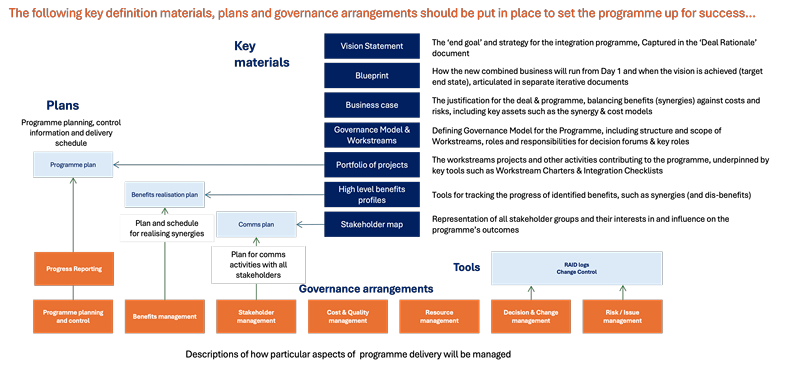
Figure 3 Approach to Programme Management Definition
Case Study: Embedding Portfolio Management into a European Pharmaceutical Business
This business began a portfolio management journey by recognising the need for Integrated Planning to address the reality of initiative overload in the business divisions (LOCs) and to align the multitude of global and regional projects to the core strategic objectives of the European Region.
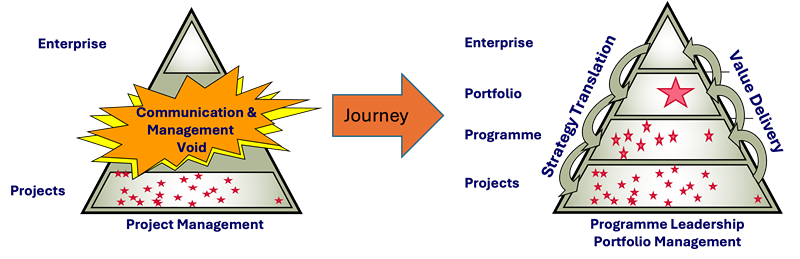
Figure 4 The Journey to Effective Portfolio Management
Key factors:
- to implement a ‘target lite’ model of integrated planning which provides the Europe region with the governance model and analytics to begin making portfolio and resourcing decisions
- to create a league table of clearly prioritised projects, duly categorised and scored against strategic criteria, which can be consistently communicated to LOCs and initiatives for planning purposes
- to have the opportunity to progress our capability, both at a European level, and within business divisions; but first, to fully embed what had been created to ensure the Integrated Planning Board (IPB) established its credibility, in the eyes of Business Division GMs and the European Executive Team, through sound recommendations and decision-making
- to recognise that as more projects are initiated, and resources are further squeezed, the need for this capability increases; and the risk to the business of not doing it properly rises exponentially

Figure 5 Portfolio Management Options to Consider

Figure 6 Target Lite Model of Portfolio Management includes
The initial phase of portfolio management implementation sought to achieve greater control through integrated planning, with European LOCs will be better positioned to deliver on business performance in the context of managing the scope and scale of change within the organisation.
When fully implemented, the Integrated Planning function would:
- Establish a decision-making mechanism (the Integrated Planning Board) to influence how and when global and regional initiatives are implemented within Europe, and by exception to challenge the decision to launch.
- Ensure markets have early visibility of new initiatives as they emerge and are kept informed about progress on global and regional initiatives.
- Provide clarity on the contribution of global and regional initiatives to Pharma Europe strategy.
But the selected “lite” model would not be able to put focus on one of the previously stated goals:
- Provide transparency on what the markets are focusing their energy on and their capacity/ capability to accommodate further change.
They used the P3M3 Model (see Table 1) to assess current capabilities and stated ambition, aiming for Level 2 processes during Phase 1 and Level 3 in Phase 2.

Figure 7 Key Questions to Answer in Phase 1 & 2
At the outset, a number of key challenges were identified in order to deliver and implement portfolio management (integrated planning) successfully:
- The authority of the Integrated Planning function must be respected across the business
- ELT and IPB to continue to mandate across the business that all new proposed global and or regional initiatives to come through the Integrated Planning function and board for impact assessment and prioritisation
- IPB, constituted of European Functional Leads, further builds its credibility by decisive recommendations to the ELT and driving up standards of project business cases and planning, further enhancing IPB standing in the eyes of GMs and ELT
- Global/regional Initiative leads recognise IPB as supportive as well as challenging
- Sufficient resources of the right capability to drive Integrated Planning at pan-European and LOC level
- Under the “lite” model, LOC level integrated planning is left to the LOC to determine the best approach
- The European IP team should focus on supporting the ‘Target Lite’ function and board to embed the process and credibility in the eyes of initiative leads and IPB
- Ensuring predictability to help LOCs forward plan in a stable environment
- Consider, as a next step, early locking of plans in advance of period in which initiatives land, e.g. the approval of Q4 initiatives is locked down at the end of Q2
- Establish an exception process that can accommodate mandatory changes that emerge after the deadline based on strict approval criteria
- Requires early comms to functional sources of initiatives
- Integrated Planning needs to cover both existing and new global and regional initiatives
- Completed as part of the implementation
- Ensure continued application of minimum criteria
- Look to encourage consistent ways of working with other parts of the organisation
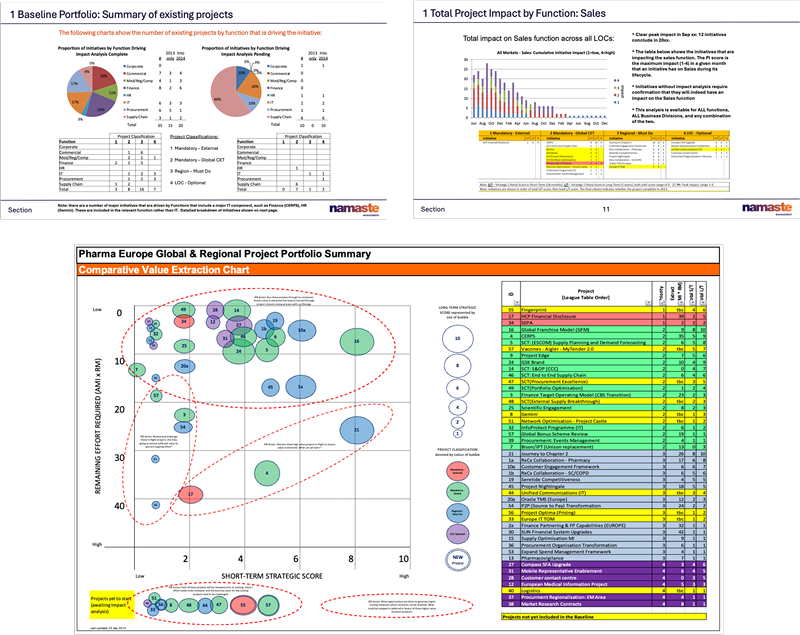
Figure 8 Sample Dashboards Created in Phase 1
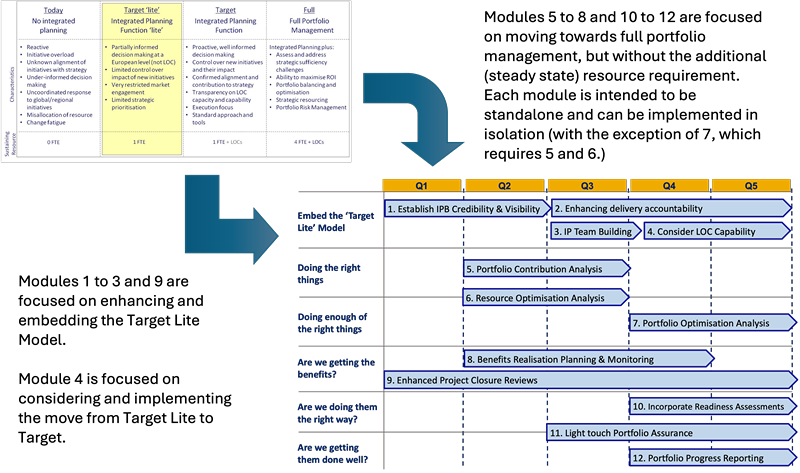
Figure 9 Phase 2 Overview
Through Phases 1 & 2, this business was able to align portfolio management processes to the right organisation level, see Figure 10. Each process was designed to be:
- rigorous and comprehensive
- simple to communicate
- easy to operate
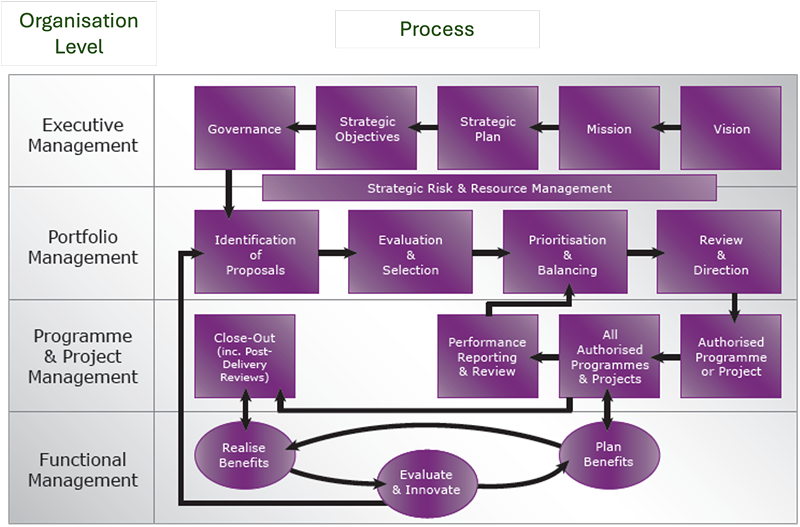
Figure 10 Bringing it all Together – Portfolio Governance