
Executive Summary
For CxO leaders, orchestrating a successful strategic change programme is a defining challenge that demands strategic clarity, disciplined execution, and cross-functional alignment. This guide provides a comprehensive roadmap for designing and delivering transformation initiatives that integrate changes across people, processes, technology, and facilities. By establishing a clear vision, robust governance, and a prioritised portfolio, leaders can mitigate risks like change fatigue and siloed workstreams.
Industry data underscores the stakes: McKinsey reports that 70% of transformation programmes fail due to poor alignment or execution, yet organisations that excel in change management are 3.5 times more likely to outperform peers (Prosci).
This guide equips executives and practitioners with actionable frameworks, tools, and metrics to drive sustainable value, supported by case studies and reflection questions to ensure strategic focus and stakeholder engagement. It covers:
- Vision & Strategic Governance: The North Star for Change
- Portfolio Level Planning: Sequencing & Prioritisation
- Impact Assessment & Multi-Level Stakeholder Engagement
- An Integrated Programme Architecture
- Change Management & Acceleration Tactics
- Performance Monitoring, Adaptation & Sustainability
- Toolkit: Accelerating Delivery
- Commons Pitfalls & Mitigations
- Ready to Use Programme Checklist
- Links to Available Namaste Management Tools & Templates
1. Vision & Strategic Governance: The North Star for Change
Strategic Alignment & Vision Narrative
- Co-author a transformation charter that connects the programme to long-term strategy and value creation objectives (e.g. efficiency, innovation, scalability).
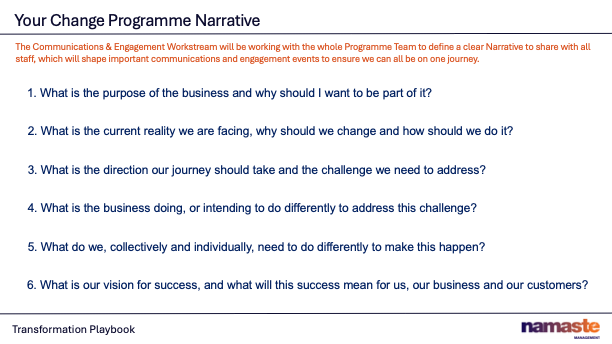
- Develop an inspirational narrative that explains not just the “what,” but the “why” – anchored in business purpose and competitive advantage.
Governance Architecture:
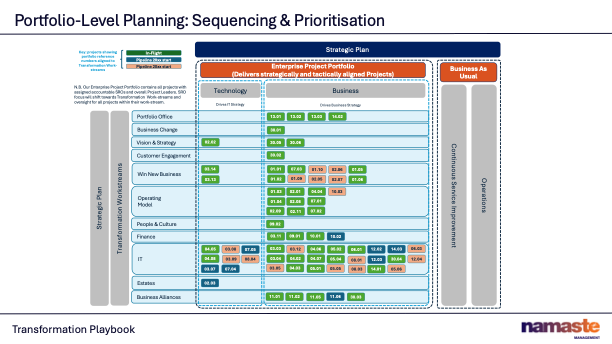
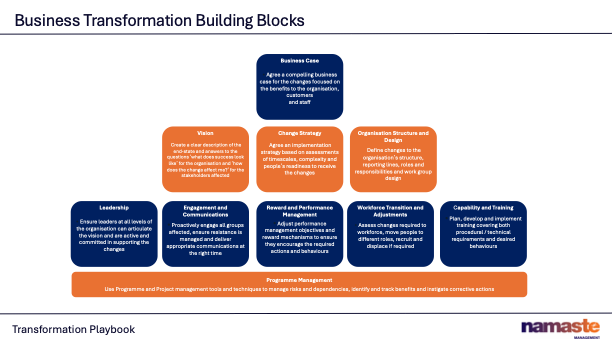
Form a Programme Management Office (PMO) and transformation team with executive sponsorship and a senior overall owner (ideally C‑suite or board member).
- Establish four-tier governance:
- Company Board: ultimate accountability.
- Steering Committee: strategic oversight and funding decisions.
- PMO: cross-functional / cross-workstream coordination.
- Workstreams: domain leads (people, process, tech, facilities, each workstream aligned to a business function).
- Clarify roles, RACI models, escalation routes, and decision rights from “day zero.”
Reflection Questions
- How does your transformation vision align with your organisation’s strategic goals?
- Are your governance structures empowering rapid decision-making without creating bottlenecks?
- What steps are you taking to ensure the “why” of the transformation resonates with all stakeholders?
Case Study: Global Retail Transformation. A global retailer launched a transformation to integrate omnichannel sales. Their PMO, led by the COO, crafted a vision tied to a 20% revenue growth target. By establishing a steering committee with cross-functional C-suite representation, they reduced decision-making delays by 30%, achieving a 15% increase in customer satisfaction (NPS) within 18 months.
2. Portfolio-Level Planning: Sequencing & Prioritisation
Portfolio Mapping & Interdependencies
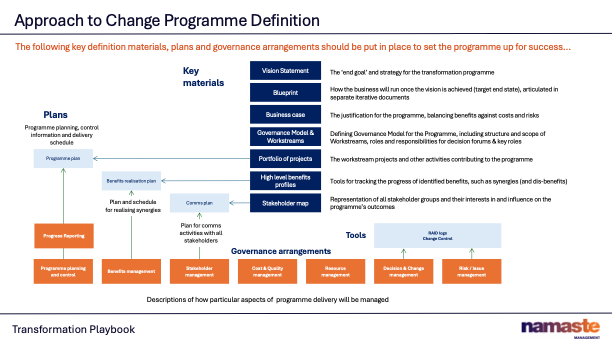
- Capture all initiatives in a transformation portfolio, with clear descriptions, owners, dependencies, and status.
- Create an interdependency map to highlight domains that feed or block each other – for example, a new CRM system (technology) fuels sales process redesign and facility layout adaptation.
Prioritisation & Sequencing
- Use a dot‑voting matrix or weighted scoring model to prioritise based on impact, effort, risk, and readiness.
- Stagger high-visibility changes (e.g. HR policy or major tech rollout) after foundational improvements are proven in pilot zones.
Resource Capacity Management
- Monitor resource utilisation across workstreams to avoid “change fatigue.”
- Enforce resource gating: only start new initiatives when capacity thresholds are respected.
Reflection Questions
- Have you mapped all interdependencies to avoid delays in critical workstreams?
- How are you balancing high-impact initiatives with available resource capacity?
- What criteria are you using to prioritise initiatives, and are they aligned with strategic goals?
Case Study: Healthcare System Overhaul. A healthcare provider mapped 25 initiatives, identifying that EMR system upgrades blocked patient scheduling redesign. Using a weighted scoring model, they prioritised EMR implementation, achieving a 25% reduction in scheduling errors and a 10% increase in staff productivity within 12 months.
3. Impact Assessment & Multi-Level Stakeholder Engagement
Impact Analysis
- Conduct a Business Domain Impact Assessment (BDIA) to identify workflows, user segments, facilities, and systems changed by each initiative.
- Use RACI overlays to understand who is impacted and who holds accountability.
Stakeholder Mapping & Advocacy
- Identify stakeholders across hierarchical levels and value chains—including hidden or emergent groups like contractors, frontline staff, or vendor partners.
- Create Change Advocate Networks – volunteer route-mappers or champions in each team who feed early warnings and ideas into PMO.
Communication Strategy
- Design a tailored communication roadmap by stakeholder group; blend rational and emotional frames (e.g. “This is better for your team,” not “better for the business”).
- Leverage multi-channel tactics: town halls, team huddles, Yammer chats, feedback kiosks, Q&A sessions.
- Establish a listening loop – review sentiment, adjust message cadence, and share back improvements to demonstrate responsiveness.
Leadership Checklist for Change:
- Have you identified all stakeholder groups, including indirect or emergent ones?
- Are communication plans tailored to address both rational and emotional needs?
- Have you established a feedback loop to monitor stakeholder sentiment?
- Are change advocates embedded across all levels to amplify engagement?
- Is the BDIA comprehensive, covering all impacted domains and workflows?
Reflection Questions
- Are all stakeholder groups, including indirect ones, accounted for in your engagement plan?
- How are you measuring the effectiveness of your communication strategy?
- What mechanisms are in place to act on stakeholder feedback promptly?
Case Study: Financial Services Engagement. A bank undergoing digital transformation conducted a BDIA, identifying 12 impacted workflows. By deploying change advocates across branches, they increased employee adoption of a new CRM by 40%, reducing customer onboarding time by 20% within 9 months.
4. An Integrated Programme Architecture
People Transformation
- Conduct a future skills gap analysis aligned to new processes, systems, and ways of working.
- Execute blended learning: formal training, on-the-job coaching, bite-sized micro-learning, and digital adoption platforms (DAPs).
- Monitor change saturation via pulse surveys and bandwidth assessments, sanction rest periods between initiatives.
- Promote psychological safety through open forums and transparent escalation channels.
Process Re‑engineering
- Map current (as-is) and desired (to-be) processes across workstreams using BPMN or value-stream mapping.
- Apply agile pilots: make changes in pods or regions first, refine with data and feedback, then roll out enterprise wide.
- Enforce process governance: define workflows, KPIs, handover points, and escalation rules.
Technology Enablement
- Derive a Tech Roadmap that sequences ERP/SaaS implementations, data migration, automation (RPA/AI), integration, and decommissioning of legacy systems.
- Optimise for adoption: include user experience design, adoption metrics, a support desk, and embedded help tools.
- Integrate cybersecurity, data governance, and privacy checks into system selection and deployment plans.
Facilities & Workspace Alignment
- Design physical space to match future ways of working: collaboration zones, quiet areas, hybrid seating, and health/safety compliance.
- Use simulation tools (e.g. digital twins, space utilisation analysis) before committing to construction or refurb.
- Partner closely with the people workstream—office layout decisions should reflect process flows, team proximities, and tech attachment points (e.g. hot-desk kits, video‑conferencing areas).
Reflection Questions
- How are you ensuring alignment between people, process, tech, and facilities workstreams?
- Are your training programmes flexible enough to address diverse skill gaps?
- What tools are you using to simulate and validate facilities changes before implementation?
Case Study: Tech Firm Workspace Redesign. A tech firm used digital twins to simulate a hybrid workspace, aligning it with new agile processes. Post-implementation, employee collaboration scores rose by 35%, and workspace utilisation improved by 25%, per internal surveys.
5. Change Management & Acceleration Tactics
Framework Tailoring
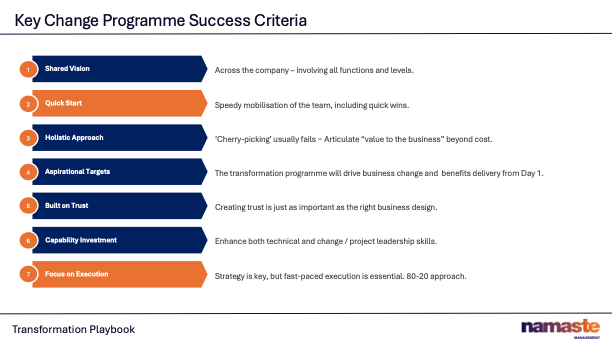
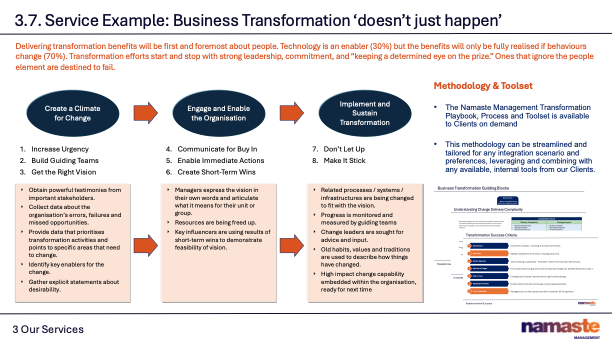
- Adapt change frameworks (ADKAR, Kotter 8-Step, Lewin) to your programme size. For instance:
- ADKAR for individual adoption: Awareness → Desire → Knowledge → Ability → Reinforcement.
- Kotter for organisational momentum: create urgency → form coalition → generate short wins → anchor new practices.
- Lewin for structured change: Unfreeze → Change → Refreeze
Comparison of Change Management Frameworks
| Framework | Focus | Key Stages | Strengths | Weaknesses |
| ADKAR | Individual adoption | Awareness, Desire, Knowledge, Ability, Reinforcement | Clear, individual-focused milestones; measurable outcomes | Less emphasis on organisational dynamics |
| Kotter 8-Step | Organisational change | Create urgency, form coalition, vision, communicate, empower, short wins, consolidate, anchor | Drives enterprise-wide momentum; leadership-centric | Can be complex for smaller teams |
| Lewin | Structural change | Unfreeze, Change, Refreeze | Simple, intuitive framework; good for process-driven change | Oversimplifies complex transformations |
Change Leadership Cadence
- Embed bi-weekly change forums, where domain leads review readiness, resistance, adoption, and escalation needs.
- Use change readiness dashboards that track sentiment, adoption rates, training completion, and risk flags.
Change Networks & Reinforcement
- Launch change squads that include power users, champions, and domain leads.
- Recognise and reward behaviours that reflect the new ways of working – celebrate quick wins and share success stories across teams.
Reflection Questions
- Which change framework best suits your organisation’s size and culture?
- How are you ensuring change squads are empowered to drive adoption?
- Are your dashboards providing real-time insights to adjust tactics?
Case Study: Manufacturing Change Acceleration. A manufacturer used Kotter’s framework to drive automation adoption. By celebrating short wins (e.g., 15% productivity gains in pilot lines), they boosted employee buy-in, achieving a 22% overall efficiency increase within 14 months.
6. Performance Monitoring, Adaptation & Sustainability
Integrated KPI Frameworks
- Define outcome-based KPIs (e.g. productivity gains, cost savings, customer NPS, workspace utilisation) and leading indicators (e.g. training uptake, ticket volume, sentiment).
- Use a single dashboard accessible to all stakeholders for transparency and context.
Agile Retrospectives & Continuous Improvement
- Hold regular retrospectives at pilot and programme scale.
- Use feedback data to pivot: adapt roll‑out sequencing, adjust communications, adjust training schedules.
Handover & Sustainment Mechanisms
- Establish robust handover protocols: operations teams take ownership when initiatives stabilise.
- Formalise operational cadence: monthly performance reviews, process improvements continued, a standing transformation review forum.
Reflection Questions
- Are your KPIs aligned with both short-term wins and long-term strategic goals?
- How are retrospectives driving actionable improvements in your programme?
- What mechanisms ensure sustained ownership post-handover?
Case Study: Telecom Sustainability. A telecom firm implemented a KPI dashboard tracking adoption and NPS. Agile retrospectives reduced implementation errors by 18%, and formal handovers ensured a 95% sustainment rate of new processes after 24 months.
7. Toolkit: Accelerating Delivery
- Transformation Playbook: a living guidebook with process maps, governance templates, escalation paths, communications plan, and training blueprints.
- Digital Adoption Platform (DAP): in-app walkthroughs, guided flows, user analytics, feedback capture.
- Change Readiness Heatmaps: track sentiment, adoption and resistance by team or geography.
- Impact Simulations: disruption impact models (e.g. for facilities changes), scenario planning, and risk overlays.
Reflection Questions
- Are your tools accessible and tailored to different stakeholder needs?
- How are you leveraging DAPs to enhance user adoption?
- What simulation tools can improve decision-making for high-risk changes?
Case Study: Insurance Toolkit Deployment. An insurer deployed a DAP, reducing training time by 30% and increasing software adoption by 45%. Heatmaps identified resistance in 10% of teams, enabling targeted interventions.
8. Common Pitfalls & Mitigations
| Pitfall | Mitigation |
|---|---|
| Siloed Workstreams | Regular cross‑workstream coordination via integrated boards and themed workshops |
| Change Overload | Use portfolio gating and restart points to prevent saturation |
| Low Adoption | Deploy change champions, listen-and-respond channels, tailored training |
| Underinvestment | Secure dedicated budget lines, ring-fenced funding and executive sponsorship |
| Lack of Feedback Loop | Embed retrospectives, citizen reporting tools, and iteration protocols |
Reflection Questions
- What steps are you taking to prevent siloed workstreams?
- How are you monitoring for signs of change overload?
- Are your mitigation strategies proactive or reactive?
Case Study: Energy Sector Pitfall Avoidance. An energy company used cross-workstream workshops to reduce siloed efforts, cutting project delays by 25%. Gating prevented overload, maintaining 85% employee engagement.
9. Ready‑to‑Use Transformation Programme Checklist
✅ Compelling transformation vision & strategic alignment
✅ Programme governance tiers & PMO structure defined
✅ Portfolio-mapped change initiatives with interdependency mapping
✅ Sequenced prioritisation and resource gating in place
✅ Deep stakeholder & impact analysis conducted
✅ Multi-channel communication and change advocacy network launched
✅ Integrated workstreams with clear ownership and coordination
✅ People upskilling, process redesign, tech enablement, and facilities alignment plans
✅ Change models and change-lead structures appointed
✅ KPI dashboards, readiness metrics, and monitoring dashboards active
✅ Continuous feedback, retrospective loops, and adjustment processes embedded
✅ Formal handover strategy and post‑programme sustainment mechanisms defined
Reflection Questions
- Have you validated that all checklist items are actively implemented?
- Are there gaps in your programme that the checklist highlights?
- How will you ensure the checklist evolves with programme needs?
Conclusion: Delivering Transformation with Integration and Purpose
Companies frequently fail at transformation not because they lack ambition, but because they orchestrate too many disparate changes without a unifying structure. An effective programme treats change holistically: aligning people, processes, technology, and facilities behind the same north star.
Success isn’t declared at launch—it’s earned through executive stewardship, disciplined sequencing, transparent measurement, and iterated momentum. Driving enterprise transformation at scale is less about fixing discrete problems, and more about crafting the systems and muscle memory for continuous, integrated change.
When transformation is owned, measured, and embedded – with adaptability and shared ownership as core behaviours – it becomes a defining competitive advantage.
Sample Namaste Management Change & Transformation Tools Available in Our Shop
| Tool | Description |
| Business Case Template | A business case template to ensure you capture all key and relevant information about your project or programme, including a tool to calculate key project return on investment figures. |
| Change Strategy & Plan | A comprehensive business change strategy and plan to enable you to think about all the key features and impacts of a project or programme on your business. |
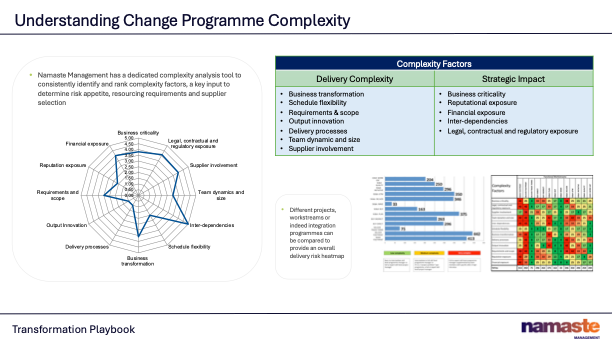
| Programme Complexity Tool | A tool for analysing the complexity of your project or programme and its constituent workstreams to provide a measurement of risk and the likely skill level programme leaders will require to deliver. |
| Business Function/Process Taxonomy | A taxonomy of high-level process areas for all business functions within a corporate organisation. This includes a template for mapping as-is and to-be processes. |
| Business Culture Guidance | Guidance for how to think about business culture, its impact on business performance and mechanisms to measure, monitor and change culture. |
| Project Charter | A template charter (or overview) of your project, programme or workstream. |
| PMO Governance Tool | An advanced RAID tool for robustly capturing all your programme or project risks & issues, actions, decisions, dependencies and forward planning your key meeting agendas. |
| Change Impact Assessment | A tool to enable you to assess the impact of all changes you are planning to implement through a project or programme on all business functions. |
| Change Readiness Assessment | A tool to enable you to assess the readiness of business functions to accept the impact of all changes you are planning to implement through a project or programme. |
| Programme Project & Milestone Log | A template to capture the key information for all your projects (Master Project List) and to capture and track all your project milestones, including Gantt view. |
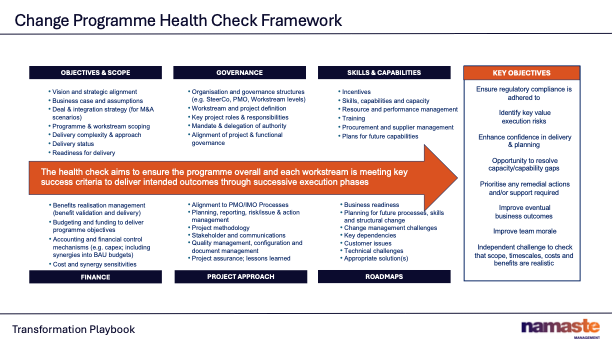
| Programme Health Check Tool | A comprehensive tool for analysing and documenting the health of your project or programme, organised into 6 core themes that underlie the success factors of programme delivery. |