Introduction
As we enter 2026, AI adoption is no longer optional – it is a survival imperative.
However, nearly all organizations now use AI in at least one function, yet many struggle to realize meaningful ROI, according to McKinsey’s 2025 State of AI survey. This gap stems from insufficient data literacy, which undermines AI’s potential. Gartner reports that 79% of CEOs anticipate AI will have the greatest impact of any technology on their industry in the next three years, but without combining AI fluency with robust data skills, companies risk wasted investments and ethical pitfalls.
Namaste Management’s integrated approach – fusing AI and data literacy through targeted upskilling, cultural shifts, and measurable KPIs – delivers tangible returns: 15-25% productivity boosts, 10-20% efficiency gains, and ROI multiples of 2-3x within 6-12 months, as evidenced by Deloitte’s insights on AI investments. For CEOs focused on growth, CIOs on tech resilience, CPTOs on operational efficiency, CHROs on talent development, and CDOs on data governance, this literacy establishes the foundation for ethical, sustainable AI adoption. It drives behaviour change from reactive to proactive decision-making, quantified by KPIs like reduced decision times and lower error rates.
Unlock your organization’s potential with Namaste’s ID8 AI diagnostic – identify quick-win opportunities yielding up to 15% immediate savings.
The Leadership Gap in the AI Era
Artificial intelligence has accelerated beyond corporate preparedness. In just two years, generative AI tools have revolutionized how teams ideate, analyse, and execute – yet a majority of C-suites remain unable to articulate their underlying mechanisms or mitigate risks beyond superficial productivity metrics.
This disconnect manifests in critical vulnerabilities:
- CEOs (Chief Executive Officers) greenlight AI projects without evaluating data integrity, exposing firms to regulatory fines.
- CIOs (Chief Information Officers) grapple with ungoverned models amid escalating compliance demands.
- CPTOs (Chief Product & Technology Officers)contend with fragmented tech stacks that hinder efficiency.
- CHROs (Chief Human Resources Officers) face cultural backlash, contributing to 20-30% higher talent attrition in AI-mature firms lacking literacy programs (McKinsey); and
- CDOs (Chief Data Officers)struggle to align data strategies with business outcomes.
In a landscape of investor scrutiny and information deluge, executives must evolve into strategic AI interpreters to lead with assurance and foresight.
Why AI & Data Literacy Is the New Core Compet ency
Data literacy has transitioned from a niche expertise to an indispensable executive capability. With every strategic pivot – from dynamic pricing to ESG compliance – now reliant on AI-mediated data, leaders equipped with this fluency drive superior, ethical outcomes. Deloitte highlights that 84% of AI investors report ROI when paired with strong data management, underscoring literacy’s role in amplifying returns.
At its core, literacy transcends technical prowess; it is about discerning judgment – deciphering data’s nuances, scrutinizing AI algorithms for biases, and insisting on human-centric oversight.
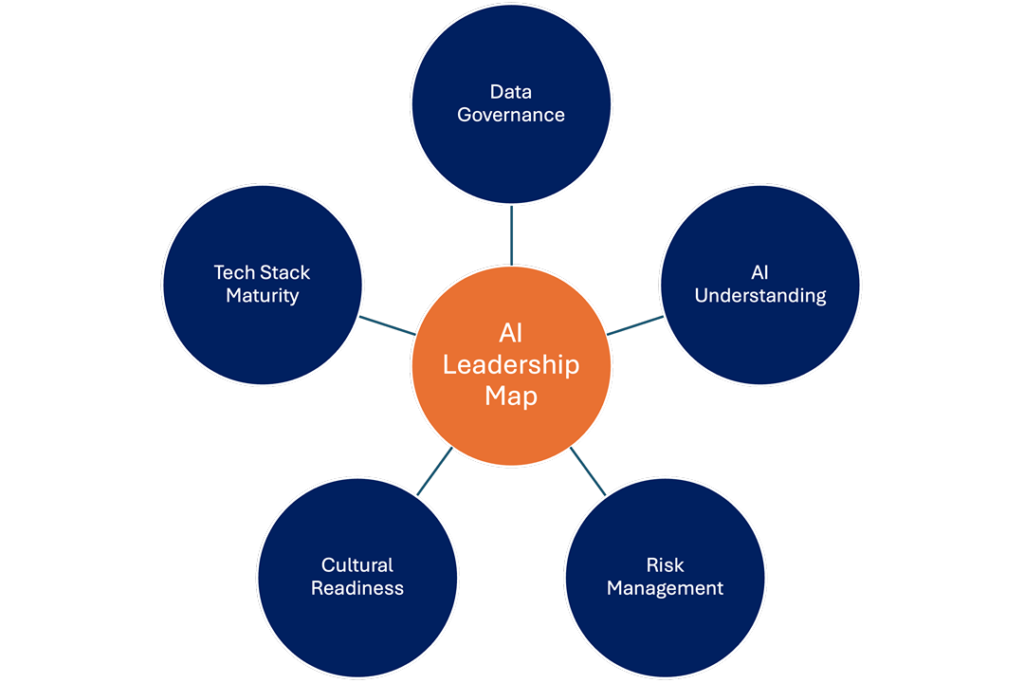
Figure 1 AI Leadership Gap Map
For C-suite stakeholders:
- CEOs: Harness AI for strategic foresight, such as predictive analytics fuelling 15-20% revenue uplift through informed market positioning.
- CIOs: Fortify governance by tracing data lineages, ensuring secure, scalable infrastructures that mitigate risks.
- CPTOs: Optimise workflows with AI tools, slashing product development cycles by 20-30% and enhancing efficiency.
- CHROs: Nurture inclusive cultures via L&D initiatives that bridge skill gaps, boosting employee engagement by 30% and curbing turnover (Gallup).
- CDOs: Champion data stewardship to support analytics-driven reporting, directly influencing profitability trends in investor communications.
Fluent leaders do not merely trust AI outputs; they interrogate them, weaving data narratives into operational realities. This fosters a collaborative ecosystem where AI augments human ingenuity, cultivating a culture of innovation and resilience.
Lessons from PE-Backed Businesses: Proven Financial Returns
In the high-stakes world of private equity, where value must materialize in 3-5 year horizons, AI and data literacy serve as pivotal levers for accelerated performance. Namaste Management’s engagements reveal how literacy transforms data from a liability into a profit engine.
Consider these real-world examples:
- Margin Optimisation: A PE-backed manufacturing entity revamped its data governance framework, integrating AI for supplier analytics. This yielded a 3% EBITDA boost – equating to $3-7M annually – through predictive procurement, alongside a 15% reduction in supply chain inefficiencies.
- Operational Forecasting: In a mid-market logistics firm, machine learning applied to historical data enhanced route planning and inventory management by 15%, liberating over $1.5M in working capital while elevating productivity by 25%. Leaders’ data fluency enabled them to validate AI models, ensuring accuracy and trust.
- KPI-Driven Accountability: A services company automated data pipelines for investor dashboards, enabling real-time variance analysis. This shifted board dynamics from retrospective reviews to predictive strategy, cutting decision-making delays by 25% and fortifying investor confidence – directly correlating to a 10% valuation uplift.
- Talent and Efficiency Synergy: A tech-enabled PE portfolio company invested in cross-functional literacy training, resulting in AI-optimised HR processes that reduced recruitment cycles by 40% and turnover by 18%. The ROI? A $2M annual saving in talent costs, with productivity gains amplifying output by 22%.
These successes share a thread: Leadership teams did not just adopt AI; they mastered data literacy to interrogate, refine, and scale it. PE investors now probe, “How does your data maturity fuel AI value?” – and unprepared responses signal strategic deficits. In other words, “Weak answers = Red flags.”
For your enterprise, emulating this could unlock similar gains; Namaste’s ID8 Toolkit offers a rapid audit to quantify your baseline and project 10-25% efficiency improvements.
The Synergy of AI and Data Literacy: Building Measurable Foundations
True AI adoption thrives only when underpinned by data literacy – the symbiotic relationship that establishes robust foundations for benefits. Isolated AI implementation often falters; McKinsey notes that AI can automate up to 30% of current worked hours by 2030, but without literacy, poor data quality leads to flawed outputs, eroding trust and ROI. Combining the two creates a virtuous cycle: Data literacy ensures clean, contextual inputs for AI, while AI amplifies data’s insights, driving measurable payback.

Figure 2 The AI & Data Literacy Value Loop
Organizations training employees in AI report higher project success rates, though overall AI pilot failure rates remain high at 95% without proper literacy integration (MIT). Literate teams identify biases, validate assumptions, and align tools to business KPIs.
This synergy manifests in behaviour change: From siloed, opinion-driven decisions to collaborative, evidence-based agility.
KPIs include:
- Productivity Metrics: 20-30% reduction in task times, tracked via pre/post-training benchmarks.
- Efficiency Gains: 15-25% cost savings in operations, with payback periods of 6-12 months.
- Innovation Indicators: 2x increase in data-informed initiatives, measured by project success rates.
- Cultural Shifts: 25-35% uplift in engagement scores, correlating to lower attrition and higher retention.
By fostering this integration, companies achieve sustainable AI assimilation, where benefits are not hypothetical but quantified – ensuring investments yield defined ROI rather than evaporating in adoption pitfalls.
Upskilling Leadership and Rethinking Structures
To harness this synergy, organizations must prioritize upskilling as a cultural cornerstone, reshaping structures for data-first agility.
Namaste identifies three transformative shifts; each tied to L&D and ROI:
- Cross-Functional L&D Programs: Move beyond IT-centric training to executive-focused curricula. Workshops simulate AI scenarios, teaching bias detection, ethical governance, and KPI alignment. For instance, role-specific modules empower CEOs to forecast AI’s strategic impact, CIOs to architect resilient data systems, CPTOs to deploy efficiency tools, CHROs to integrate literacy into talent pipelines, and CDOs to oversee data-driven analytics for financial reporting. These programs drive behaviour change through gamification and mentorship, yielding 30% higher adoption rates. ROI emerges quickly: A McKinsey study shows analytics-savvy firms are 23x more likely to acquire customers, translating to multimillion-dollar revenue gains. Payback KPIs include 15-20% productivity spikes within quarters, measured by output metrics and employee surveys.
- Emerging Roles for Stewardship: Introduce positions like AI Ethics Officers, Data Insight Partners, and – critically – the Chief Data Officer (CDO) to bridge gaps. The CDO plays a pivotal role in AI and data literacy activities, serving as the custodian of the organization’s data ecosystem. Their accountability spans data management (ensuring data quality, integration, and accessibility across silos), governance (enforcing compliance, privacy standards, and ethical AI use to mitigate risks), and analytics (developing robust models for operational reporting). Specifically, CDOs lead literacy initiatives that equip teams to leverage data for insightful analytics, directly supporting half-yearly and annual company reports. These reports, published for shareholders and investors, rely on accurate trends in profitability and revenue growth – upticks driven by AI-optimised forecasting and efficiency gains. For example, a CDO-led literacy program can enhance data analytics to reveal 10-15% hidden revenue opportunities, ensuring investor-facing metrics demonstrate sustained growth. These roles facilitate knowledge transfer, ensuring AI decisions are transparent and traceable, reducing error rates by 25% and boosting efficiency – key for CIOs, CHROs, and CDOs alike.
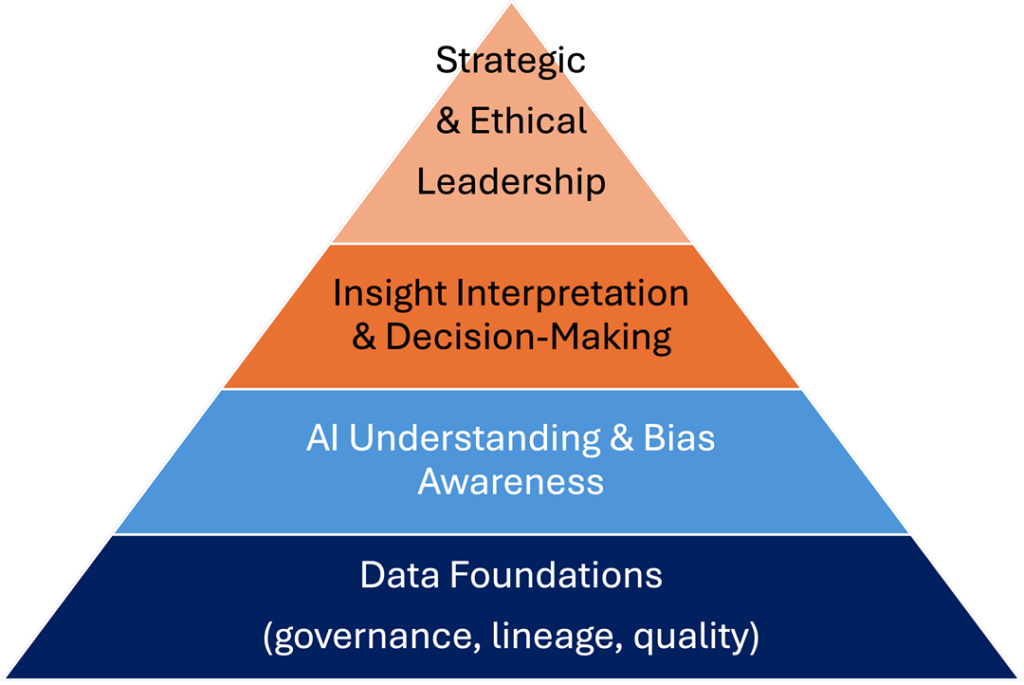
Figure 3 AI Literacy Pyramid
- Data-First Operating Models: Redesign workflows to embed AI loops across functions, treating data as a core asset. This reconfiguration minimizes silos, enabling seamless collaboration, e.g., a CDO partnering with a CHRO on predictive talent analytics or with a CPTO on optimizing product roadmaps, all while ensuring governance supports reliable reporting for investor transparency. Cultural integration via L&D fosters proactive behaviours, with KPIs tracking 20% faster decision cycles and 10-15% reduced operational costs.
Upskilling is not a one-off; it is an ongoing investment with compounding returns. Data Society emphasizes focusing on productivity for ROI measurement, where automation frees resources for high-value work, with clients reporting 2-3x ROI through sustained behaviour shifts and quantifiable gains. By involving CDOs in literacy efforts, organizations ensure data management and governance underpin AI adoption, leading to measurable upticks in financial metrics that satisfy investor expectations.
Accelerating Impact with Namaste’s ID8 Toolkit
Transformation often bogs down in inception. Namaste’s ID8 Toolkit cuts through, diagnosing data opportunities for swift, high-ROI interventions.
It probes:
- Processes rich in data but starved of insights.
- Bottlenecks in manual reporting.
- Reliance on gut-feel over evidence.
A retail client, for example, was able to rectify multichannel data discrepancies, saving £1.5M in capital while establishing AI foundations – achieving 20% efficiency gains and a 9-month payback. Another case: A financial services firm identified L&D gaps via ID8, rolling out literacy training that boosted AI project success by 40%, per internal KPIs.
ID8 does not supplant strategy; it propels it, ensuring AI investments yield measurable outcomes like 15-25% productivity lifts.
Book a 30-minute ID8 consultation to map your data maturity and forecast personalized ROI.
Strategy-Through-Execution: Namaste’s Differentiator
Namaste Management excels in bridging insight to impact. Unlike consultancies halting at recommendations, we partner through execution:
- Capability Uplift: Custom AI/data literacy L&D, fostering cultural change with KPIs tracking 25% engagement rises.
- Model Design: Infuse data principles into governance for enduring efficiency, with 10-20% cost reductions.
- Execution Support: Deploy specialists to maintain momentum, linking efforts to performance metrics like EBITDA growth.
Our human-analytic blend ensures AI assimilation, delivering ethical ROI. For PE or public entities, this means workforce empowerment and investor assurance.
Conclusion: A CALL TO LEADERSHIP
AI and data literacy form the bedrock for thriving in 2025-2026. Without their synergy, AI remains a buzzword; with it, it unlocks precision leadership. C-suites: Embrace fluency to drive ethical, measurable advantage.
Namaste Management propels this journey – upskill boards, redesign models, and realize data-driven opportunities.
Initiate with a no-commitment strategy session: Convert literacy into lasting financial returns today.
Key Namaste Management Services
- Buy & Build Strategy Planning & Execution (Playbooks, Operational & ESG Due Diligence, Integration Planning & Execution)
- Scale Up, AI & Performance Improvement Diagnostics (Identify, Plan & Execute Value Creation Initiatives)
- Expert Resources to Deliver Complex Business & Operational Transformation Projects
- Interim Functional Leaders to fulfil BAU as well as Project Roles in LTs