Executive Summary
In many industries today, the difference between market leaders and underperformers is not product quality alone. Increasingly, it is go-to-market (GTM) capability – the ability to design and execute a coherent commercial system that consistently converts innovation into revenue.
Across sectors such as enterprise software, healthcare, consumer goods, and industrial technology, companies frequently launch products that are technically competitive yet commercially disappointing. The issue is rarely that the product fails to solve a problem. More often, it is that the organisation has not built the commercial architecture required to win the market.
This reality has elevated go-to-market strategy from a marketing function to a core executive discipline. For CEOs, commercial leaders, and private-equity investors, GTM excellence is increasingly central to value creation. In growth transformations, post-merger integrations, and market expansions, the quality of commercial design and execution often determines whether strategic ambition translates into measurable results.
This article presents a practical playbook for senior leaders seeking to strengthen their organisation’s go-to-market capability. It explores how high-performing companies design GTM strategies, align commercial systems, and execute with discipline – supported by anonymised case examples from multiple industries.
1. What a Go-to-Market Strategy Actually Is
A go-to-market strategy is the integrated blueprint for how an organisation acquires, serves, and grows customers profitably. It defines how a company translates its offering into revenue through specific segments, channels, and commercial models.
At its core, a GTM strategy answers three strategic questions:
Where will we compete?
- Which customers, industries, and geographies offer the most attractive growth opportunities?
How will we win?
- What differentiated value proposition will persuade those customers to choose us?
How will we deliver that value profitably?
- What channels, pricing models, sales processes, and operational capabilities will convert demand into revenue?
When these choices are explicit and aligned, the organisation gains clarity about how growth will occur. When they are vague or inconsistent, commercial performance becomes unpredictable.
Importantly, GTM strategy is often misunderstood in three ways.
GTM is not just marketing or product launch
Many organisations treat go-to-market strategy as a marketing plan for introducing a new product. In reality, it governs the entire commercial system, including:
- segmentation and ideal customer profiles
- positioning and value proposition
- pricing and packaging
- channel and ecosystem strategy
- sales coverage and account management
- customer success and expansion
It therefore influences the entire customer lifecycle, from first awareness to long-term retention.
GTM is a cross-functional system
Commercial success rarely depends on a single function. Instead, it emerges from the alignment of multiple teams: product, marketing, sales, customer success, operations, and finance.
When these functions operate with different assumptions about target customers, pricing, or growth priorities, even strong individual performance can produce weak overall results.
The organisations that excel at GTM treat it as a shared operating system across the commercial organisation.
GTM must evolve continuously
Markets change quickly. Customer expectations shift, competitors respond, and new technologies reshape buying behaviour.
As a result, the most successful companies treat GTM strategy as an adaptive process rather than a static plan. They refine segmentation, messaging, pricing, and channel models regularly using real market data.

Figure 1 Customer-Centric Target Operating Model
Case Example: Aligning a Commercial System in B2B Software
A North American enterprise software scale-up experienced strong pipeline generation but erratic revenue performance. Quarterly bookings fluctuated widely despite steady marketing investment.
Leadership initially assumed the issue was sales productivity. However, a cross-functional review revealed deeper structural misalignment.
- Product development prioritised features designed for large enterprises.
- Marketing campaigns targeted mid-market demand generation.
- Sales incentives rewarded quick, smaller deals.
Each function was performing well individually, but the overall commercial system lacked coherence.
The leadership team redesigned the GTM architecture around a clearly defined ideal customer profile (ICP) and prioritised market segments. They aligned messaging, pricing, qualification criteria, and sales incentives with that focus.
Within eighteen months, new annual recurring revenue became significantly more predictable. Win rates improved in the primary segment, and marketing efficiency increased without additional spending.
The key lesson was not about product innovation but about commercial alignment.
2. Designing a High-Quality Go-to-Market Strategy
Effective GTM design translates growth ambition into specific commercial choices.
A useful executive test is simple: if a newly appointed regional leader were handed this strategy, could they run the business successfully from it?
If the answer is unclear, the GTM strategy likely lacks operational precision.
Start With Outcomes and Economic Guardrails
GTM design should begin with explicit economic objectives and constraints.
These may include:
- revenue growth targets
- minimum gross margin requirements
- customer acquisition cost (CAC) thresholds
- acceptable payback periods
- brand or regulatory risk boundaries
Establishing these guardrails early ensures that subsequent decisions – on segments, channels, and pricing – are aligned with the economics of the business model.
For example, organisations targeting high-growth SMB markets must build low-cost acquisition models, while enterprise strategies typically require heavier investment in sales capability and relationship building.
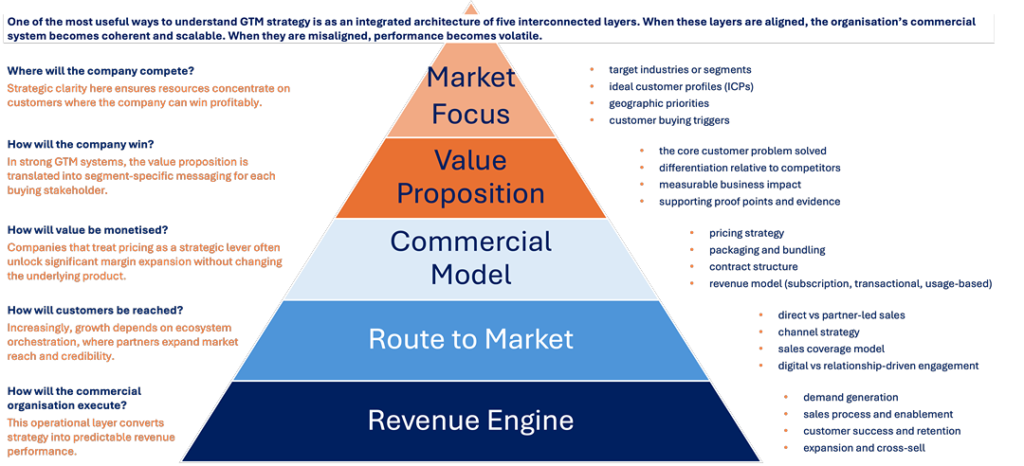
Figure 2 Go-to-Market Framework: A Unified GTM Architecture
Focus Relentlessly on the Right Customers
One of the most common commercial mistakes is trying to serve too many customer segments simultaneously.
High-performing GTM strategies define ideal customer profiles with operational precision. This includes:
- firmographic characteristics
- technology environment or infrastructure
- organisational maturity
- typical buying triggers
- decision makers and influencers
- budget thresholds
- disqualifying characteristics
Importantly, segmentation should reflect buying behaviour and economic value, not simply industry categories.
Executive teams should also require quantified analysis of each segment:
- total addressable market
- accessibility through existing channels
- expected deal size and sales cycle
- competitive intensity
Equally critical is identifying segments that will not be prioritised. Strategic focus often requires disciplined trade-offs.
Craft a Value Proposition That Resonates Economically
At the heart of every successful GTM strategy lies a compelling value proposition.
Strong positioning answers three questions clearly:
- What critical problem does the customer face?
- Why is this organisation uniquely positioned to solve it?
- What proof demonstrates credibility?
Leading companies translate these answers into customer-centric narratives grounded in measurable outcomes, such as cost reduction, revenue growth, operational efficiency, or risk mitigation.
However, complex purchasing decisions typically involve multiple stakeholders. Messaging therefore needs to be adapted for different roles:
- operational users
- technical evaluators
- financial decision makers
- executive sponsors
Effective GTM strategies address the priorities of each stakeholder group.
Design the Right Route to Market
Route-to-market decisions determine how efficiently the organisation reaches customers.
These decisions influence cost structure, market coverage, and speed of expansion.
Key design choices include:
- direct versus partner-led sales
- geographic versus industry-focused coverage
- inside sales versus field sales
- digital versus relationship-driven engagement
In many industries, growth increasingly depends on partner ecosystems. Systems integrators, consulting firms, distributors, and technology alliances often provide access to customers and enhance credibility.
However, these partnerships must be carefully managed. Channel conflict – where partners compete with the company’s direct sales force – can rapidly undermine trust.
Successful GTM strategies establish clear rules for:
- lead ownership
- deal registration
- pricing guidelines
- partner incentives
Without this governance, partner ecosystems can become a source of friction rather than growth.
Use Pricing as a Strategic Lever
Pricing and packaging are among the most powerful yet underutilised GTM tools.
Rather than simply reflecting cost or competitor benchmarks, effective pricing strategies align with perceived customer value.
Examples include:
- tiered packages reflecting different customer needs
- usage-based pricing linked to consumption
- subscription models enabling predictable revenue
- outcome-based pricing tied to measurable value
Executives should ensure pricing decisions are informed by direct customer insights, such as willingness-to-pay analysis, pilot programs, and structured interviews.
Small adjustments in pricing strategy can often produce substantial improvements in revenue and profitability.
3. Translating Strategy into Results: The Execution Challenge
Even the most thoughtful GTM strategies fail without disciplined execution.
Research and industry experience suggest that only a small minority of product launches achieve their expected commercial results. The gap between intention and outcome typically reflects execution capability rather than strategic vision.

Figure 3 Commercial Execution Framework
Four organisational capabilities consistently distinguish high-performing commercial systems.
- Cross-Functional Alignment and Governance
Effective execution requires a single commercial operating structure that connects product development, marketing, sales, and customer success.
Many high-growth organisations create a GTM council or growth board responsible for coordinating cross-functional decisions.
This group typically oversees:
- segmentation priorities
- launch readiness
- sales enablement
- pipeline development
- customer feedback loops
Equally important is the operating rhythm. Successful organisations review GTM performance regularly, focusing not only on metrics but on learning and adaptation.
In many cases, improved governance alone unlocks meaningful performance gains.
- Sales Execution and Enablement
Commercial strategies ultimately succeed or fail in customer interactions.
Modern sales excellence relies on several core capabilities:
- clear deal qualification frameworks
- structured pipeline management
- well-designed territories and account plans
- strong enablement and training
- integrated CRM and analytics systems
- consistent frontline coaching
Executives should ensure that sales tools and messaging frameworks are embedded into daily workflows, not optional resources.
Equally important is leadership capability. Sales managers who can coach teams using data, process discipline, and customer insight often outperform organisations that rely solely on individual “rainmakers.”
- Metrics and Commercial Visibility
High-performing organisations manage GTM performance through a focused set of leading and lagging indicators.
Typical metrics include:
- brand awareness and engagement
- marketing-generated pipeline
- conversion rates between funnel stages
- average deal size and sales cycle length
- retention and expansion revenue
These indicators should connect directly to the economic guardrails established during strategy design.
Equally important are feedback loops that capture market insights. Structured win-loss analysis, customer feedback programs, and sales team input all help refine the GTM strategy over time.
- Institutionalised Experimentation
The most advanced commercial organisations treat go-to-market optimisation as a continuous experimentation process.
Rather than relying on occasional strategic resets, they systematically test improvements in:
- messaging
- pricing
- product packaging
- sales playbooks
- digital marketing approaches
Each experiment is designed with a clear hypothesis and measurable success criteria.
Leading companies maintain a prioritised backlog of GTM experiments, supported by dedicated resources and analytical capability.
This disciplined experimentation culture allows them to adapt faster than competitors.
4. Go-to-Market Strategy in Practice
Medical Device Market Entry in Asia
A European medical device manufacturer launched a new mid-priced product in a rapidly growing Asian healthcare market. Although the product performed well clinically, early commercial results were disappointing.
Public tenders were frequently lost, and private hospitals were slow to adopt the device.
A detailed review revealed that the GTM strategy had focused primarily on hospital procurement departments. However, purchasing decisions were heavily influenced by government regulators, clinical societies, and leading physicians.
The company redesigned its GTM strategy to address the full healthcare decision ecosystem. Engagement strategies were developed for each stakeholder group, and pilot programs were launched with leading hospitals to generate local clinical evidence.
Distributors were also repositioned to focus on physician education and training rather than simple product distribution.
The revised approach established a strong presence in leading private hospitals and created a repeatable market-entry model for other regions.
Software Company Transitioning to Enterprise Sales
A global software vendor historically generated most of its Asia-Pacific revenue through high-velocity transactional deals. As competitors began targeting larger enterprise opportunities, leadership decided to move up-market.
However, early results were disappointing. The organisation lacked experience managing complex enterprise sales cycles.
A new regional leader initiated a transformation that included upgrading sales leadership, introducing structured deal-qualification frameworks, and building alliances with global consulting firms.
Within a short period, the region closed the largest deal in its history and built a sustainable enterprise pipeline.
The transformation demonstrated that shifting GTM strategy often requires new capabilities and operating models, not simply new targets.
Managing Omnichannel Conflict in Consumer Retail
A European consumer brand expanded aggressively into direct-to-consumer e-commerce while maintaining long-standing retail partnerships.
Initially, online sales grew rapidly. However, pricing and promotions on the company’s website began undercutting retail partners, triggering significant channel conflict.
Retailers responded by reducing shelf space and prioritising competing brands.
The company redesigned its omnichannel strategy to clarify channel roles. Retail partners focused on discovery and broad distribution, while the direct channel emphasised deeper product ranges, personalisation, and community engagement.
Pricing guidelines and promotional guardrails were introduced to reduce conflict.
Over the following year, retailer relationships stabilised, online sales continued growing profitably, and customer satisfaction improved across channels.
5. An Executive Checklist for Strengthening GTM Capability
Senior leaders seeking to improve commercial performance can begin by asking several diagnostic questions.
Strategy clarity
- Are our primary target segments clearly defined and economically attractive?
- Do we understand the buying triggers and decision processes of these customers?
- Is our value proposition expressed in the customer’s language and supported by evidence?
Execution readiness
- Is there a single executive owner responsible for GTM performance?
- Are sales incentives, marketing programs, and product priorities aligned with the strategy?
- Are partner ecosystems integrated into the commercial model?
Learning and adaptability
- Do we have reliable visibility into the commercial funnel?
- Are customer insights systematically captured and translated into action?
- Are we running structured GTM experiments to improve performance?
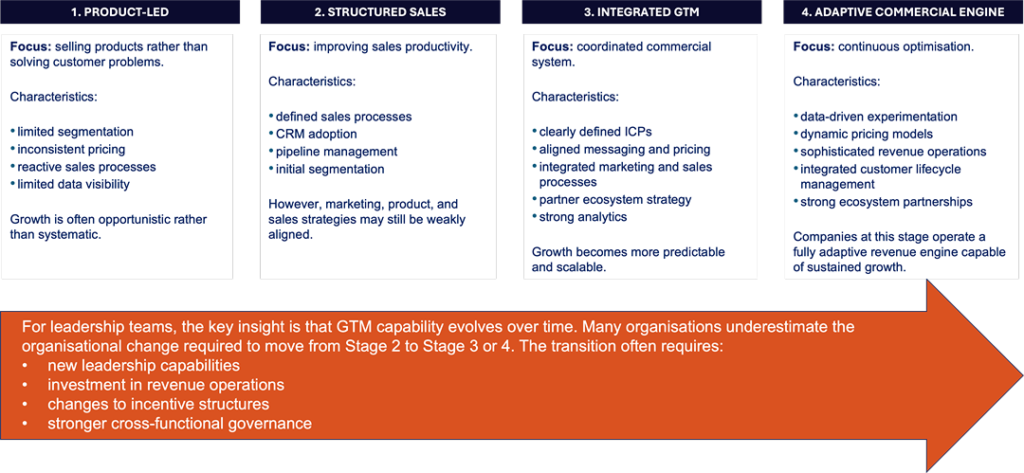
Figure 4 A Go-to-Market Maturity Model
6. The Leadership Imperative
Ultimately, go-to-market excellence is a leadership responsibility.
Organisations that consistently outperform competitors typically exhibit several leadership behaviours.
First, they treat GTM as a board-level strategic capability, subject to the same scrutiny as capital allocation or mergers and acquisitions.
Second, they invest deliberately in commercial capabilities – sales leadership, pricing expertise, revenue operations, and partner management.
Third, they insist on data-driven decision making, grounding strategic adjustments in customer behaviour and economic performance.
Finally, they create cultures that value disciplined experimentation and learning.
Conclusion
In modern competitive environments, superior products alone rarely guarantee market success. What increasingly separates leading companies from their peers is the strength of their go-to-market system.
Organisations that integrate segmentation, value proposition design, pricing strategy, channel architecture, and sales execution into a coherent commercial engine create a foundation for repeatable growth.
For CEOs, commercial leaders, and investors, the implication is clear: treat go-to-market capability not as a periodic activity surrounding product launches but as a core organisational muscle.
When that muscle is built deliberately – through sharp strategic choices, aligned execution, and continuous learning – growth becomes far more predictable and sustainable.