
Chief Legal & Risk Officers (CLROs) operate at the nexus of trust, compliance, and enterprise value. In a world of regulatory complexity, cyber risk, and public scrutiny, their role has expanded from guardian to strategist – balancing legal oversight with proactive risk leadership. The CLRO’s mandate is no longer about preventing loss, but enabling intelligent risk-taking that sustains innovation, reputation, and growth.
The modern CLRO unites governance, ethics, data, and performance under one mission: to safeguard enterprise integrity while empowering transformation. Their effectiveness depends on cross-functional collaboration, digital acumen, and operational due diligence that turns compliance into competitive advantage.
What follows are the eight most pressing challenges shaping the CLRO’s agenda – and the strategies driving high-performance legal and risk functions.
For Your Readiness Check, Guide to Scoring and Next Steps:
- Rate each statement (1 = Strongly Disagree to 5 = Strongly Agree).
- Section Score: Add your three ratings, divide by 3.
- Overall Score: Average all section scores.
- Guidance, per section and overall:
- Below 3.0 → Priority for action.
- 3.0–3.5 → Emerging capability; strengthen through targeted initiatives.
- 3.5–4.5 → Solid foundation; refine and scale.
- 4.5–5.0 → Best-in-class readiness; benchmark against peers.
Use this tool regularly to track progress, align with your leadership team, and ensure operational readiness in a volatile environment.
1. Governance, Ethics & Enterprise Trust
The Challenge:
Reputational crises and ethical failures can destroy value faster than financial losses. Yet many organisations lack coherent governance frameworks that embed integrity into daily decisions.
How CLROs Are Responding:
CLROs are redefining governance as a culture system, not a compliance checklist. They establish integrated ethics programs, board-level reporting dashboards, and leadership accountability mechanisms that link behaviour to performance outcomes.
Case Insight: A global consumer company rebuilt brand trust and reduced regulatory incidents by 45% after integrating ethics KPIs into leadership scorecards.
Your Readiness Check:
- Governance frameworks link ethics, performance, and accountability.
- Board oversight includes real-time monitoring of ethics indicators.
- Integrity is embedded in decision-making culture across levels.
2. Regulatory Complexity & GLobal COmpliance
The Challenge:
Rapid regulatory change – spanning ESG, AI, data privacy, and anti-corruption – exposes organisations to fragmented compliance burdens and escalating penalties.
How CLROs Are Responding:
Leading CLROs are creating unified regulatory intelligence functions that monitor, interpret, and implement compliance globally. They use AI-driven tools to track legislative change and operational due diligence to validate adherence at process and supplier level.
Case Insight: A logistics enterprise reduced compliance violations by 60% through a centralised compliance hub and AI-enabled regulatory tracking system.
Your Readiness Check:
- Regulatory monitoring is proactive and technology enabled.
- Compliance frameworks are harmonised across geographies.
- Operational due diligence verifies compliance maturity and controls.
3. Cybersecurity, Data Privacy & Digital Risk
The Challenge:
Data breaches and digital vulnerabilities pose existential threats. Legal and risk functions often struggle to integrate with technology governance and incident response.
How CLROs Are Responding:
Modern CLROs are partnering with CIOs and CTOs to embed cyber and privacy oversight into enterprise risk frameworks. They ensure that data protection, incident response, and digital compliance are treated as strategic imperatives – not IT issues.
Case Insight: A financial services organisation reduced breach response times by 70% after aligning cyber risk governance under a joint Legal–Risk–Technology model.
Your Readiness Check:
- Legal, risk, and IT collaborate on digital and privacy governance.
- Data protection is embedded in enterprise and vendor contracts.
- Cyber incident response is tested and continuously improved.
4. Risk Strategy, Appetite & Resilience
The Challenge:
Traditional risk management often focuses on mitigation rather than value creation. Without clear risk appetite, organisations oscillate between caution and exposure.
How CLROs Are Responding:
High-performing CLROs lead enterprise risk strategy, defining clear risk appetite statements linked to growth objectives. They implement integrated risk dashboards that quantify exposure, scenario test resilience, and enable dynamic decision-making.
Case Insight: A multinational manufacturer achieved 30% improvement in resilience index scores after aligning strategic planning with risk appetite frameworks.
Your Readiness Check:
- Risk appetite is defined, quantified, and aligned to business goals.
- Resilience is actively measured and scenario tested.
- Risk ownership extends across business units and leadership layers.
5. Contracting, Commercial Risk & Value Assurance
The Challenge:
Increased contractual complexity and global partnerships expose organisations to delivery risk and value leakage. Legal functions often lack commercial visibility into operational performance.
How CLROs Are Responding:
CLROs are transforming contract management into a strategic performance capability. They use digital contract lifecycle management (CLM) tools, apply operational due diligence to validate supplier and partner performance, and track post-signature compliance and value delivery.
Case Insight: A technology firm reduced claims exposure by 35% after implementing CLM systems that linked contract data to supplier operational performance metrics.
Your Readiness Check:
- Contract lifecycle management is digitised and performance linked.
- Operational due diligence informs commercial risk evaluation.
- Post-contract value delivery is measured and transparent.
6. ESG, Sustainability & Responsible Governance
The Challenge:
Stakeholders increasingly expect governance systems that support sustainability, transparency, and ethical supply chains. Fragmented ESG ownership undermines credibility and assurance.
How CLROs Are Responding:
CLROs are embedding ESG compliance and governance into core legal and risk frameworks. They ensure that environmental, social, and governance data are verified, auditable, and reflected in board disclosures. Operational due diligence validates supplier ESG claims and reduces greenwashing risk.
Case Insight: A global apparel brand achieved ESG reporting credibility by embedding legal and risk oversight into sustainability verification processes.
Your Readiness Check:
- ESG governance is embedded in legal and risk frameworks.
- Supply chain due diligence ensures data integrity and ethical standards.
- ESG reporting meets regulatory and stakeholder assurance standards.
7. Crisis Management & Business COntinuity
The Challenge:
Crisis events – cyber, legal, operational, or reputational – can escalate quickly without integrated preparedness. Many organisations lack cohesive response playbooks.
How CLROs Are Responding:
Modern CLROs lead enterprise resilience programs that connect risk, legal, communications, and operations. They conduct crisis simulations, clarify escalation paths, and integrate lessons learned into governance cycles.
Case Insight: A multinational energy firm shortened crisis recovery times by 50% after implementing a cross-functional crisis governance structure co-led by the CLRO and COO.
Your Readiness Check:
- Crisis management frameworks are enterprise-wide and tested.
- Legal, risk, and communication functions operate as one team.
- Post-crisis reviews drive structural and procedural improvements.
8. Digital Transformation, AI Ethics & Operational Due Diligence
The Challenge:
AI adoption and automation raise new questions about liability, fairness, and governance. Without operational due diligence, AI systems can create unforeseen ethical and compliance risks.
How CLROs Are Responding:
Forward-looking CLROs are developing AI governance policies and ethical review boards. They apply operational due diligence to assess algorithmic transparency, data provenance, and human oversight in digital systems. Legal and risk teams now play a central role in ensuring responsible technology use.
Case Insight: A healthcare organisation established an AI Ethics Council under its CLRO, reducing compliance risk exposure by 40% while accelerating digital deployment.
Your Readiness Check:
- AI governance frameworks define accountability and oversight.
- Operational due diligence assesses digital systems before deployment.
- Legal and risk collaborate on ethical technology design and assurance.
Deep-Dive CLrO Diagnostics – Leveraging Namaste Aspire ID8
The Namaste Aspire ID8 CLRO Diagnostic enables Chief Transformation Officers to rapidly assess the maturity, readiness and compliance of their legal & risk functions. Built on a proven framework and underpinned by our AI-enabled proprietary software, the review consists of three layers and 24 review areas, providing a 360-degree view of how effectively the business drives measurable improvement in governance capability and organisational trust.
The CLRO Diagnostic is typically a structured 10-day review which combines structured analysis, stakeholder engagement, and data-driven insights to deliver a practical, prioritised action plan.
The approach is structured into a 6-step approach with steps 1-5 in Phase 1 culminating in a recommended action plan to implement to address the challenges identified. Phase 2, Step 6 relates to the execution / implementation of the recommendations which naturally follows on from the Phase 1 activity.
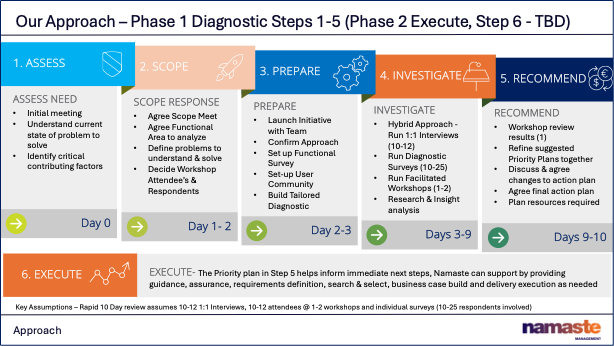
Phase 1 – Diagnostic Assessment (Steps 1–5)
1. Assess (Day 0)
Initial meeting to clarify objectives, understand current issues and challenges, and identify critical factors shaping Operations performance.
2. Scope (Days 1–2)
Agree functional areas, define issues to investigate, and confirm interviewees, workshop attendees, and survey participants.
3. Prepare (Days 2–3)
Launch the initiative, confirm the diagnostic framework, configure tailored surveys, and set up a user community.
4. Investigate (Days 3–9)
Hybrid approach combining 1:1 interviews, diagnostic surveys, and facilitated workshops. Findings are reinforced with research and benchmarking.
5. Recommend (Days 9–10)
Results reviewed in a workshop. Our AI-enabled ID8 software refines a prioritised action plan with clear ownership, resourcing, and timelines, which is then agreed by stakeholders.
Phase 2 – Execution & Change Delivery (Step 6)
6. Execute (Post-Diagnostic)
Namaste Management can then further support the CLRO in delivering the agreed roadmap and priority actions, from business case development and requirements definition to programme delivery and performance tracking.
The Value Delivered
- Rapid 10-day review combining speed and depth
- 360° insight through interviews, surveys, and workshops
- Prioritised action plan aligned with strategy and risk profile
- Execution support to ensure recommendations are delivered and embedded
The Aspire ID8 CLRO Diagnostic moves quickly from assessment to action, enabling operations to become a true strategic enabler of resilience, efficiency, and growth.
Namaste Management can also provide 1-2-day board level workshops or 5-day or 15-day variations on the 10-day example shared above.
Aspire ID8 CLRO Diagnostic Typical Review Areas
The Aspire ID8 CLRO Diagnostic provides Chief Legal and Risk Officers with a structured, data-driven framework to assess the maturity, effectiveness, and strategic integration of the organisation’s legal, governance, and risk management capabilities. It helps CLROs evaluate how well legal and risk functions are aligned to protect the enterprise, enable strategic decision-making, and support sustainable business performance.
Using a three-layer framework, the diagnostic examines strategy, governance, operational maturity, and value creation — identifying gaps, strengths, and actionable opportunities to strengthen compliance, resilience, and stakeholder confidence.
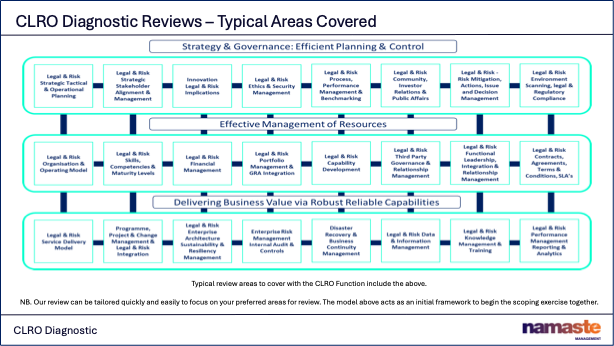
1. Strategy & Governance: Efficient Planning & Control
This layer assesses how effectively legal and risk strategies are aligned with enterprise objectives and risk appetite.
It covers:
- Legal and risk strategic planning, alignment, and prioritisation
- Stakeholder management across business units and the Board
- Innovation and technology enablement in legal and compliance processes
- Ethics, governance, and security management
- Risk mitigation, issue management, and regulatory scanning
- Public affairs, investor relations, and reputation management
Value delivered: insight into how effectively the legal and risk functions contribute to enterprise strategy, ensuring robust governance, ethical conduct, and proactive risk management.
2. Effective Management of Resources
This layer evaluates the people, processes, and financial management underpinning legal and risk delivery.
It examines:
- Organisational design and operating model for legal and risk functions
- Skills, competencies, and maturity levels of teams
- Financial management and portfolio oversight
- Capability development and regulatory integration
- Third-party, regulatory, and partner relationship management
- Functional leadership, collaboration, and contractual governance
Value delivered: clarity on how well resources and structures are aligned to manage risk exposure, control cost, and ensure consistent legal compliance and oversight.
3. Delivering Business Value via Robust Reliable Capabilities
The third layer focuses on operational excellence and enterprise resilience through legal and risk management capabilities.
It includes:
- Service delivery and change management integration
- Enterprise risk management and internal audit
- Disaster recovery, business continuity, and sustainability planning
- Legal and risk data, analytics, and information management
- Knowledge management, training, and reporting frameworks
Value delivered: assurance that the legal and risk function provides both protective and enabling value — supporting resilience, compliance, and business continuity while driving transparency and informed decision-making.
Why It Matters
The Aspire ID8 CLRO Diagnostic helps Chief Legal and Risk Officers move beyond compliance oversight to strategic risk leadership. It provides:
- A comprehensive maturity assessment across legal, compliance, and risk management domains
- Benchmarking and insight dashboards to identify risk exposure and performance improvement priorities
- A prioritised roadmap for governance enhancement and capability development
- A platform for building trust, transparency, and resilience across the organisation
By combining structured diagnostics, stakeholder engagement, and best-practice benchmarking, Aspire enables CLROs to transform Legal & Risk into a strategic enabler of governance excellence, enterprise integrity, and long-term value protection.