
Executive Summary
The financial services industry is navigating a period of unprecedented change, shaped by regulatory evolution, technological transformation, economic pressures, and shifting workforce dynamics. This environment demands strategic agility, disciplined execution, and a balanced approach to both organic and inorganic growth. Firms that align technology, talent, and customer-centricity with robust risk management and operational resilience will be best positioned to lead. Key insights from the analysis include:
Key Takeaways:
Navigating Regulatory Complexity and Risk Management
- Firms face increasing scrutiny over fraud prevention, compliance, and consumer protection, requiring adaptable regulatory strategies and integrated risk frameworks that address cyber, reputational, and ESG risks.
Leveraging Technology and AI for Competitive Advantage
- The race to modernise legacy systems and deploy AI across customer service, fraud detection, trading, and risk assessment is accelerating. Success depends on strong data infrastructure, ethical AI use, and cyber resilience.
Balancing Organic and Inorganic Growth Strategies
- Leading firms combine deep client relationships, digital innovation, and service excellence (organic growth) with well-integrated acquisitions and partnerships (inorganic growth) to scale capabilities and market reach.
Talent and Culture as Strategic Levers
- Critical skills shortages in AI, cybersecurity, and data science require adaptive workforce strategies, inclusive cultures, and a focus on employee development to attract and retain top talent.
Resilience, Trust, and Execution as Differentiators
- Building operational resilience, restoring consumer trust, and mastering strategy execution across both growth and compliance domains are essential for navigating disruption and maintaining long-term competitiveness.
Strategic Challenges In Financial Services
The financial services industry is operating in an environment of rapid change and rising expectations. Success in this landscape requires agility, foresight, and disciplined execution. Below are the key strategic challenges facing the sector today, as identified by leading industry analysts, regulators, and market participants:
1. Regulatory Complexity and Volatility
Regulation remains one of the most dynamic forces in the industry. Regulators are intensifying efforts to combat investment fraud, authorised push payment (APP) scams, and money laundering. New reimbursement mandates, flexible payment delay protocols, and an increasingly data-driven supervisory approach are raising the bar for compliance.
At the same time, a mix of deregulation in some areas and new rulemaking in others is creating uncertainty. Financial institutions must remain vigilant and adaptable, ensuring compliance while maintaining strategic flexibility.
2. Technological Transformation and Digital Innovation
Technology is reshaping every facet of financial services. Firms are under pressure to modernise outdated infrastructure, adopt artificial intelligence, and deliver seamless digital experiences.
The shift to AI-powered analytics, instant payments, and cloud-based platforms offers competitive advantage – but it also requires substantial investment, change management, and strengthened governance. Cybersecurity, data integrity, and ethical AI use are now board-level concerns, demanding robust risk oversight. See later for detailed AI implications for Financial Services.
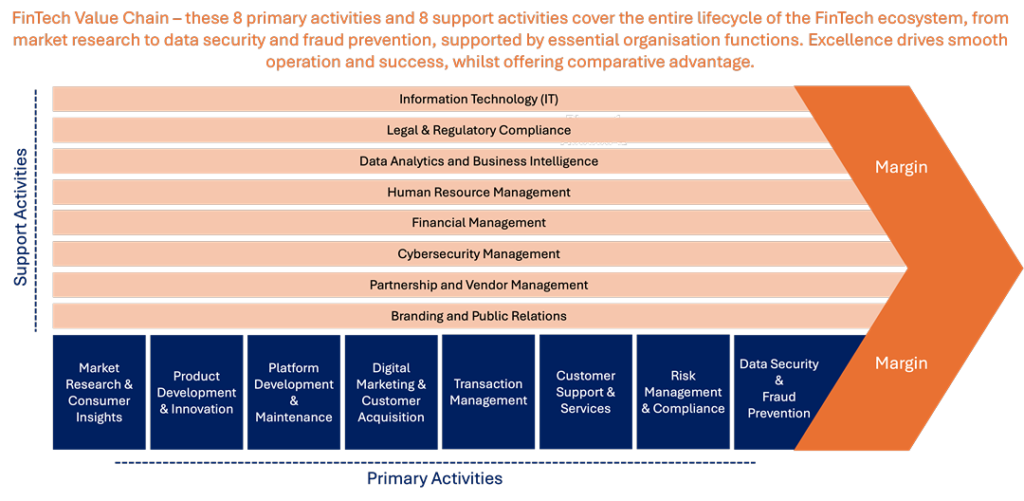
Figure 1 FinTech Value Chain
“The FinTech Industry Value Chain seamlessly integrates market research, product development, and advanced digital platforms to deliver innovative financial solutions. Efficient transaction processing and robust risk management are crucial for maintaining customer trust and ensuring regulatory compliance in the FinTech ecosystem. Continuous innovation and leveraging advanced data analytics enable FinTech companies to stay ahead of market trends and meet evolving customer demands.” Flevy Lean
3. Balancing Growth and Profitability
While regulators are encouraging firms to pursue innovation and market expansion, the economic landscape remains challenging. Low interest rates, rising non-interest expenses, and inflationary pressures are eroding margins.
Sustainable growth now depends on strategic reinvestment, operational efficiency, and careful cost management. Firms must weigh short-term performance against long-term competitiveness and resilience.
4. Managing Multi-Dimensional Risk
Geopolitical instability, economic uncertainty, climate risk, and supply chain disruptions are all contributing to a more volatile risk environment. Financial institutions must continuously assess and adapt their enterprise risk management frameworks to stay ahead of threats.
Key focus areas include:
- Technology and cyber risk
- Regulatory and compliance risk
- Third-party/vendor
- Market / credit / other operational risk
- Reputational risk stemming from ESG missteps or customer harm
Proactive risk identification and real-time monitoring are now essential capabilities.
5. Workforce and Talent Strategy
The industry faces critical skills gaps – particularly in AI, data science, cybersecurity, and compliance. As digital transformation accelerates, attracting, retaining, and upskilling talent is becoming a strategic imperative.
A widening skills gap is impeding innovation. In technology, there’s a growing need for specialised roles, including AI engineers (28%), IT security engineers (16%), and cybersecurity experts (13%). As emerging technologies evolve faster than educational pipelines can adapt, companies face an uphill battle in recruiting and retaining the talent necessary to stay ahead of the curve. Continuous upskilling and adaptive workforce strategies are essential.
Firms must rethink workforce planning, balancing automation with human capital needs, and building cultures that support innovation, inclusion, and agility. Employee engagement, development, and well-being are central to long-term competitiveness.
6. Consumer Outcomes and Trust
Restoring and maintaining consumer trust is an ongoing priority. Regulators are placing greater emphasis on outcomes – transparency, fairness, and protection from harm – especially as fraud increases and financial products become more complex.
Firms must ensure their offerings are designed with the customer’s best interests in mind and deliver experiences that are intuitive, inclusive, and aligned with evolving expectations.
7. Operational Resilience and Compliance Readiness
Operational resilience is no longer optional. With growing cyber threats, regulatory scrutiny, and reliance on third-party providers, firms must build the capacity to withstand and recover from disruptions.
Key priorities include:
- Strengthening infrastructure and IT continuity
- Embedding resilience into governance and oversight
- Enhancing monitoring, testing, and incident response capabilities
Compliance, meanwhile, is evolving from a check-the-box function to a strategic differentiator – requiring integrated frameworks, advanced data analytics, and board-level ownership.
Strategic Readiness as a Competitive Advantage
In sum, the financial services industry must contend with a highly complex, rapidly shifting strategic environment. Success depends on the ability to:
- Adapt to regulatory change
- Embrace technological innovation
- Sustain growth amid economic pressure
- Manage multi-faceted risks
- Develop future-ready talent
- Protect consumer trust
- Build resilient, compliant operations
Firms that proactively tackle these challenges – rather than react to them – will be best positioned to lead in a transformed financial ecosystem.

Figure 2 Strategy Execution Process
Mastering Growth in Financial Services
A Strategic Guide to Organic and Inorganic Expansion
As a consultancy in the financial services sector, we are frequently engaged to help organisations navigate the complexities of sustainable growth. From banking and wealth management to insurance and fintech, the industry faces relentless pressures: regulatory demands, rapid technological innovation, evolving client expectations, and fierce competition. In this landscape, striking the right balance between organic and inorganic growth isn’t just a strategic option – it’s a necessity for long-term success and market leadership.
Understanding the Growth Imperative
Financial services firms typically pursue growth through two main avenues:
- Organic Growth: Expansion driven internally through client acquisition, deeper relationships, product innovation, and service enhancements.
- Inorganic Growth: Growth through mergers, acquisitions, or strategic partnerships, enabling rapid access to new markets, talent, and technologies.
Both paths present unique challenges and rewards. The highest-performing firms aren’t those that choose one over the other – but those that integrate both into a cohesive, adaptable growth strategy.
The Challenges of Organic Growth
1. Competing in Saturated Markets
Organic growth is often slow and difficult in mature markets where new client acquisition is limited, and margins are under pressure. Firms must continuously innovate to remain relevant, requiring sustained investment in digital transformation, product development, and customer experience.
2. Deepening Client Relationships
Many firms leave value on the table by failing to anticipate evolving client needs. Too often, they rely on outdated assumptions and one-size-fits-all offerings. To drive organic growth, firms need robust client segmentation, data analytics, and personalised service models that truly reflect client preferences.
3. Attracting and Retaining Talent
Talent is the cornerstone of organic growth. Yet, in an industry where burnout and job dissatisfaction are common, firms struggle to retain top performers. Investing in professional development, wellness, and career progression is essential to building resilient, high-performing teams.
4. Using Technology and Data Effectively
Without strong data infrastructure and analytics, opportunities for organic growth are easily missed. Leading firms leverage advanced technology platforms to enable smarter decision-making, deliver personalised client experiences, and streamline internal processes.
Case Example – Organic Growth in Wealth Management
A UK-based private bank launched a digital-first wealth advisory platform targeted at next-generation high-net-worth clients. By combining AI-powered portfolio recommendations with human relationship managers, they reduced onboarding time from 10 days to 48 hours and increased client acquisition by 22% year-on-year. Net Promoter Score (NPS) rose by 15 points, while cost-to-serve dropped by 18% within 12 months.
The Challenges of Inorganic Growth
1. Complex Integrations
Post-merger integration is fraught with operational, cultural, and technological hurdles. Without careful planning, firms risk losing clients, demoralising employees, and missing out on anticipated synergies.

Figure 3 Identifying Value Capture & Value Creation Synergies to Maximise Deal ROI
2. Cultural Disconnects
Cultural misalignment is one of the most common reasons acquisitions underperform. Aligning organisational values and leadership styles early is critical to building a unified, cohesive entity.
3. Regulatory and Financial Exposure
M&A activity attracts intense regulatory scrutiny and requires significant capital outlays. Firms must have the financial resilience and compliance frameworks in place to manage associated risks and obligations.
4. Retaining Key People
Acquisitions can breed uncertainty, prompting key talent to exit. Transparent communication, clear role definition, and strategic retention plans are vital to keeping high performers engaged.
Case Example – Inorganic Growth via Fintech Acquisition
A mid-tier retail bank acquired a payments fintech to accelerate entry into the e-commerce merchant services market. Post-integration, the bank reported £150M in additional annual payment processing revenue and reduced merchant onboarding times from 5 days to less than 24 hours, resulting in a 30% merchant base growth in the first year.
Strategies to Overcome Growth Barriers
For Organic Growth
- Invest in Client Intelligence
Use structured research and analytics to better understand and anticipate client needs, enabling smarter segmentation and product tailoring. Example: A Nordic insurer used predictive analytics to anticipate policy lapse risks. Proactive outreach reduced lapse rates by 12% and increased cross-sell conversion rates by 9% in six months.
- Empower Talent
Create a culture that promotes innovation and learning. Support teams with the tools, training, and flexibility they need to thrive. Example: A Singaporean asset manager implemented a “skills wallet” programme, giving every employee a £2,000 annual training budget. Employee retention improved by 14%, while innovation submissions in the company’s internal idea portal rose by 40%.
- Digitise Strategically
Adopt platforms that enhance client experience, streamline operations, and support data-driven decision-making. Example: An Australian mutual bank rolled out a cloud-based lending platform, cutting mortgage approval times from 10 days to 72 hours and increasing loan conversion rates by 21%.
- Refresh Offerings Regularly
Continuously evolve your value proposition to keep pace with shifting expectations and market dynamics. Example: A US-based credit union introduced a subscription-style banking model with bundled services. Membership grew by 18% in the first year, with a 25% increase in average product holding per member.
“Perhaps more than at any time in a generation, CTOs and CIOs are recognising that legacy data environments and the technical debt surrounding them are hampering firms’ ability to leverage investment in new technologies to drive growth and customer adoption. The successful implementation of AI use-cases, which Boards and shareholders are increasingly demanding, will fundamentally depend on access to a firm’s proprietary data to train models and provide agentic support to staff which is customised to that firm’s customers, products and processes.
But all too often, that data is not clean, complete or accurate and is contained in multiple stranded islands of disparate applications. Fixing the basic data foundations will allow the unleashing of AI and cloud capability, but will require resources, time and expertise to plan, build and test. The firms that rise to that challenge will have a significant first-mover advantage over their competitors”, Andy Smith, FS Technology Consulting Director
For Inorganic Growth
- Build a Detailed Integration Plan
Define integration goals, assign dedicated teams, and track progress rigorously. Integration should begin during due diligence – not after the deal closes. Example: Following a cross-border insurance merger, the integration office used a 90-day synergy capture plan, realising 80% of targeted cost synergies within the first year and exceeding revenue synergy targets by 12%.

Figure 4 High Level Integration Plan
- Address Cultural Differences Early
Identify cultural gaps and align leadership around shared values. Foster inclusive leadership and transparent communication throughout the organisation. Example: In a merger between a US investment firm and a European private bank, leadership established “culture squads” mixing staff from both entities. Post-integration surveys showed a 30% increase in employee engagement scores.
- Strengthen Risk and Capital Planning
Ensure you have the capital strength and regulatory readiness to support acquisition activity and withstand unexpected shocks. Example: A regional bank acquiring a mortgage lender underwent pre-deal stress testing, which helped secure regulator approval 3 months ahead of schedule and reduced integration compliance costs by 15%.
- Secure and Motivate Key Talent
Develop targeted retention strategies, outline growth paths, and maintain open communication to retain top performers from acquired firms. Example: After acquiring a fintech, a Canadian bank offered retention bonuses tied to innovation milestones. 85% of key engineers stayed through the two-year earn-out period, ensuring uninterrupted product development.
Achieving Balance: The Dual Engine of Growth
The most successful financial services firms understand that sustainable growth is rarely one-dimensional. Organic growth brings depth, resilience, and closer client relationships. Inorganic growth accelerates scale, capability, and market access. Together, they form a powerful, complementary engine for navigating disruption and achieving long-term performance.
Leading with Strategy Execution and People
To thrive in today’s financial services environment, firms must master both organic and inorganic growth strategies. That means investing in insights, empowering talent, embracing technology, and maintaining a relentless focus on client value. It also requires strategic discipline in M&A – careful planning, cultural alignment, risk mitigation, and talent retention.
Those that can balance speed with stability, growth with governance, and innovation with empathy will not only survive market change – they’ll lead it.
Case Study: Navigating the Summit Of Wealth Management Integration
By Bauke van der Ploeg, Integration-Transformation Consultant
The integration of two wealth management firms is a mountain to climb not for the faint-hearted.
- Mergers involving publicly listed companies often make bold proclamations about integration benefits and timelines while the advance team is still studying the route map.
- Your most vocal and influential stakeholders are the client-facing team: Investment Managers, Wealth Advisors, and Independent Financial Advisors. This single-minded team of AUM and revenue-focused colleagues has zero tolerance for delays or route changes. They’re laser-focused on reaching their targets and view any integration “rest stops” as unnecessary diversions.
- The underlying systems powering these businesses often rely on eons-old legacy code. This poorly documented technology struggles to support modern demands for versatility and data enrichment.
- Given the high risks of this corporate expedition, companies typically engage management consultants or specialist advisory firms. These external guides arrive with ‘industry best-practice’ playbooks that may not suit the challenges associated with your integration.
How to Slalom Past the Integration Crevasses:
- First and foremost, resist the temptation to over-engineer the integration. Make it your mission to minimise the number of switchbacks and technical sections in your integration journey. Install a ‘simplification discipline’ across your entire team – it is likely that the most direct route is the safest if there are appropriate rehearsals and control gates along the route.
- Integration milestones may have already been broadcast into the public domain. Create a plan which allows you to honour those public commitments while giving yourself adequate time to properly plan and rehearse the bulk migration activities and the more complex scenarios that needs to be catered for.
- Maximise the involvement of your internal knowledge experts from both the legacy and target organizations. While the board may be tempted to hire external consultancy teams, the people who truly understand how to navigate the known weaknesses and limitations of the operational systems are your incumbent SMEs, so blend your teams wisely.
This is a Business Expedition, not a Technical Exercise. Integration success depends on business leadership driving the journey forward, not getting lost in the technical details of systems, data migration, or technology upgrades. Full focus on business integration – the technology is just the equipment that gets you there.
The Implications of AI in Financial Services

AI is revolutionising the financial services industry by enhancing efficiency, reducing risks, and improving customer experiences. From banking and insurance to investment management and fraud detection, AI is reshaping how financial institutions operate.
1. Automated Customer Service & Personalisation
AI-driven chatbots and virtual assistants improve customer engagement by:
- Providing 24/7 support for account inquiries and transactions.
- Offering personalised financial advice based on user behavior.
- Reducing wait times and improving customer satisfaction.
Example: Bank of America’s Erica and JPMorgan’s COiN AI systems enhance customer interactions and automate document review.
2. Fraud Detection & Cybersecurity
AI enhances security by:
- Analysing transaction patterns to detect fraudulent activities in real time.
- Using biometric authentication (e.g., voice and facial recognition) for secure banking.
- Preventing cyber threats through AI-driven anomaly detection.
Example: Mastercard and Visa use AI to monitor millions of transactions per second to detect fraud instantly.
3. Algorithmic Trading & Investment Management
AI-driven models analyse market trends and execute trades faster than humans:
- High-frequency trading (HFT) – AI makes split-second buy/sell decisions based on real-time data.
- AI-powered robo-advisors – Platforms like Wealthfront and Betterment use AI to create personalised investment portfolios.
- Sentiment analysis – AI scans news, social media, and reports to predict market movements.
Example: Hedge funds like Renaissance Technologies use AI for predictive analytics and algorithmic trading.
4. Risk Management & Credit Scoring
AI improves financial risk assessment by:
- Analysing creditworthiness beyond traditional FICO scores, using alternative data (e.g., spending habits, social behaviour).
- Predicting loan defaults with machine learning models.
- Assessing macroeconomic risks to guide investment decisions.
Example: AI-powered platforms like SestFinance and Upstart offer fairer, data-driven loan approvals.
5. Process Automation & Cost Reduction
AI-driven Robotic Process Automation (RPA) improves operational efficiency by:
- Automating repetitive tasks like data entry, compliance checks, and reporting.
- Reducing back-office costs and improving accuracy.
- Enhancing compliance by ensuring regulatory requirements are met.
Example: JPMorgan’s COiN system processes legal documents in seconds, reducing manual work by 360,000 hours per year.
6. Personalised Banking & Financial Planning
AI provides hyper-personalised financial solutions:
- Smart budgeting tools – AI tracks spending and suggests savings strategies.
- Automated wealth management – AI advises users on investment strategies.
- Real-time financial insights – AI-powered dashboards predict cash flow trends.
Example: AI-driven fintech apps like Mint and Cleo provide real-time financial insights and automated savings plans.
7. Insurance & Claims Processing
AI transforms the insurance industry by:
- Automating claims processing – AI detects fraud and speeds up payouts.
- Improving risk assessment – AI predicts claim probabilities based on customer profiles.
- Enhancing underwriting decisions – AI analyses medical history and behaviour patterns for policy pricing.
Example: Insurtech firms like Lemonade and Root use AI to assess risk and process claims within minutes.
Challenges of AI in Financial Services
Despite its benefits, AI faces key challenges:
- Regulatory concerns – AI decision-making must comply with strict financial laws (e.g., GDPR, SEC regulations).
- Data privacy risks – AI requires sensitive financial data, raising security concerns.
- Bias in AI models – AI-driven credit scoring and risk assessment may lead to unfair outcomes if trained on biased data.
AI is reshaping financial services by improving efficiency, security, and customer experience. However, regulatory challenges and ethical concerns must be addressed to ensure fair and responsible AI adoption.
“Bridging the Cyber-and-AI Hiring Gap: A Concise Playbook for CTOs & CISOs: Demand for defenders and threat hunters still surges; demand for AI Specialists & ML engineers and model-ops leads is even greater! Average vacancy time is in the order of six months in both domains. The root issue is the same: job adverts chase mythical all-rounders, while overlooked juniors, career-switchers and diverse talent pools wait in the wings. Five joined-up moves:
- State the mission, cut the buzzwords.
- Cyber: “Reduce mean-time-to-contain by 40 %.” AI: “Lower fraud false positives 30 %.”
- List five core skills; drop the certification wish-list and the insistence on 10 years of experience
- Hire for mindset, train for skill.
- Critical thinking, ability and adaptability are the most valuable skills; curiosity and data ethics beat ‘ten years of TensorFlow’. Commit to a 90-day up-skill plan that includes safe AI or secure-coding labs.
- Guarantee a modern toolbox.
- SOC analysts need sandboxed malware labs; AI engineers need self-service GPU queues. Assured tool access will help to attract & retain staff.
- Streamline and flex.
- One practical interview, decision in a week; remote or four-day weeks will attract. Both communities value autonomy as much as cash.
- Grow your own bench.
- Fund apprenticeships, MSc conversions and an internal ‘guild’ where cyber and AI teams swap playbooks.
Track success visibly: dashboards showing incidents contained, models deployed and staff skills advanced. Leaders who develop talent instead of chasing unicorn résumés will close both gaps – and ship secure, intelligent products while your competitors keep rewriting job specs.” Adam Sztuka, Clarity