Executive Summary
ERP as the Operating Backbone of Digital Transformation
Why the right platform – and the right implementation – determines whether transformation creates value or destroys it. Digital transformation rarely fails because of ambition. It fails because the operational backbone cannot support the change.
For most organisations, that backbone is the enterprise resource planning (ERP) platform. What was once viewed as “back-office plumbing” has become the core operating system of the modern enterprise, integrating finance, supply chain, sales, manufacturing, and service into a single operational architecture.
For senior executives and private equity sponsors, ERP decisions increasingly determine whether companies can:
- Scale operations efficiently
- Integrate acquisitions quickly
- Gain real-time operational insight
- Deploy automation and AI across the enterprise
- Support new business models and revenue streams
In other words, ERP is now a direct lever of value creation.
In private equity portfolios in particular, the ERP platform often defines the ceiling on operational improvement. Companies with fragmented legacy systems struggle to integrate add-ons, scale operations, or produce reliable data. Companies with modern, well-implemented ERP platforms can absorb acquisitions, standardise processes, and unlock automation at speed.
The implication is simple: ERP strategy is now a board-level issue.
Why ERP Has Become a Board-Level Topic
Historically, ERP discussions were delegated to CIOs and IT teams. Today they are central to corporate strategy, operational performance, and exit value.
Three structural shifts have elevated ERP to the executive agenda.
1. ERP is the foundation of digital transformation
Most digital initiatives – automation, analytics, AI, customer experience platforms – depend on consistent, reliable enterprise data.
ERP platforms provide:
- Core financial and operational data
- Process orchestration across functions
- Standardised workflows
- Integrated analytics and reporting
Without this foundation, digital initiatives tend to create isolated solutions rather than enterprise capability.
2. Cloud ERP enables speed and scalability
Modern ERP platforms are cloud-native, mobile-enabled, and designed to integrate easily with external systems.
This allows organisations to:
- Deploy updates continuously
- Scale infrastructure without large capital investments
- Access real-time operational insights
- Integrate acquisitions or new business units faster
In fast-moving environments – particularly PE-backed companies – this flexibility is essential.
3. ERP increasingly embeds AI and automation
Leading ERP platforms now integrate advanced capabilities including:
- Predictive demand forecasting
- Intelligent inventory management
- Automated financial close
- AI-assisted procurement and supply chain planning
- Real-time operational dashboards
These capabilities transform ERP from a transaction system into a decision platform.
ERP and the Private Equity Value-Creation Agenda
For private equity sponsors, ERP modernisation is not simply a technology upgrade. It is often a core value-creation lever.
Well-designed ERP platforms can directly support key value drivers:
| Value Lever | ERP Impact |
| Revenue growth | Enables scalable order processing, pricing management, and customer analytics |
| Margin improvement | Automates processes, reduces manual work, optimises procurement |
| Working capital | Improves inventory planning and cash visibility |
| M&A integration | Accelerates onboarding of acquisitions |
| Operational visibility | Provides real-time performance insight |
For portfolio companies executing buy-and-build strategies, ERP becomes even more critical.
Without a scalable ERP backbone, integration of add-on acquisitions often requires:
- Manual data consolidation
- Duplicated systems
- Inconsistent financial reporting
- Delayed synergies
Modern ERP platforms allow sponsors to industrialise integration.
Board-Level Questions Executives Should Ask
Before initiating an ERP transformation, leadership teams should confront several strategic questions.
1. Does our ERP platform support the value-creation plan – or constrain it?
Many companies operate on systems designed for a smaller organisation or simpler operating model.
2. Can we integrate acquisitions quickly without extensive manual work?
Integration speed directly affects synergy realisation.
3. Are we over-engineering the system relative to our ownership horizon?
Private equity sponsors must balance long-term architecture with hold-period economics.
4. Can the system support future growth, geographic expansion, and new business models?
ERP decisions today should not constrain strategy tomorrow.
ERP Selection: From Technology Choice to Value Design
Many ERP selection processes fail because they focus on feature comparisons rather than operational value.
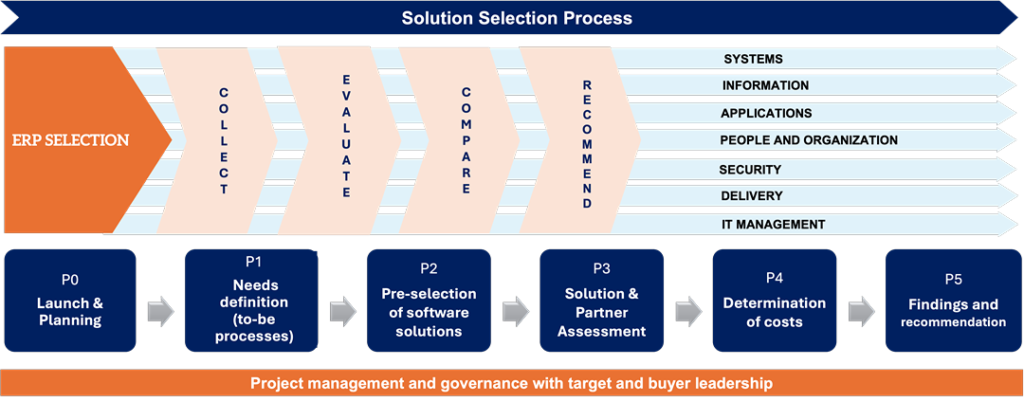
Figure 1 ERP Selection Process
Large companies often generate hundreds – or even thousands – of functional requirements. Vendors respond with equally large compliance matrices claiming near-perfect coverage.
This approach rarely identifies the best solution.
High-performing organisations approach ERP selection differently.
Start with value, not modules
Instead of asking which system has the most features, leaders ask:
- Which platform best supports our value-creation strategy?
- Which processes must be optimised to achieve our goals?
Identify the few processes that matter most
Most companies only have a handful of truly strategic processes.
Examples include:
- Configure-price-quote
- Complex pricing models
- Multi-entity consolidation
- Demand planning
- Production scheduling
ERP selection should focus heavily on how vendors support these high-impact workflows.
Demand evidence, not demos
Software demonstrations often showcase idealised scenarios.
Executives should push vendors to show:
- Real client implementations
- Measurable improvements
- Reference customers with similar operating models
Evaluate the implementation partner
ERP success depends heavily on the implementation partner.
Strong partners bring:
- Industry expertise
- Process transformation capability
- Change management skills
- Technical integration experience
Selecting the right partner can be as important as selecting the platform itself.
Major ERP Platforms: Strengths and Trade-Offs
Several leading ERP platforms dominate the market. Each has distinct strengths depending on company size, industry, and complexity.
| SAP (S/4HANA) | Oracle ERP Cloud | Microsoft Dynamics 365 | NetSuite | |
| Strengths: | Deep functionality for complex global enterprises Strong manufacturing and supply chain capabilities Extensive ecosystem and industry solutions Powerful analytics through HANA architecture | Strong financial management capabilities Advanced analytics and reporting Robust cloud architecture Good support for global operations | Strong integration with the Microsoft ecosystem Flexible and modular architecture Lower cost than many enterprise platforms Rapid adoption in mid-market companies | Cloud-native architecture Rapid implementation compared to traditional ERP Strong financial management and multi-entity capabilities Popular in high-growth companies |
| Challenges: | High implementation cost Significant complexity Long deployment timelines Requires strong governance and experienced partners | Implementation complexity Higher total cost of ownership than mid-market solutions Requires experienced implementation partners | Less deep functionality in some specialised industries Heavy reliance on partner ecosystem for customisation Variable implementation quality depending on partner | Limited functionality for complex manufacturing Customisation constraints compared with larger platforms May require additional systems as organisations scale |
| Best suited for: | Large multinational enterprises Complex manufacturing organisations Highly regulated industries | Large enterprises seeking modern cloud ERP Organisations prioritising financial and reporting capabilities | Mid-size companies scaling rapidly Organisations already standardised on Microsoft technologies | Growth companies and scale-ups PE portfolio companies pursuing rapid standardisation |
Industry-specific ERP Platforms
Some sectors benefit from specialised ERP solutions.
Examples include:
- Manufacturing-focused ERP platforms
- Retail and e-commerce ERP systems
- Construction or project-based ERP solutions
Strengths:
- Industry-specific functionality
- Faster deployment in specialised environments
Challenges:
- Smaller vendor ecosystems
- Long-term scalability concerns
Case Study 1: ERP as an Accelerator of Value Creation
A mid-market industrial services company acquired by private equity had grown through multiple acquisitions.
The organisation faced several operational challenges:
- Five different ERP systems
- Inconsistent financial reporting
- Manual consolidation of financial results
- Limited visibility into operational performance
Management implemented a cloud-based ERP platform across the group.
Key outcomes included:
- Standardised financial reporting across all business units
- Reduction of financial close cycle from 15 days to 5 days
- Improved inventory visibility across locations
- Faster integration of new acquisitions
The ERP platform became the operational backbone of the buy-and-build strategy, allowing the company to integrate acquisitions within months rather than years.
At exit, the improved operational visibility and scalability supported a significant valuation uplift.
Case Study 2: When ERP Implementation Destroys Value
A global consumer products company attempted a large-scale ERP transformation across multiple divisions.
The program encountered several issues:
- Aggressive timeline driven by executive pressure
- Inadequate testing of integrated processes
- Limited user training
- Major data migration challenges
The system went live during a peak trading period.
The result was severe disruption:
- Order processing failures
- Inventory inaccuracies
- Delayed shipments to major retailers
The company ultimately lost significant revenue and customer trust.
Post-mortem analysis identified familiar root causes:
- Governance focused on deadlines rather than readiness
- Underinvestment in change management
- Insufficient integration testing
The lesson was clear: ERP failure is rarely a technology problem; it is a leadership and governance problem.
Implementation: Where Most ERP Programs Fail
Even when the right platform is selected, implementation risks remain high.
Common causes of failure include:
- Unrealistic timelines
- Insufficient testing
- Weak data migration planning
- Over-customisation
- Poor change management
Executives must treat ERP programs with the same rigour applied to major acquisitions or capital projects.
A Value-Driven ERP Implementation Model
Successful ERP transformations share several characteristics.
| Governance focused on readiness | Phased deployment | End-to-end testing | Investment in change management |
| Steering committees should track: Data qualityTesting coverageUser readinessIntegration risks Not just schedule and budget. | Phased rollouts reduce risk by limiting operational disruption. Many organisations implement ERP by: Business unitGeographyFunctional capability | Testing must simulate real-world operational scenarios across: Order-to-cashProcure-to-payRecord-to-report Partial testing rarely identifies systemic failures. | ERP systems change how people work. Organisations that underinvest in training and change management often experience: User resistanceOperational errorsProductivity decline after go-live |
ERP as a Digital Platform
Modern ERP should not attempt to do everything.
Instead, it should serve as the core platform within a broader digital ecosystem.
This ecosystem often includes:
- CRM platforms
- eCommerce systems
- advanced analytics tools
- AI platforms
- IoT solutions
ERP provides the clean operational data and process orchestration that allow these technologies to function effectively.
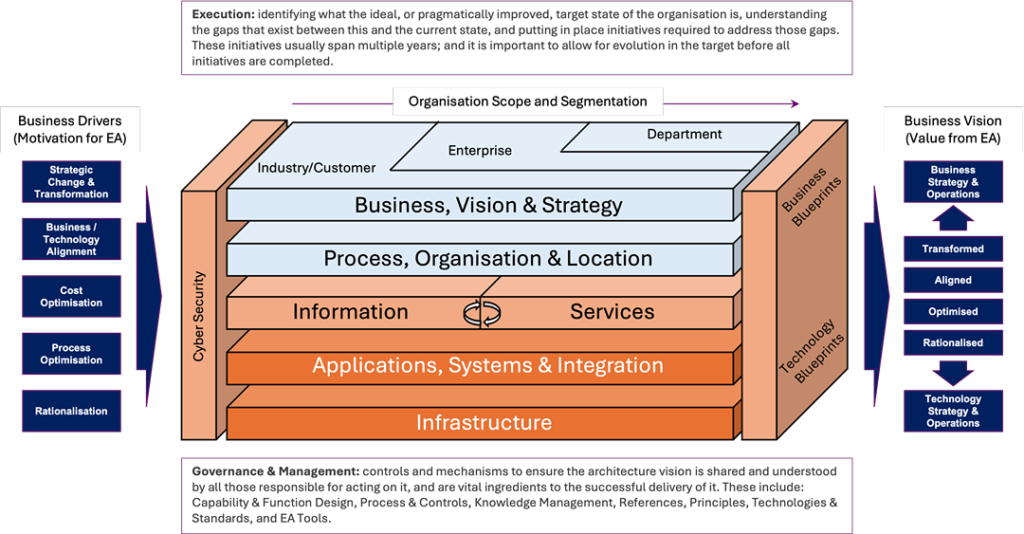
Figure 2 Big Picture: An Enterprise Architecture View
Greenfield, Brownfield, or Hybrid Transformation?
Organisations modernising ERP systems typically choose among three approaches.
| Greenfield | Brownfield | Hybrid approach | |
| Description: | A completely new implementation with redesigned processes. | Migration of the existing system to a modern platform with minimal process change. | Selective transformation while retaining stable processes. |
| Advantages: | Maximum transformation potential Clean data architecture Modern processes | Lower disruption Faster deployment Lower initial cost | Balanced risk and innovation More targeted change |
| Challenges: | High cost Longer timeline Greater change impact | Legacy processes remain Technical debt may persist | Complex architecture Potentially longer timelines |
The optimal approach in a hybrid scenario depends on the organisation’s:
- operational complexity
- transformation ambition
- risk tolerance
- investment horizon
The Strategic Imperative
ERP decisions now shape the long-term competitiveness of organisations.
Companies that treat ERP as a strategic operating platform can:
- scale more efficiently
- integrate acquisitions faster
- automate operations
- leverage advanced analytics and AI
Those that treat ERP as a technical upgrade often end up with systems that constrain growth.
For senior executives and private equity professionals, the lesson is clear:
ERP selection and implementation should be governed with the same discipline applied to strategy, acquisitions, and capital allocation.
Done well, ERP becomes a structural advantage.
Done poorly, it becomes a structural constraint.
And in today’s digital economy, the difference between those outcomes can determine whether a transformation succeeds – or fails.