Executive Summary
Innovation is the critical engine of growth, competitiveness, and long-term value creation in today’s dynamic markets. From incremental improvements to disruptive breakthroughs, innovation manifests in many forms – product, process, business model, service, technology, marketing, and sustainability-driven. To succeed, organisations must adopt a structured yet adaptable approach to fostering innovation and developing new products.
This comprehensive guide outlines the strategic foundations and operational best practices for innovation across all types. It highlights the need for a clear innovation strategy, leadership commitment, customer-centricity, cross-functional collaboration, and data-driven decision-making. Equally, it emphasises building a culture that values experimentation, embraces failure, yet execution excellence, and scales what works.
A robust, best-practice New Product Development (NPD) process – from idea generation to post-launch iteration – completes the innovation framework. Together, these strategies equip businesses to systematise innovation and transform it into sustainable competitive advantage.
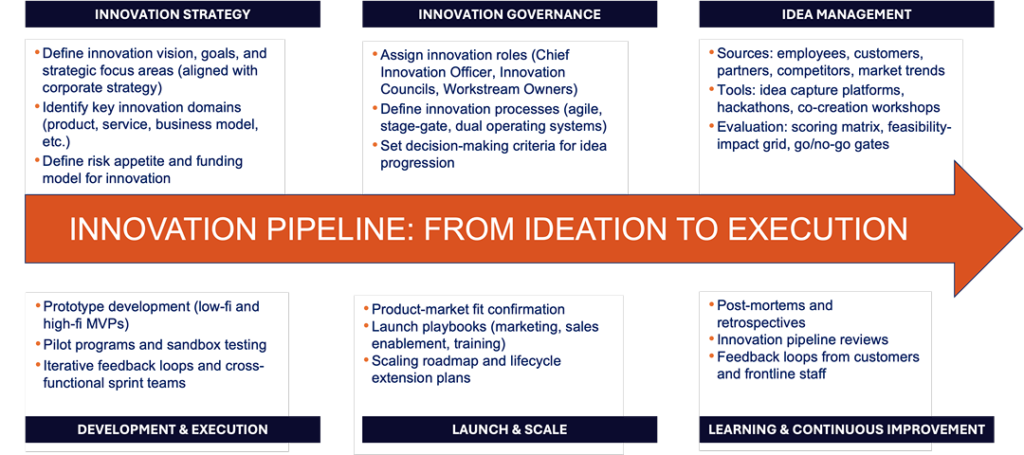
Figure 1 Innovation Pipeline
1. The Full Spectrum of Innovation
Innovation is the lifeblood of sustainable growth and market leadership. Yet different types of innovation – product, process, business model, service, technological, marketing, and sustainability/social – require tailored strategies, organisational capabilities, and execution disciplines. What unites successful innovation across formats is a strategic, customer-focused, well-governed, and data-driven approach.
1. Product Innovation
Excellence in product innovation is achieved when organisations consistently deliver high-impact, customer-centric solutions that not only meet market needs but also anticipate future demand. It requires a disciplined yet agile approach that integrates deep market insight, cross-functional collaboration, rapid prototyping, and iterative feedback loops. Organisations that excel in product innovation embed innovation into their culture, empower empowered teams to challenge assumptions, and balance creativity with commercial viability. They continuously refine their new product development processes to shorten time-to-market while enhancing quality and differentiation, ensuring that each product reinforces strategic positioning and long-term value creation.
- Incremental improvements (e.g. feature enhancements, refreshed SKUs) maintain relevance.
- Radical or breakthrough innovations can open new markets or shift industry paradigms.
- Examples: Electric vehicle models; biodegradable packaging solutions.
- Best-practices:
- Co-create with lead users to ensure fit.
- Use modular architectures for flexibility.
- Push for sustainability standards – recycled materials, lower carbon footprint.
- Example: A consumer electronics company co-creates a modular smartphone with early adopter communities, building recyclable components and open software.
2. Process Innovation
Excellence in process innovation involves the systematic redesign and optimisation of workflows to enhance efficiency, reduce costs, improve quality, and enable scalability. Organisations that lead in this domain view process innovation not as a one-time initiative, but as a continuous improvement mindset embedded across all functions. They leverage data analytics, automation, lean methodologies, and employee-driven ideas to identify inefficiencies and unlock hidden value. Crucially, they align process changes with strategic goals and customer expectations, ensuring that improvements translate into measurable performance gains. By fostering a culture that values operational excellence and adaptability, these organisations build resilient, future-ready systems that support sustained growth and competitive advantage.
- Optimises internal efficiency, consistency, quality, and cost.
- Includes Lean, Six Sigma, automation, and workflow redesign.
- Examples: Robotic process automation in finance, real-time analytics in logistics.
- Best-practices:
- Map value streams; eliminate non-value steps.
- Automate with RPA, AI, IoT for real-time quality control.
- Engage front-line operators in Kaizen workshops.
3. Business Model Innovation
Excellence in business model innovation lies in an organisation’s ability to rethink how it creates, delivers, and captures value – often challenging industry norms to unlock new revenue streams and market opportunities. Leading innovators excel by continuously scanning market trends, emerging technologies, and unmet customer needs to identify transformative opportunities. They are unafraid to experiment with pricing models, distribution channels, partnerships, or customer engagement strategies, while maintaining a strong alignment with their core purpose. Crucially, they combine strategic foresight with disciplined execution, testing new models quickly through pilots and MVPs before scaling. This ability to pivot or reinvent the business model – not just the product – gives these organisations a powerful edge in rapidly evolving markets.
- Redefines how value is created, delivered, and monetised.
- Shifts might include subscriptions, outcome-based models, platform ecosystems.
- Examples: Software becoming service; DTC brands evolving into marketplace operators.
- Best-practices:
- Pilot strategic pilots (e.g. subscription tiers, outcome-based pricing).
- Use small-scale live tests (pilot trials) to validate economic model before scale.
- Reformat operations, fulfilment, and billing to support that model.
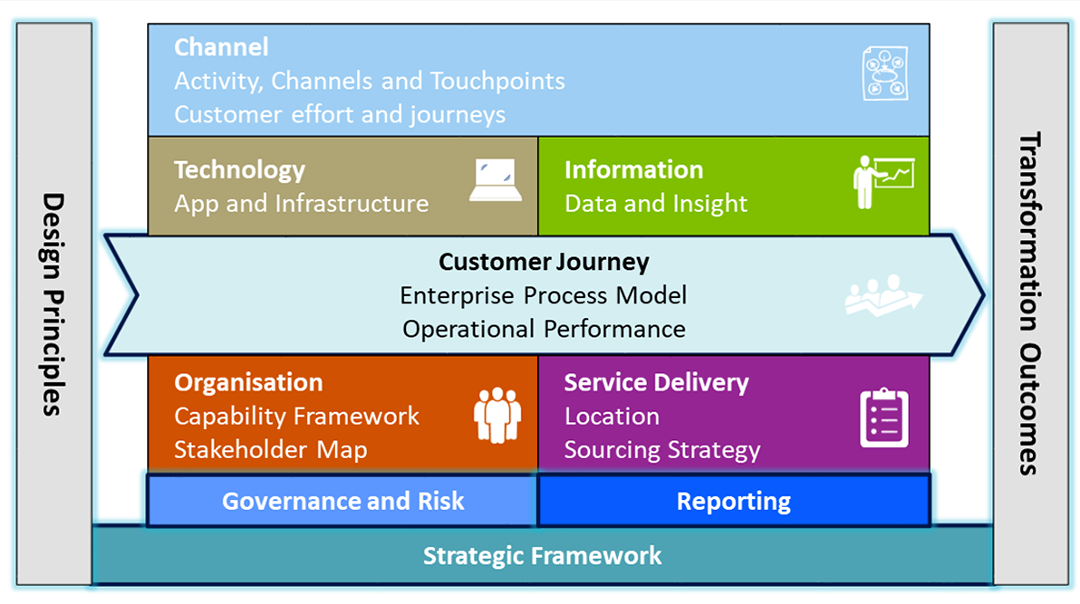
Figure 2 Customer-Orientated Target Operating Model
4. Service Innovation
Excellence in service innovation is defined by an organisation’s ability to design and deliver differentiated, high-impact service experiences that create meaningful value for customers and competitive advantage for the business. It requires a deep understanding of customer journeys, pain points, and expectations – combined with creativity, empathy, and technological enablement. Leading organisations excel by integrating digital tools, personalisation, and seamless omni-channel experiences, while also empowering frontline teams to deliver consistent and human-centric interactions. They continuously refine service models through real-time feedback, experimentation, and customer co-creation. By aligning service innovation with brand promise and operational capabilities, these organisations elevate customer satisfaction, loyalty, and lifetime value.
- Enhances customer experience through new service models, channels, or support mechanisms.
- Examples: Virtual health clinics, concierge-level customer service, AI‑powered self-service.
- Best-practices:
- Map customer journeys; identify friction points.
- Use customer-centric design thinking to co-create new services.
- Design service models around convenience, personalisation, and outcome delivery.
5. Technological Innovation
Excellence in technological innovation is demonstrated by an organisation’s ability to harness emerging and existing technologies to create breakthrough solutions, optimise operations, and redefine market boundaries. It involves not only staying ahead of the technology curve but also strategically integrating tech advancements – such as AI, IoT, blockchain, or advanced analytics – into products, services, and processes in a way that drives tangible business value. Organisations that lead in technological innovation foster strong R&D capabilities, agile development practices, and a culture that embraces experimentation and fast learning. They balance visionary thinking with pragmatic execution, ensuring that innovation is scalable, secure, and aligned with strategic objectives. This capability allows them to outpace competitors, adapt rapidly to disruption, and unlock new growth opportunities.
- Adoption or creation of new technologies to secure competitive advantage (e.g. AI, blockchain, IoT).
- Examples: Predictive maintenance via IoT sensors; AI‑driven personalisation engines.
- Best-practices:
- Maintain technology radar. Set budget for experimentation.
- Use sandbox environments to vet emerging tech in low-risk settings.
- Craft intellectual property strategies to capture and defend innovation.
6. Marketing Innovation
Excellence in marketing innovation is achieved when organisations consistently craft novel strategies and channels to engage, attract, and retain customers in an increasingly dynamic and saturated marketplace. It goes beyond traditional campaigns, embracing data-driven personalisation, experiential engagement, influencer ecosystems, and emerging platforms like AR/VR, social commerce, or AI-powered content. Leading marketers excel by deeply understanding customer behaviour and cultural trends, enabling them to tell compelling stories and create emotionally resonant experiences that drive action. They iterate rapidly, leveraging real-time analytics and customer feedback to refine messaging, optimise spend, and maximise ROI. At its core, marketing innovation is about turning creativity and insight into strategic advantage – building stronger brand equity, deeper loyalty, and sustained market relevance.
- Reinventing how customers engage with the brand or discover products.
- Includes guerrilla marketing, experiential campaigns, influencer models.
- Examples: AR try-on tools, gamified loyalty programs.
- Best-practices:
- Use micro-influencers and community marketing to create authenticity.
- Embed digital-BOPIS experiential activations.
- Track real-time response analytics and iterate campaigns dynamically.
7. Sustainability & Social Innovation
Excellence in sustainability and social innovation is marked by an organisation’s ability to embed environmental and social value creation into its core strategy, operations, and offerings – moving beyond compliance to become a force for positive change. Leaders in this space proactively identify systemic challenges such as climate impact, inequality, and resource scarcity, and respond with innovative solutions that generate both societal benefit and long-term business resilience. They design products, services, and business models that reduce environmental footprints, empower underserved communities, and align with the UN Sustainable Development Goals. Excellence also involves transparent governance, stakeholder co-creation, and rigorous impact measurement. By integrating sustainability and social purpose into innovation, these organisations not only future proof their operations but also inspire trust, attract talent, and unlock new markets aligned with global values.
- Defines products, strategies, or processes that deliver environmental or social value alongside financial return.
- Examples: Upcycled materials, fair-trade sourcing, carbon‑neutral production methods.
- Best-practices:
- Map supply chain social and environmental impact.
- Introduce circular design: take-back programmes, material recycling, carbon-neutral targets.
- Get third-party sustainability certifications or use ESG ratings frameworks.
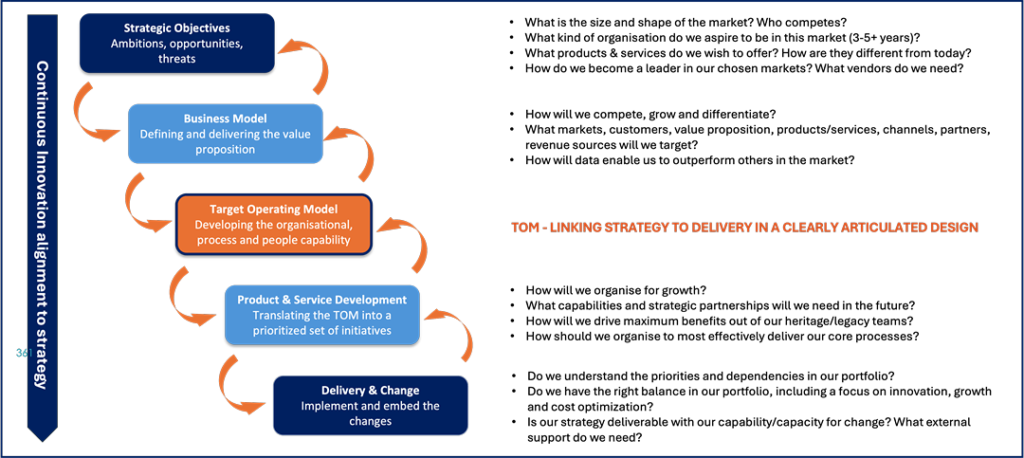
Figure 3 Continuous Innovation Alignment to Business Strategy
2. Foundational Best Practices for Innovation Excellence
1. Craft a Clear Innovation Strategy
- Align innovation goals with corporate strategy, competitive positioning, and growth targets.
- Define innovation priorities: breakthrough, adjacent, sustaining.
- Embed innovation targets into annual OKRs or KPIs—e.g. percentage of revenue from new products, time-to-market metrics.
2. Foster a Culture of Experimentation
- Normalise risk and failure as learning mechanisms, not liabilities.
- Host innovation sprints or hackathons and identify “moonshot” projects.
- Celebrate small wins and lessons learned publicly across the organisation.
3. Cross-Functional & Diverse Collaboration
- Include R&D, marketing, operations, legal, finance, sales, and external partners from early ideation.
- Set up innovation teams or incubator labs with dedicated space, budget, and organisational autonomy.
4. Open Innovation & Ecosystem Engagement
- Tap into universities, startups, suppliers, customers, and external experts.
- Participate in corporate accelerators, joint ventures, licensing partnerships.
- Use crowdsourcing platforms or partner with innovation hubs.
5. Harness Digital and Data Tools
- Leverage idea‑management and innovation platforms (e.g. Ideanote, Brightidea, Hype).
- Use analytics, customer insight tools, and predictive modelling to identify opportunity areas.
- Prototyping tools—CAD, simulation, MVP frameworks, low‑code platforms—enable rapid validation.
6. Use Structured Processes and Data-Informed Metrics
- Blend stage‑gate rigor with Agile flexibility.
- Define stage‑gate criteria, decision points, investment thresholds, and performance metrics.
- Monitor metrics such as:
- Concept-to-launch timeline
- NPV or ROI forecast variance
- Adoption and customer satisfaction scores
- Failure rate and learning velocity (time between pivot or iteration).
7. Executive Support & Resource Alignment
- Associate innovation goals with executive sponsorship, budget pools, and empowerment.
- Protect innovation funding from short-term replacements or budget cuts.
- Assign visible roles to executives for major innovation programmes.
8. Build Scalability and Repeatability
- Capture lessons and build repeatable frameworks from pilots that succeed.
- Use playbooks, toolkits, and process templates.
- Treat NPD as a learning system—embedding retrospectives, user-feedback loops, and iteration cadence.
- Be excellent at execution
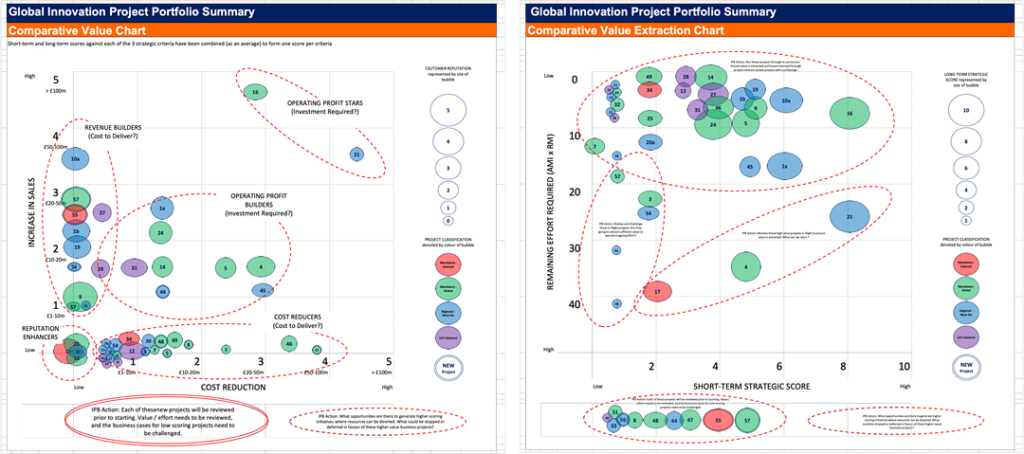
Figure 4 Using Portfolio Management Capabilities to Assess Innovation Ideation
9. Maintain Market Focus & User-Centred Validation
- Use continuous voice-of-customer (VoC) inputs, ethnographic studies, and user testing.
- Validate assumptions early using prototypes, landing pages, or micro‑launches.
- Ensure market problems are real—and design solutions from those insights.
10. Celebrate Success & Learn from Failure
- Share success stories broadly and build internal evangelism.
- Document “failures” with clear post-mortem insights: root causes, hypotheses invalidated, pivot decisions.
- Encourage psychological safety – team members rewarded for responsible experimentation.
3. Advanced New Product Development (NPD) Framework
Excellence in new product development (NPD) is achieved when organisations consistently deliver high-quality, market-relevant products that drive growth, differentiation, and customer satisfaction. It requires a structured yet flexible approach that blends strategic alignment, deep customer insight, and agile execution.
Leading innovators manage NPD through disciplined stage-gate or agile processes, ensuring each phase – from idea generation and concept validation to design, testing, and launch – is informed by data, user feedback, and cross-functional collaboration. They prioritise speed-to-market without compromising quality, leveraging digital tools, rapid prototyping, and iterative refinement. Critically, they maintain a customer-first mindset throughout, ensuring that every new product solves real problems and creates measurable value. This capability not only drives commercial success but also reinforces brand credibility and innovation leadership.
Here’s a detailed, extended NPD lifecycle, enriched with modern best practices:
1. Discover & Generate Ideas
- Integrate multiple channels: hackathons, customer insight labs, trend‑spotting, supplier collaborations.
- Use trend-analysis tools (e.g. Google Trends, social listening, patent monitoring).
- Include capability-based ideation: leveraging core strengths or exploiting emerging tech (AI, IoT, sustainable materials).
2. Screen & Prioritise Concepts
- Apply scoring models for strategic fit, market potential, technical feasibility, sustainability impact, commercial viability.
- Assess risk trade‑offs (technical, regulatory, time-to-market, brand).
- Maintain agile portfolio governance – curate a balanced mix of short-, mid-, and long-term projects.
3. Develop & Validate the Concept
- Move beyond focus groups: use rapid prototyping, usability studies, A/B tests, virtual simulations.
- Validate with customers in real-world context via pilot programs or minimum viable products (MVPs).
- Iteratively refine based on quantitative feedback loops – conversion rates, stated preference, NPS.
4. Build Business Case & Feasibility
- Generate structured business modelling: investment required, pricing elasticity, margin analysis, break-even timelines.
- Flesh out Go‑to‑Market (GTM) approach – channel strategy, partnerships, pricing, brand positioning.
- Include sustainability and ESG impact modelling as part of ROI estimates.
5. Design, Engineering & Prototyping
- Use iterative design sprints and minimum marketable feature (MMF) roadmaps.
- Cross-functional involvement: engineering, quality assurance, operations, marketing, legal.
- Conduct risk profiling: regulatory, scalability, interoperability, sustainability.
6. Pilot & Test Market Rollout
- Plan phased rollouts (beta programmes, geo-limited launches, controlled user segments).
- Monitor engagement, operational constraints, quality metrics.
- Collect post‑pilot learnings and refine features, production processes, supply chain needs.
7. Commercialise & Launch
- Build integrated launch operations – coordination between marketing, sales, support, logistics, training.
- Train staff and channel partners; plan launch events or VIR events (virtual influencer rollouts).
- Monitor early adoption metrics, conversion knee points, logistics performance, customer satisfaction.
8. Post‑Launch Review & Continuous Improvement
- Hold formal post-mortem reviews: sales performance, customer feedback, cost analysis, lessons learned.
- Embed mechanisms for iterative updates – feature releases, process improvements, customer service updates.
- Capture insights into product roadmaps, adjacent innovation possibilities, and scale strategies.
4. The Namaste Management Innovation Execution Complexity ANalysis
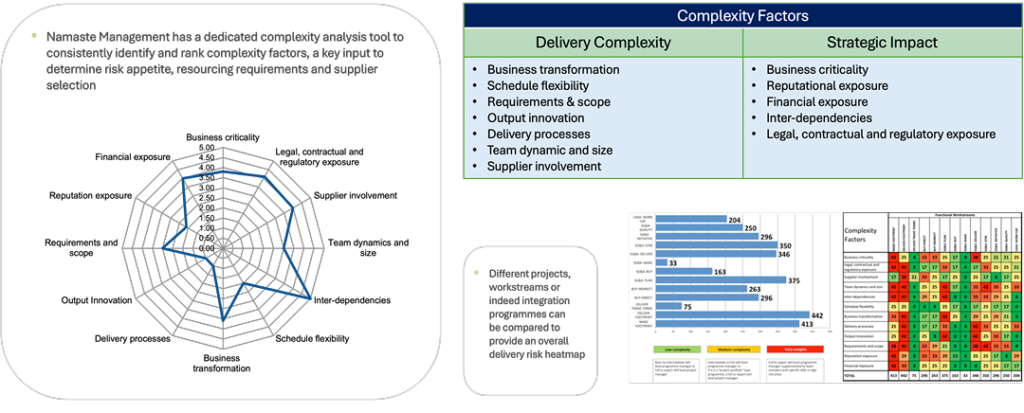
Figure 5 Using Namaste Management Complexity Analysis to Assess Innovation Idea Execution Difficulty, Risk & Resourcing Needs
| Factor | Description |
| Business criticality | This factor addresses the alignment to strategy and the importance to the business of completing the work. The more critical the work is to the organisation, the greater the management attention should be. |
| Reputation exposure | Even the cheapest, smallest work can have a catastrophic or beneficial impact on an organisation’s reputation, which in turn can impact sales and business survival. |
| Business transformation | This factor addresses the transformational change challenge required in the work in terms of culture, people, process and technology. The greater the transformation needed, the greater the challenge and complexity. |
| Legal, contractual and regulatory exposure | This factor addresses the potential legal, contractual and regulatory impact on the work. Work undertaken in a highly legalistic or regulatory environment has a greater number of constraints which need careful management. Breaching these constraints may lead to damages or penalties. |
| Schedule flexibility | This factor addresses the criticality and flexibility relating to the schedule. Some work schedules may be negotiated or have significant float within the context of higher-level work. Others are constrained by contracts, which may be negotiable, whilst in the extreme, some are constrained by immoveable events. |
| Requirements and scope | This factor addresses the degree to which the vision, requirements and scope are defined at the outset. The less well defined these are, the greater the potential for scope creep, misunderstandings and disputes. Specific management techniques need to be used and agreed for such risky situations. |
| Output Innovation | This factor looks at how standard or novel the output from the work is. The development of completely new outputs requires a higher level of expertise and management than ones where standard approaches are used. |
| Delivery processes | Most programmes and projects require more than one management or delivery process or method. This factor addresses the maturity of the ones being used. If the processes and methods are well tried and tested, then the work is less risky. If new processes and methods must be developed for the work, then that makes the undertaking more complex. |
| Financial exposure | This factor addresses the extent to which an organisation will benefit or suffer from the work. Some work is “within the noise” of the overall budget, whilst other work is highly visible in the formal accounts. |
| Inter-dependencies | This factor addresses the number of interdependencies into and out of the work. The greater the number of dependencies, the more constraints there are and the riskier the work becomes as such dependencies cross managerial boundaries. |
| Team dynamics and size | This factor addresses core team size and dynamics. The smaller and less dispersed the team is, the easier it is to manage and have effective communication. The larger and more distributed the core team, the greater the effort needed to keep them aligned. |
| Supplier involvement | This factor addresses the degree of reliance on suppliers and includes such aspects as number of suppliers, reliability of supplier and experience with those suppliers to date. |
5. Metrics & KPIs: Measuring Innovation Performance
| KPI Category | Sample Metrics |
| Input Metrics | R&D spend as % of revenue, number of submitted & active ideas, number of pilots, cross-functional team involvement |
| Throughput / Process Metrics | Ideas in pipeline, Average time per stage (idea to launch), conversion ratios at each gate, development cycle time, prototype development spend |
| Output Metrics | Number of launched innovations, % of revenue from products launched in last 3 years, product adoption rate, |
| Efficiency Metrics | Cost per innovation, time to market, failure rate (learned lessons) |
| Strategic Metrics | Alignment score with business strategy, % of projects targeting strategic priorities |
| Impact Metrics | ROI, NPS change, cost savings, operational efficiency gains |
| Cultural Metrics | Innovation engagement index (survey), training hours, participation in idea forums |
| ESG Metrics | % of innovations aligned with ESG goals, Carbon footprint reduction, recyclable materials used, social impact scores |
6. Organisational Capabilities to Enable Innovation
- Innovation Governance: Board or executive-level innovation councils to align investments and strategy.
- Centres of Excellence (CoEs) for design thinking, prototyping, UX, digital innovation.
- Talent Systems: Roles like “Innovation Catalyst,” allocated time for innovation, mobility across projects.
- Platform Tools: Idea platforms, digital adoption tools, prototyping facilities, and analytics dashboards.
7. Common Pitfalls & Strategic Solutions
| Pitfall | Why It Happens | Best Practice Fix |
| Innovation in silos | Departments working independently | Formal cross-functional innovation ops and integrated governance |
| Over-focus on breakthrough only | Ignoring sustaining and quick-win ideas | Balanced innovation portfolio (incremental, adjacent, radical) |
| Poor validation | Insufficient customer testing | Robust prototyping, MVP, and pilot testing |
| Failure to scale | Lacking launch capability | Integrated commercialisation planning and GTM readiness |
| Short-term funding | Innovation resources reallocated when budgets shrink | Ring-fenced funding and executive safeguards |
| Ignoring sustainability | Profit- or speed-first mindset | Incorporate ESG as part of concept scoring and value drivers |
8. Conclusion: Innovation Engine as a Strategic Capability
In rapidly changing markets, the ability to create, iterate, and commercialise new ideas is no longer optional – it’s core to competitive advantage. By aligning strategy, process, people, metrics, and governance – and embedding a culture of continuous experimentation – organisations can build real innovation muscle.
Effective innovation isn’t accidental. It’s systemic, disciplined, and enabled by leadership, rigorous processes, and a relentless focus on customer and market value. When packaged as a repeatable, scalable system, your innovation engine can become your most powerful growth asset.