
Chief Transformation Officers (CTrOs) are at the epicentre of reinvention. As markets shift, costs rise, and technology accelerates, transformation has evolved from episodic initiatives to a continuous strategic capability. The CTrO’s role now extends far beyond program management – it’s about orchestrating end-to-end change that reshapes operating models, behaviours, and business value.
The modern CTrO is both strategist and integrator – translating vision into execution and ensuring transformation delivers measurable outcomes. Success depends on rigorous governance, operational alignment, and the ability to embed change sustainably across the organisation.
What follows is an integrated view of today’s eight most critical transformation challenges and the strategic responses driving lasting enterprise renewal.
For Your Readiness Check, Guide to Scoring and Next Steps:
- Rate each statement (1 = Strongly Disagree to 5 = Strongly Agree).
- Section Score: Add your three ratings, divide by 3.
- Overall Score: Average all section scores.
- Guidance, per section and overall:
- Below 3.0 → Priority for action.
- 3.0–3.5 → Emerging capability; strengthen through targeted initiatives.
- 3.5–4.5 → Solid foundation; refine and scale.
- 4.5–5.0 → Best-in-class readiness; benchmark against peers.
Use this tool regularly to track progress, align with your leadership team, and ensure operational readiness in a volatile environment.
1. Aligning Strategy & Transformation
The Challenge:
Many transformation programmes falter because they operate apart from strategy. Misalignment between ambition and execution leads to diluted focus, redundant efforts, and poor ROI.
How CTrOs Are Responding:
Transformation leaders are embedding strategic alignment from inception. They co-create transformation roadmaps with strategy, finance, and operations, linking each initiative to measurable enterprise objectives. Digital dashboards now provide real-time visibility from boardroom goals to frontline delivery.
Case Insight: A financial services group lifted transformation ROI by 20% after introducing a strategy-to-execution mapping tool that aligned initiatives directly with strategic priorities.
Your Readiness Check:
- Transformation initiatives align clearly with enterprise strategy.
- Leadership teams share a unified vision and success metrics.
- Progress is tracked transparently from boardroom to business unit.
2. Governance, Funding & Value Realisation
The Challenge:
Without disciplined governance, transformation programs risk scope drift and resource misallocation. Many organisations lack clear ownership or mechanisms to quantify value delivery.
How CTrOs Are Responding:
Leading CTrOs establish enterprise transformation offices (ETOs) with governance models that combine agility and accountability. They introduce value-tracking systems that monitor benefits from inception through delivery, integrating financial and operational KPIs.
Case Insight: A global consumer brand achieved 92% of projected transformation savings by linking funding release to milestone-based value tracking.
Your Readiness Check:
- Governance structures are clear, empowered, and effective.
- Transformation funding aligns with value milestones.
- Benefits tracking integrates financial, operational, and ESG metrics.
3. Digital & AI-Enabled Transformation
The Challenge:
Technology-led transformations often underdeliver when digital solutions outpace human and process readiness. Many initiatives struggle with adoption and integration across silos.
How CTrOs Are Responding:
Transformation leaders are integrating digital adoption with change design. They use AI-enabled tools for predictive project analytics, risk detection, and stakeholder sentiment tracking – ensuring transformation is both data-driven and people-centric.
Case Insight: A manufacturing conglomerate reduced transformation overruns by 30% by using AI to forecast delivery risks and optimise resource allocation in real time.
Your Readiness Check:
- Digital transformation is guided by clear business outcomes.
- AI and analytics enhance visibility and decision-making.
- Technology, process, and people changes are synchronised effectively.
4. Cultural & Leadership Transformation
The Challenge:
Transformation often stalls when culture resists change or leaders lack alignment. Psychological safety, communication, and empowerment are as critical as design and execution.
How CTrOs Are Responding:
Modern CTrOs treat culture as a performance system. They define transformation behaviours, coach senior leaders, and use data-driven tools to measure adoption and sentiment. Leadership alignment and communication cadences are institutionalised across transformation phases.
Case Insight: A healthcare group doubled program adoption rates after integrating leadership coaching and cultural feedback loops into transformation governance.
Your Readiness Check:
- Leadership demonstrates unified sponsorship of transformation.
- Cultural barriers are identified and actively addressed.
- Transformation values and behaviours are embedded organisation wide.
5. Cross-Functional Collaboration & Operating Model Redesign
The Challenge:
Fragmented ownership and legacy structures impede transformation speed. Traditional hierarchies inhibit the flow of information, accountability, and innovation.
How CTrOs Are Responding:
Transformation leaders are adopting network-based operating models and cross-functional squads. They design governance models that connect strategy, delivery, and operations – ensuring every function plays an integrated role in transformation delivery.
Case Insight: A telecom company accelerated delivery timelines by 35% after implementing cross-functional squads supported by agile governance and transparent decision rights.
Your Readiness Check:
- Transformation teams are cross-functional and empowered.
- Operating model design supports agility and alignment.
- Decision-making is transparent and data informed.
6. Workforce Capability & Change Adoption
The Challenge:
Skill gaps and change fatigue undermine transformation performance. Employees often feel change is done to them, not with them.
How CTrOs Are Responding:
Leading CTrOs deploy structured workforce enablement programs – embedding learning, co-creation, and recognition. Transformation teams partner with HR to deliver capability academies that upskill employees for digital, analytical, and agile competencies.
Case Insight: A logistics enterprise increased adoption speed by 40% after launching a Transformation Academy focused on digital and operational agility skills.
Your Readiness Check:
- Transformation success depends on empowered, skilled people.
- Capability-building is integrated into change delivery.
- Adoption progress is tracked through behavioural and performance data.
7. Measuring Impact & Sustaining Momentum
The Challenge:
Transformation fatigue and shifting priorities often lead to regression once initial milestones are reached. Without consistent measurement, momentum fades.
How CTrOs Are Responding:
Top-performing CTrOs use balanced scorecards linking financial, customer, operational, and cultural metrics. They create transformation “pulse” reports to sustain visibility, celebrate wins, and reset focus. Success is reframed as continuous evolution rather than a fixed endpoint.
Case Insight: A global energy firm sustained transformation engagement above 80% by maintaining quarterly impact reviews and publishing visible success metrics.
Your Readiness Check:
- Transformation impact is measured continuously and transparently.
- Metrics connect performance outcomes to strategic objectives.
- Momentum is sustained through recognition and adaptive planning.
8. Operational Due Diligence & Transformation Readiness
The Challenge:
Transformations often fail because foundational operational issues are uncovered too late – or ignored during planning. Without rigorous operational due diligence, execution risk multiplies.
How CTrOs Are Responding:
Transformation leaders are institutionalising operational due diligence before launching major change programs. This includes deep assessments of process maturity, data integrity, and technology readiness – ensuring execution plans reflect reality, not ambition. It also serves as the bridge between corporate development, finance, and operations.
Case Insight: A global manufacturing group cut transformation overruns by 25% after conducting pre-program operational due diligence that identified process bottlenecks early.
Your Readiness Check:
- Operational due diligence precedes all major transformation programs.
- Transformation design reflects operational and systems realities.
- Readiness assessments mitigate execution risk and enhance credibility.
Deep-Dive CTrO Diagnostics – Leveraging Namaste Aspire ID8
The Namaste Aspire ID8 CTrO Diagnostic enables Chief Transformation Officers to rapidly assess the maturity, readiness and impact of their enterprise transformation. Built on a proven framework and underpinned by our AI-enabled proprietary software, the review consists of three layers and 24 review areas, providing a 360-degree view of how effectively the business integrates strategy, operations, culture and governance that accelerates performance improvement.
The CTrO Diagnostic is typically a structured 10-day review which combines structured analysis, stakeholder engagement, and data-driven insights to deliver a practical, prioritised action plan.
The approach is structured into a 6-step approach with steps 1-5 in Phase 1 culminating in a recommended action plan to implement to address the challenges identified. Phase 2, Step 6 relates to the execution / implementation of the recommendations which naturally follows on from the Phase 1 activity.
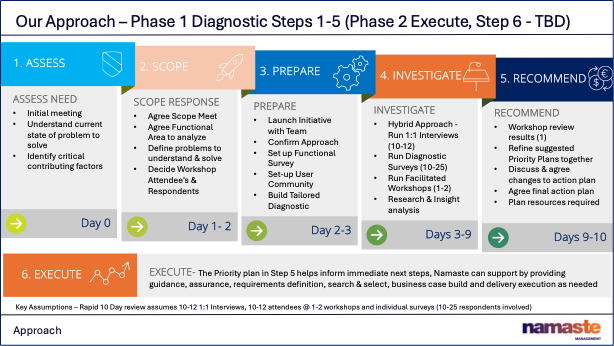
Phase 1 – Diagnostic Assessment (Steps 1–5)
1. Assess (Day 0)
Initial meeting to clarify objectives, understand current issues and challenges, and identify critical factors shaping Operations performance.
2. Scope (Days 1–2)
Agree functional areas, define issues to investigate, and confirm interviewees, workshop attendees, and survey participants.
3. Prepare (Days 2–3)
Launch the initiative, confirm the diagnostic framework, configure tailored surveys, and set up a user community.
4. Investigate (Days 3–9)
Hybrid approach combining 1:1 interviews, diagnostic surveys, and facilitated workshops. Findings are reinforced with research and benchmarking.
5. Recommend (Days 9–10)
Results reviewed in a workshop. Our AI-enabled ID8 software refines a prioritised action plan with clear ownership, resourcing, and timelines, which is then agreed by stakeholders.
Phase 2 – Execution & Change Delivery (Step 6)
6. Execute (Post-Diagnostic)
Namaste Management can then further support the CTrO in delivering the agreed roadmap and priority actions, from business case development and requirements definition to programme delivery and performance tracking.
The Value Delivered
- Rapid 10-day review combining speed and depth
- 360° insight through interviews, surveys, and workshops
- Prioritised action plan aligned with strategy and risk profile
- Execution support to ensure recommendations are delivered and embedded
The Aspire ID8 CTrO Diagnostic moves quickly from assessment to action, enabling operations to become a true strategic enabler of resilience, efficiency, and growth.
Namaste Management can also provide 1-2-day board level workshops or 5-day or 15-day variations on the 10-day example shared above.
Aspire ID8 CTrO Diagnostic Typical Review Areas
The Aspire ID8 CTrO Diagnostic enables Chief Transformation Officers to assess the maturity, effectiveness, and impact of the organisation’s transformation agenda. It provides a data-driven framework to evaluate how well strategic change is governed, resourced, and delivered — ensuring alignment between strategic intent, operational execution, and measurable outcomes.
Through its three-layer diagnostic framework, Aspire helps CTrOs gain visibility across transformation governance, capability, and delivery performance — providing a clear roadmap to accelerate change, mitigate risk, and maximise value realisation.
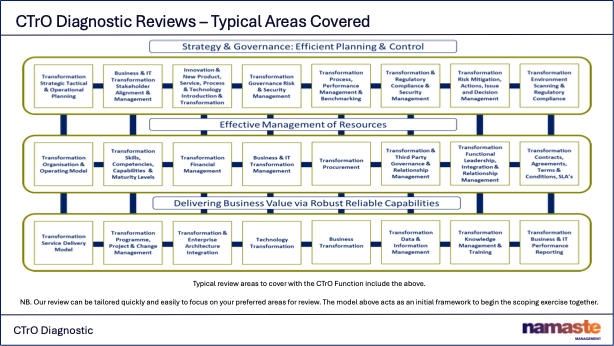
1. Strategy & Governance: Efficient Planning & Control
This top layer reviews how transformation strategy, planning, and governance mechanisms support enterprise objectives.
It assesses:
- Transformation strategy and operational planning
- Business–IT stakeholder alignment and leadership collaboration
- Innovation and new product, service, and technology introduction
- Governance, risk, and security management
- Performance benchmarking and compliance assurance
- Risk mitigation, issue management, and environmental scanning
Value delivered: clarity on whether transformation strategy and governance are aligned, well-controlled, and agile enough to guide large-scale enterprise change.
2. Effective Management of Resources
This layer evaluates how effectively people, budgets, and partnerships are deployed to manage and deliver transformation programmes.
It reviews:
- Transformation organisation and operating model
- Leadership skills, competencies, and maturity levels
- Financial management and portfolio control
- Business and IT transformation alignment
- Procurement and third-party governance
- Functional leadership, integration, and relationship management
Value delivered: actionable insights into the efficiency, capability, and readiness of transformation resources, enabling more disciplined execution and faster value delivery.
3. Delivering Business Value via Robust Reliable Capabilities
The final layer focuses on execution excellence and the capabilities required to sustain enterprise transformation.
It explores:
- Service delivery model for change and transformation
- Programme, project, and change management maturity
- Enterprise architecture integration and technology enablement
- Data, information, and knowledge management
- Business performance measurement and continuous improvement
Value delivered: assurance that transformation initiatives are executed with structure, transparency, and resilience — ensuring tangible business impact and sustained performance gains.
Why It Matters
The Aspire ID8 CTrO Diagnostic helps Chief Transformation Officers move from managing change to leading transformation strategically and systematically. It provides:
- A 10-day maturity assessment across strategy, capability, and delivery functions
- Benchmarking and visual analytics highlighting performance gaps and strengths
- A prioritised roadmap to accelerate change delivery and realise measurable outcomes
- A foundation for embedding a culture of continuous improvement and innovation
By combining structured diagnostics, best-practice benchmarking, and practical action planning, Aspire empowers CTrOs to drive enterprise transformation with confidence, clarity, and measurable impact.