Chief Information Officers (CIOs) stand at the forefront of enterprise transformation. Technology now defines strategic advantage, resilience, and innovation. As AI, cybersecurity, and data sovereignty reshape the landscape, CIOs must deliver reliability and speed – while enabling the business to continuously reinvent itself.
The modern CIO is both guardian and catalyst: protecting digital assets while pioneering new capabilities. By uniting governance with experimentation, CIOs turn disruption into digital opportunity.
What follows is an integrated view of today’s eight most critical technology leadership challenges; and the strategic responses shaping secure, intelligent, and agile organisations..
For Your Readiness Check, Guide to Scoring and Next Steps:
- Rate each statement (1 = Strongly Disagree to 5 = Strongly Agree).
- Section Score: Add your three ratings, divide by 3.
- Overall Score: Average all section scores.
- Guidance, per section and overall:
- Below 3.0 → Priority for action.
- 3.0–3.5 → Emerging capability; strengthen through targeted initiatives.
- 3.5–4.5 → Solid foundation; refine and scale.
Use this tool regularly to track progress, align with your leadership team, and ensure operational readiness in a volatile environment.
1. Digital Transformation & Enterprise Architecture Modernisation
The Challenge:
CIOs must balance legacy stability with innovation. Outdated systems, fragmented data, and inflexible architectures limit agility and speed. Enterprise-wide digital transformation requires unified design principles, scalable cloud infrastructure, and measurable business outcomes.
How CIOs Are Responding:
Leading CIOs are replatforming legacy systems, deploying modular enterprise architectures, and aligning IT roadmaps with business value streams. They use digital twins and architecture blueprints to synchronise operations and technology investments.
Case Insight: A multinational manufacturer reduced system downtime by 35% and integration costs by 20% after implementing a modular architecture and API-led data strategy.
Your Readiness Check:
- Our architecture supports agility, scalability, and interoperability.
- Technology investments directly align with business value streams.
- Legacy system dependency is being actively reduced.
2. AI Governance & Data Ethics
The Challenge:
The adoption of AI and automation introduces new governance risks. Bias, privacy breaches, and uncontrolled model proliferation threaten trust and compliance.
How CIOs Are Responding:
Progressive CIOs are creating AI ethics boards, defining responsible AI policies, and integrating explainability into their data models. They partner with CFOs and Chief Risk Officers to ensure AI aligns with enterprise governance frameworks.
Case Insight: A European bank established a cross-functional AI governance council that reduced regulatory risk and ensured all models adhered to ethical AI standards.
Your Readiness Check:
- AI governance and ethics frameworks are embedded across the organisation.
- Model transparency, fairness, and accountability are ensured.
- Cross-functional oversight supports responsible AI deployment.
3. Cybersecurity, Privacy & Resilience
The Challenge:
The proliferation of connected systems expands the attack surface. Ransomware, data breaches, and geopolitical cyber threats continue to escalate.
How CIOs Are Responding:
CIOs are embedding cybersecurity into enterprise strategy, implementing zero-trust frameworks, and deploying AI-driven threat detection. Regular penetration tests and digital crisis simulations build resilience.
Case Insight: A financial services provider reduced breach response time by 50% through a unified security operations centre and AI-based anomaly detection.
Your Readiness Check:
- We maintain a zero-trust security architecture across systems.
- Cyber resilience is tested through simulations and monitoring.
- Security, privacy, and continuity frameworks are fully integrated.
4. Cloud Optimisation & Cost Management
The Challenge:
Cloud adoption continues to rise, but costs and complexity often spiral. Shadow IT, data duplication, and uncontrolled usage undermine ROI.
How CIOs Are Responding:
CIOs are adopting FinOps frameworks to monitor, manage, and optimise cloud spend. They rationalise workloads, use AI for predictive capacity planning, and align cloud consumption with business outcomes.
Case Insight: A global media company saved $40M annually by consolidating cloud environments and deploying FinOps-based spend analytics.
Your Readiness Check:
- Cloud utilisation is efficient, governed, and transparent.
- FinOps principles are embedded into our technology management.
- We continuously align cloud strategy with financial and business outcomes.
5. Talent, SKills & Technology Leadership
The Challenge:
Technology capability gaps persist in AI, cybersecurity, and cloud engineering. Retention challenges and evolving hybrid work expectations add further strain.
How CIOs Are Responding:
CIOs are investing in reskilling, digital academies, and new career pathways to build internal tech capability. They champion cultures of learning and innovation while redefining leadership expectations for digital fluency.
Case Insight: A leading insurer increased retention by 15% after launching a Tech Leadership Academy focused on AI, DevOps, and agile delivery skills.
Your Readiness Check:
- We have a strong pipeline of digital and technical leadership talent.
- Upskilling programs are embedded in our technology function.
- Our culture supports innovation, learning, and career growth.
6. Regulatory, Risk & Compliance Complexity
The Challenge:
Rapidly evolving regulations – from data sovereignty to AI oversight – create operational and compliance complexity. Manual monitoring and reporting strain resources.
How CIOs Are Responding:
CIOs are automating compliance reporting, using AI to track regulatory changes, and embedding data lineage tools to ensure full auditability. They collaborate closely with risk and legal teams to anticipate new mandates.
Case Insight: A telecommunications provider automated GDPR compliance tracking, cutting audit preparation time by 60% and reducing regulatory risk exposure.
Your Readiness Check:
- Regulatory compliance is automated and proactively managed.
- Data lineage and audit trails are transparent and verifiable.
- Compliance monitoring integrates with enterprise risk management.
7. Business Alignment & Technology Value Creation
The Challenge:
CIOs must ensure technology investments directly enable strategic outcomes. Misalignment between IT and business priorities often leads to value leakage.
How CIOs Are Responding:
CIOs are embedding value realisation frameworks, co-creating digital strategies with business leaders, and integrating KPIs that link technology to outcomes.
Case Insight: A healthcare provider improved patient experience and reduced costs by 25% after aligning digital investments with customer journey metrics.
Your Readiness Check:
- Technology roadmaps are fully aligned with business strategy.
- Value realisation is tracked through measurable KPIs.
- Digital initiatives demonstrably drive growth and efficiency.
8. Tech Vendor Ecosystem Management
The Challenge:
As ecosystems expand, vendor complexity and dependency risks rise. Multi-cloud, SaaS, and niche partnerships demand greater oversight and integration.
How CIOs Are Responding:
CIOs are professionalising vendor management through ecosystem governance, performance scorecards, and AI-driven contract analytics. They optimise vendor portfolios to balance innovation, risk, and cost.
Case Insight: A financial services firm reduced vendor overlap by 30% and improved delivery performance using predictive vendor analytics.
Your Readiness Check:
- We manage our vendor ecosystem strategically and transparently.
- Performance metrics and governance ensure accountability.
- Vendor strategy supports innovation while mitigating dependency risk.
Deep-Dive CIO Diagnostics – Leveraging Namaste Aspire ID8
The Namaste Aspire ID8 CIO Diagnostic enables Chief Information Officers to rapidly assess the maturity of their technology organisation and define a practical, evidence-based roadmap for improvement. Built on a proven framework and underpinned by our AI-enabled proprietary software, the review consists of three layers and 24 review areas, providing a 360-degree view of how effectively operations are governed, how resources are managed, and how value is delivered through resilient and reliable capabilities.
The CIO Diagnostic is typically a structured 10-day review which combines structured analysis, stakeholder engagement, and data-driven insights to deliver a practical, prioritised action plan.
The approach is structured into a 6-step approach with steps 1-5 in Phase 1 culminating in a recommended action plan to implement to address the challenges identified. Phase 2, Step 6 relates to the execution / implementation of the recommendations which naturally follows on from the Phase 1 activity.
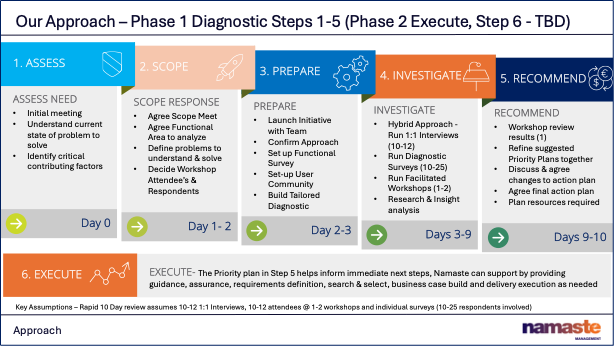
Phase 1 – Diagnostic Assessment (Steps 1–5)
1. Assess (Day 0)
Initial meeting to clarify objectives, understand current issues and challenges, and identify critical factors shaping Operations performance.
2. Scope (Days 1–2)
Agree functional areas, define issues to investigate, and confirm interviewees, workshop attendees, and survey participants.
3. Prepare (Days 2–3)
Launch the initiative, confirm the diagnostic framework, configure tailored surveys, and set up a user community.
4. Investigate (Days 3–9)
Hybrid approach combining 1:1 interviews, diagnostic surveys, and facilitated workshops. Findings are reinforced with research and benchmarking.
5. Recommend (Days 9–10)
Results reviewed in a workshop. Our AI-enabled ID8 software refines a prioritised action plan with clear ownership, resourcing, and timelines, which is then agreed by stakeholders.
Phase 2 – Execution & Change Delivery (Step 6)
6. Execute (Post-Diagnostic)
Namaste Management can then further support the COO in delivering the agreed roadmap and priority actions, from business case development and requirements definition to programme delivery and performance tracking.
The Value Delivered
- Rapid 10-day review combining speed and depth
- 360° insight through interviews, surveys, and workshops
- Prioritised action plan aligned with strategy and risk profile
- Execution support to ensure recommendations are delivered and embedded
The Aspire ID8 CIO Diagnostic moves quickly from assessment to action, enabling operations to become a true strategic enabler of resilience, efficiency, and growth.
Namaste Management can also provide 1-2-day board level workshops or 5-day or 15-day variations on the 10-day example shared above.
Aspire ID8 CIO Diagnostic Typical Review Areas
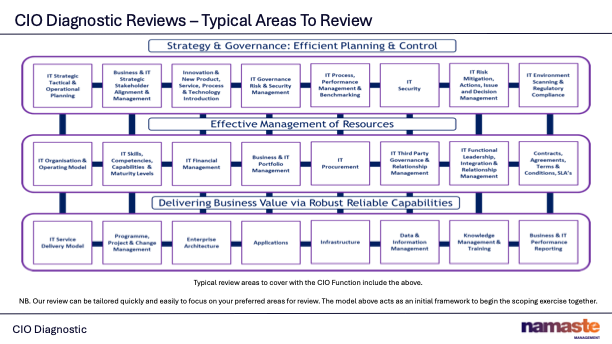
The Aspire ID8 CIO Diagnostic helps Chief Information Officers assess the maturity, performance, and strategic alignment of the IT and digital functions across the enterprise. It provides a structured, data-driven framework to evaluate technology governance, infrastructure, and capability effectiveness — identifying opportunities to improve resilience, innovation, and business value delivery.
Built on three integrated layers, the diagnostic enables CIOs to align technology strategy with enterprise goals, strengthen operational control, and accelerate transformation outcomes.
1. Strategy & Governance: Efficient Planning & Control
This top layer evaluates how effectively IT strategy and governance support enterprise priorities and risk management.
It examines key areas including:
- IT strategic and operational planning
- Business–IT stakeholder alignment
- Innovation and new technology introduction
- Governance, risk, and security management
- Performance benchmarking and IT process control
- Risk mitigation, issue management, and compliance
Value delivered: clarity on how IT governance, planning, and risk oversight enable strategic control, innovation, and regulatory assurance.
2. Effective Management of Resources
This layer focuses on how IT resources — people, budgets, partners, and portfolios — are managed to deliver reliable, cost-effective service and innovation.
It covers:
- IT organisation and operating model
- Skills, competencies, and maturity levels
- Financial and portfolio management
- Procurement, third-party governance, and vendor management
- Functional leadership, integration, and relationship management
- Contracts, service levels, and performance obligations
Value delivered: a clear picture of IT capability, efficiency, and alignment with enterprise needs, highlighting opportunities for operational improvement and cost optimisation.
3. Delivering Business Value via Robust Reliable Capabilities
The final layer assesses the resilience, agility, and effectiveness of IT delivery capabilities.
It explores:
- IT service delivery models
- Programme, project, and change management
- Enterprise architecture and application management
- Infrastructure design and resilience
- Data, information, and knowledge management
- Performance reporting and analytics
Value delivered: assurance that IT systems, data, and delivery models are robust, scalable, and equipped to drive digital enablement, innovation, and business growth.
Why It Matters
The Aspire ID8 CIO Diagnostic transforms technical and organisational complexity into clear, actionable insights. It enables CIOs to:
- Benchmark technology maturity and governance effectiveness
- Identify risks, inefficiencies, and innovation opportunities
- Develop a prioritised, data-backed roadmap for digital transformation
- Strengthen IT’s role as a strategic business enabler
By combining structured diagnostics, stakeholder engagement, and best-practice benchmarking, Aspire empowers CIOs to move confidently from technology management to digital value leadership — enabling IT to deliver sustainable business advantage.