
Chief Corporate Development Officers (CCDOs) operate at the forefront of strategic growth, transformation, and value creation. In an era defined by geopolitical uncertainty, capital scarcity, and technological disruption, corporate development has evolved from deal execution to enterprise transformation. The CCDO’s mandate now extends across strategy, investment, integration, and innovation – bridging the boardroom vision with operational delivery.
The modern CCDO is both architect and integrator – orchestrating M&A, partnerships, and portfolio strategy while ensuring that due diligence and post-deal execution deliver sustainable value. Operational due diligence has become a defining differentiator, separating those who complete deals from those who create enduring advantage.
What follows is an integrated view of today’s eight most critical corporate development challenges – and the strategic responses shaping resilient, high-performing growth organisations.
For Your Readiness Check, Guide to Scoring and Next Steps:
- Rate each statement (1 = Strongly Disagree to 5 = Strongly Agree).
- Section Score: Add your three ratings, divide by 3.
- Overall Score: Average all section scores.
- Guidance, per section and overall:
- Below 3.0 → Priority for action.
- 3.0–3.5 → Emerging capability; strengthen through targeted initiatives.
- 3.5–4.5 → Solid foundation; refine and scale.
- 4.5–5.0 → Best-in-class readiness; benchmark against peers.
Use this tool regularly to track progress, align with your leadership team, and ensure operational readiness in a volatile environment.
1. Strategic M&A & Portfolio Realignment in Uncertain Markets
The Challenge:
Global volatility, shifting valuations, and rising financing costs are reshaping deal dynamics. Traditional acquisition models often struggle to deliver target returns when growth assumptions change mid-cycle.
How CCDOs Are Responding:
Leaders are re-evaluating M&A pipelines through a portfolio lens – balancing acquisitions, joint ventures, and divestitures. Operational due diligence has become central to this shift, providing granular insight into cost structures, supply chain resilience, and integration feasibility before capital is committed.
Case Insight: A diversified industrial group increased post-acquisition ROI by 18% after introducing operational due diligence as a mandatory pre-deal gate, aligning strategic intent with execution capability.
Your Readiness Check:
- Our M&A strategy reflects changing market conditions and risk appetite.
- Operational due diligence is systematically embedded in all transactions.
- Portfolio decisions optimise both growth potential and capital discipline.
2. Deal Sourcing, Valuation & Competitive Intelligence
The Challenge:
Competition for attractive assets remains intense, while asymmetries in data and insight can distort valuations. Many organisations rely on reactive sourcing rather than proactive intelligence.
How CCDOs Are Responding:
High-performing CCDOs are deploying AI-enabled tools to identify targets, monitor market shifts, and assess fit dynamically. They integrate strategic, financial, and operational data to evaluate not just what a target is worth, but how it will perform operationally within their ecosystem.
Case Insight: A global software firm improved deal hit rate by 25% through predictive market mapping and scenario-based valuation models linked to operational performance metrics.
Your Readiness Check:
- Deal sourcing is proactive, data-driven, and aligned with strategic priorities.
- Valuation models incorporate both financial and operational variables.
- Competitive intelligence informs every stage of the deal lifecycle.
3. Post-Merger Integration & Synergy Realisation
The Challenge:
Integration remains the most decisive – and most frequently underestimated – phase of M&A. Many deals falter not from strategic misalignment but from execution gaps, cultural friction, and overlooked operational dependencies.
How CCDOs Are Responding:
CCDOs are elevating post-merger integration (PMI) into a disciplined capability. Integration playbooks now begin during diligence, informed by deep operational analysis. The best teams treat operational due diligence not as a checklist, but as the foundation for synergy capture, cost optimisation, and cultural alignment.
Case Insight: A consumer goods company realised 95% of projected synergies within 18 months after designing its integration blueprint directly from operational due diligence findings.
Your Readiness Check:
- Integration planning begins during diligence, not post-deal.
- Operational insights directly inform synergy targets and timelines.
- PMI governance ensures accountability, transparency, and speed.
4. Partnerships, Alliances & Ecosystem Expansion
The Challenge:
As business ecosystems expand, strategic alliances and partnerships increasingly rival traditional M&A as growth levers. Yet unclear governance, misaligned incentives, and lack of operational clarity often derail value creation.
How CCDOs Are Responding:
Forward-thinking CCDOs treat partnerships as “living integrations.” They apply operational due diligence to assess partner readiness, system compatibility, and delivery maturity before formalising alliances. Success depends on structured collaboration frameworks, shared KPIs, and exit strategies.
Case Insight: A European telco reduced alliance failure rates by 40% by adopting operational readiness assessments as part of its partner selection process.
Your Readiness Check:
- Partnership strategy complements, not replaces, our M&A approach.
- Operational due diligence informs partner evaluation and governance.
- Alliances deliver measurable outcomes, not symbolic cooperation.
5. Capital Efficiency & Financing Innovation
The Challenge:
Tightening credit conditions and investor scrutiny require CCDOs to balance ambition with discipline. Inefficient capital structures or misaligned financing can constrain deal flow and slow transformation.
How CCDOs Are Responding:
CCDOs are innovating through structured financing, joint ventures, and minority stakes that preserve optionality. They integrate financial and operational scenarios to model resilience under different market conditions, ensuring that every dollar deployed delivers operational and strategic value.
Case Insight: A renewable energy company unlocked $400M in capacity by combining sale-and-leaseback financing with operational restructuring identified during due diligence.
Your Readiness Check:
- Capital allocation aligns with both strategic and operational priorities.
- Financing structures are flexible and risk aware.
- Operational performance data informs investment decisions.
6. ESG & Responsible Investment Alignment
The Challenge:
ESG and sustainability now shape valuation, access to capital, and brand reputation. Yet many M&A processes still treat ESG as an afterthought rather than an integrated due diligence dimension.
How CCDOs Are Responding:
Leaders embed ESG and operational sustainability into target evaluation. Operational due diligence includes assessment of energy intensity, supply chain ethics, and workforce practices. This not only mitigates risk but creates post-deal value through compliance efficiency and reputation enhancement.
Case Insight: An industrial acquirer avoided $70M in remediation costs after uncovering ESG non-compliance during operational due diligence and pivoting to a cleaner target.
Your Readiness Check:
- ESG criteria are fully integrated into M&A screening and due diligence.
- Sustainability performance informs valuation and deal prioritisation.
- ESG integration supports long-term strategic and operational outcomes.
7. Talent, Culture & Change Integration
The Challenge:
Culture and leadership alignment remain critical drivers of post-deal success. Talent flight, resistance, and unclear governance often erode the very capabilities acquired.
How CCDOs Are Responding:
CCDOs are collaborating closely with CHROs to embed cultural assessment into operational due diligence. They identify leadership continuity risks, cultural gaps, and workforce integration challenges early – ensuring smooth transitions and faster value realisation.
Case Insight: A financial services merger retained 95% of key leaders by incorporating cultural diagnostics into the operational diligence phase and linking incentives to integration milestones.
Your Readiness Check:
- Cultural and leadership fit are assessed during diligence.
- Integration plans include change management and communication tracks.
- Talent retention and alignment are treated as core value drivers.
8. Digital Tools, Data & AI in Corporate Development
The Challenge:
Corporate development teams are under pressure to deliver faster, smarter, and more precise deal outcomes. Yet many still rely on static spreadsheets and fragmented data sources.
How CCDOs Are Responding:
Leaders are adopting digital M&A platforms, AI-driven due diligence tools, and automated synergy tracking systems. Advanced analytics now enhance every stage of the deal lifecycle – from sourcing to valuation to post-deal integration – bringing operational and financial insights together in real time.
Case Insight: A private equity-backed healthcare group cut diligence cycle times by 40% and reduced integration delays by using AI-enabled operational analytics.
Your Readiness Check:
- Digital and AI tools enhance every stage of the deal lifecycle.
- Operational and financial data are fully integrated.
- Analytics accelerate decision-making and post-deal performance tracking.
Deep-Dive CCDO Diagnostics – Leveraging Namaste Aspire ID8
The Namaste Aspire ID8 CCDO Diagnostic enables Chief Corporate Development Officers to rapidly assess the maturity their organisation’s end-to-end deal capability from strategy to execution. Built on a proven framework and underpinned by our AI-enabled proprietary software, the review consists of three layers and 24 review areas, providing a 360-degree view of how effectively the business integrates strategic, financial and operational perspectives to ensure every growth move creates sustained enterprise value.
The CCDO Diagnostic is typically a structured 10-day review which combines structured analysis, stakeholder engagement, and data-driven insights to deliver a practical, prioritised action plan.
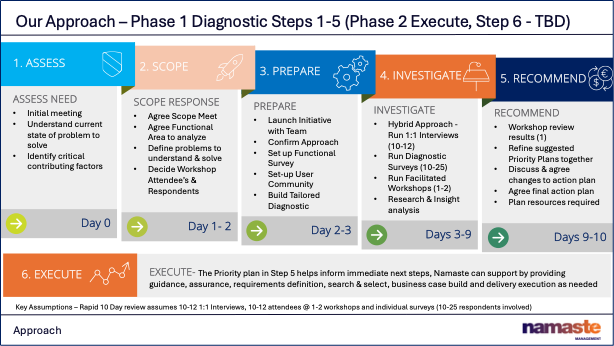
The approach is structured into a 6-step approach with steps 1-5 in Phase 1 culminating in a recommended action plan to implement to address the challenges identified. Phase 2, Step 6 relates to the execution / implementation of the recommendations which naturally follows on from the Phase 1 activity.
Phase 1 – Diagnostic Assessment (Steps 1–5)
1. Assess (Day 0)
Initial meeting to clarify objectives, understand current issues and challenges, and identify critical factors shaping Operations performance.
2. Scope (Days 1–2)
Agree functional areas, define issues to investigate, and confirm interviewees, workshop attendees, and survey participants.
3. Prepare (Days 2–3)
Launch the initiative, confirm the diagnostic framework, configure tailored surveys, and set up a user community.
4. Investigate (Days 3–9)
Hybrid approach combining 1:1 interviews, diagnostic surveys, and facilitated workshops. Findings are reinforced with research and benchmarking.
5. Recommend (Days 9–10)
Results reviewed in a workshop. Our AI-enabled ID8 software refines a prioritised action plan with clear ownership, resourcing, and timelines, which is then agreed by stakeholders.
Phase 2 – Execution & Change Delivery (Step 6)
6. Execute (Post-Diagnostic)
Namaste Management can then further support the COO in delivering the agreed roadmap and priority actions, from business case development and requirements definition to programme delivery and performance tracking.
The Value Delivered
- Rapid 10-day review combining speed and depth
- 360° insight through interviews, surveys, and workshops
- Prioritised action plan aligned with strategy and risk profile
- Execution support to ensure recommendations are delivered and embedded
The Aspire ID8 CCDO Diagnostic moves quickly from assessment to action, enabling operations to become a true strategic enabler of resilience, efficiency, and growth.
Namaste Management can also provide 1-2-day board level workshops or 5-day or 15-day variations on the 10-day example shared above.
Aspire ID8 CCDO Diagnostic Typical Review Areas
The Aspire ID8 CCDO Diagnostic provides Chief Corporate Development Officers with a structured and data-driven assessment of the organisation’s maturity across all aspects of corporate development, M&A execution, and strategic growth enablement. It helps the CCDO and executive leadership identify strengths, bottlenecks, and improvement opportunities across the end-to-end corporate development lifecycle — from deal origination and innovation to integration and value realisation.
Built around three integrated layers, the diagnostic delivers a 360° view of strategic alignment, resource management, and capability performance, empowering CCDOs to accelerate growth, improve governance, and maximise post-deal outcomes.
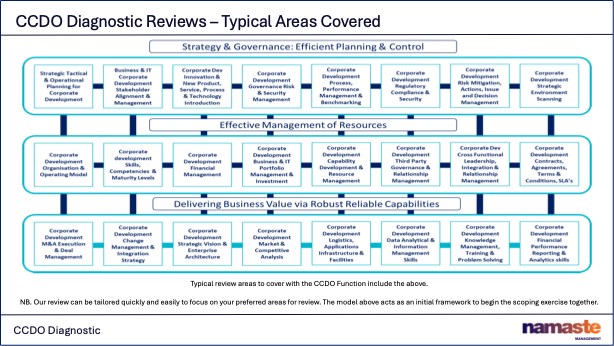
1. Strategy & Governance: Efficient Planning & Control
This top layer evaluates how effectively corporate development strategy, governance, and risk management drive enterprise growth.
It reviews:
- Strategic, tactical, and operational planning for corporate development
- Business and IT stakeholder alignment and strategic communication
- Innovation, deal origination, and new product or service introduction
- Governance, process control, and regulatory compliance
- Risk management, decision-making, and environmental scanning
Value delivered: a clear understanding of how corporate development strategy, governance, and oversight align with business priorities and shareholder expectations.
2. Effective Management of Resources
This layer focuses on how resources — people, capital, partnerships, and governance structures — are deployed to execute M&A, partnerships, and strategic initiatives effectively.
It assesses:
- Organisational structure and operating model for corporate development
- Team skills, competencies, and maturity levels
- Financial management and investment planning
- Business and IT portfolio alignment
- Third-party governance, integration leadership, and relationship management
- Contract management, SLAs, and partnership frameworks
Value delivered: insights into the efficiency, capability, and readiness of corporate development functions to manage growth and deliver successful transactions.
3. Delivering Business Value via Robust Reliable Capabilities
The final layer assesses how well the organisation delivers measurable value from strategic initiatives, M&A activities, and growth programmes.
It includes:
- M&A execution and deal management
- Change management and post-merger integration
- Strategic enterprise architecture and market analysis
- Data, analytics, and information management
- Knowledge sharing, problem solving, and financial performance reporting
Value delivered: assurance that growth initiatives are executed with operational discipline, analytical rigour, and measurable outcomes that maximise shareholder value.
Why It Matters
The Aspire ID8 CCDO Diagnostic transforms the complexity of corporate development into actionable insight. It enables CCDOs to:
- Benchmark the maturity of corporate development and M&A capabilities
- Identify risks and gaps in strategic planning, execution, and integration
- Develop a prioritised roadmap for performance improvement
- Strengthen alignment between strategy, finance, and operations
By combining structured diagnostics, stakeholder engagement, and data-led insight, Aspire empowers CCDOs to move from transactional delivery to strategic value creation, ensuring that every initiative contributes to sustainable enterprise growth and competitive advantage.