
Chief Executive Officers (CEOs) today operate in a world defined by volatility, velocity, and interdependence. Geopolitical fractures, exponential AI innovation, shifting stakeholder expectations, and sustainability imperatives are redrawing the boundaries of competitive advantage. The CEO’s role has evolved from strategist-in-chief to enterprise integrator – bridging vision and execution, purpose and performance, growth and resilience.
The modern CEO is not merely steering strategy but architecting transformation. The most effective leaders are those who connect technology with talent, operations with innovation, and governance with growth. They view disruption not as a threat to manage, but as a strategic catalyst for reinvention.
What follows is a CEO-level synthesis of the eight most pressing challenges shaping the enterprise agenda – and the strategic responses distinguishing resilient, high-performing organisations.
Use the accompanying Leadership Readiness Diagnostic to assess enterprise maturity, align your executive team, and prioritise focus areas for 2026 and beyond.
For Your Readiness Check, Guide to Scoring and Next Steps:
- Rate each statement (1 = Strongly Disagree to 5 = Strongly Agree).
- Section Score: Add your three ratings, divide by 3.
- Overall Score: Average all section scores.
- Guidance, per section and overall:
- Below 3.0 → Priority for action.
- 3.0–3.5 → Emerging capability; strengthen through targeted initiatives.
- 3.5–4.5 → Solid foundation; refine and scale.
- 4.5–5.0 → Best-in-class readiness; benchmark against peers.
Use this tool regularly to track progress, align with your leadership team, and ensure strategic readiness in a volatile environment.
1. Strategy, Purpose & Long-Term Value Creation
The Challenge:
Short-term performance pressures can obscure long-term strategic value. CEOs face growing demands to link purpose, profit, and societal impact.
How CEOs Are Responding:
Visionary CEOs are embedding purpose-driven growth models that link financial outcomes with stakeholder value. They connect ESG, innovation, and culture to performance KPIs, aligning investors and employees around shared purpose and measurable results.
Case Insight: A global industrial firm increased market valuation by 20% after integrating purpose-led metrics into board and investor reporting.
Your Leadership Check:
- Strategy integrates financial, environmental, and social outcomes.
- Purpose is measurable and drives stakeholder confidence.
- Leadership messaging aligns short-term delivery with long-term value.
2. Enterprise Transformation & Execution Discipline
The Challenge:
Transformation fatigue undermines execution. Multiple parallel change initiatives often lack governance and clarity of purpose.
How CEOs Are Responding:
Successful CEOs are establishing enterprise transformation offices (ETOs) and embedding operational due diligence into all major initiatives. They align transformation portfolios to strategic priorities and use data to track progress, capacity, and ROI.
Case Insight: A financial services CEO delivered $600M in value over three years by linking transformation governance directly to performance management.
Your Leadership Check:
- Transformation programmes align with enterprise priorities.
- Operational due diligence is applied to all change initiatives.
- Execution governance ensures accountability and sustained outcomes.
3. Leadership, Culture & Performance Integrity
The Challenge:
Culture is now a strategic asset – but often remains unmeasured. Misalignment between leadership behaviour and enterprise values erodes trust and agility.
How CEOs Are Responding:
CEOs are defining explicit leadership principles and embedding culture diagnostics into performance reviews. They ensure that leadership incentives, behaviours, and values reinforce transformation and trust.
Case Insight: A technology CEO reduced attrition by 25% and improved NPS by 15 points by embedding culture and behaviour metrics into executive performance scorecards.
Your Leadership Check:
- Culture is defined, measured, and actively led by executives.
- Leadership accountability reinforces enterprise values.
- Culture and performance are aligned through shared metrics.
4. Digital & AI-Driven Enterprise Reinvention
The Challenge:
AI and digital innovation are reshaping value chains. Many CEOs struggle to balance investment, ethics, and organisational readiness.
How CEOs Are Responding:
Modern CEOs treat digital transformation as core strategy. They build digital governance councils to align AI, data, and cyber resilience with growth priorities – supported by operational due diligence to validate technology and talent readiness.
Case Insight: A manufacturing CEO improved operational efficiency by 30% through an AI-enabled supply chain program governed by a cross-functional digital board.
Your Leadership Check:
- Digital strategy aligns with growth, risk, and ethics priorities.
- Operational due diligence assesses digital and AI readiness.
- Data, technology, and culture are integrated across leadership agendas.
5. Stakeholder Capitalism & ESG Accountability
The Challenge:
Boards, investors, and regulators expect transparency and measurable ESG impact. Fragmented ownership across functions limits credibility.
How CEOs Are Responding:
CEOs are centralising ESG leadership under integrated governance models co-led by sustainability, finance, and legal teams. They treat ESG as a performance system, not a reporting exercise – linking progress to enterprise value.
Case Insight: An energy CEO attracted major institutional investors by embedding ESG assurance and independent verification into annual reporting.
Your Leadership Check:
- ESG goals are integrated into governance and capital allocation.
- ESG data is assured, comparable, and investor ready.
- The CEO actively champions sustainability and ethical governance.
6. Board Alignment, Governance & Trust
The Challenge:
Board dynamics can hinder agility when oversight becomes risk-averse or disconnected from transformation realities.
How CEOs Are Responding:
CEOs are fostering board transformation literacy through transparent communication, scenario planning, and data-driven governance. They ensure the board understands both risk and opportunity through operational due diligence insights and external benchmarking.
Case Insight: A CEO improved board alignment on digital investment strategy after conducting structured operational due diligence on transformation risks.
Your Leadership Check:
- Board and executive priorities are aligned on strategy and risk.
- Governance is informed by evidence-based operational insights.
- Board engagement supports long-term growth and innovation.
7. Talent, Succession & Leadership Resilience
The Challenge:
Leadership pipelines are under pressure as demographic shifts and transformation demands outpace succession planning.
How CEOs Are Responding:
Forward-looking CEOs partner closely with CHROs to build enterprise leadership academies and scenario-based succession models. They combine leadership analytics with cultural and behavioural readiness assessments.
Case Insight: A global services firm reduced leadership vacancies by 40% through predictive succession analytics integrated with performance data.
Your Leadership Check:
- Succession plans are data-informed and actively maintained.
- Leadership capability supports transformation and innovation.
- Culture reinforces accountability, resilience, and agility.
8. Risk, Reputation & Crisis Leadership
The Challenge:
CEOs face amplified scrutiny in an era of social media and global transparency. Crises now escalate in hours, not days.
How CEOs Are Responding:
High-performing CEOs treat crisis management as a leadership discipline. They run simulation programs, integrate communications and legal oversight, and apply operational due diligence to identify vulnerabilities before they surface.
Case Insight: A consumer goods CEO reduced crisis recovery time by 60% after building an integrated risk communication and governance program led by the CEO office.
Your Leadership Check:
- Crisis and reputation management are CEO-led priorities.
- Operational due diligence identifies emerging vulnerabilities.
- Communication protocols protect trust and enterprise value.
In an era where complexity compounds faster than control can scale, the defining CEO capability is coherence – aligning technology, talent, and transformation under a unified strategic narrative. Those who master this orchestration will not only navigate disruption but redefine the frontier of enterprise value.
Deep-Dive CEO Diagnostics – Leveraging Namaste Aspire ID8
The Namaste Aspire ID8 CEO Diagnostic enables Chief Executive Officers to rapidly assess enterprise leadership, transformation readiness, and governance alignment. Built on a proven framework and underpinned by our AI-enabled proprietary software, the review consists of three layers and 24 review areas, providing a 360-degree view of how effectively the business combines strategic, cultural, and operational insights to shape a coherent roadmap for sustainable value creation.
The CEO Diagnostic is typically a structured 10-day review which combines structured analysis, stakeholder engagement, and data-driven insights to deliver a practical, prioritised action plan.
The approach is structured into a 6-step approach with steps 1-5 in Phase 1 culminating in a recommended action plan to implement to address the challenges identified. Phase 2, Step 6 relates to the execution / implementation of the recommendations which naturally follows on from the Phase 1 activity.
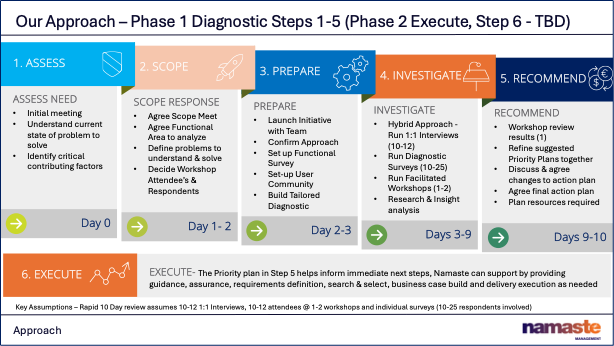
Phase 1 – Diagnostic Assessment (Steps 1–5)
1. Assess (Day 0)
Initial meeting to clarify objectives, understand current issues and challenges, and identify critical factors shaping Operations performance.
2. Scope (Days 1–2)
Agree functional areas, define issues to investigate, and confirm interviewees, workshop attendees, and survey participants.
3. Prepare (Days 2–3)
Launch the initiative, confirm the diagnostic framework, configure tailored surveys, and set up a user community.
4. Investigate (Days 3–9)
Hybrid approach combining 1:1 interviews, diagnostic surveys, and facilitated workshops. Findings are reinforced with research and benchmarking.
5. Recommend (Days 9–10)
Results reviewed in a workshop. Our AI-enabled ID8 software refines a prioritised action plan with clear ownership, resourcing, and timelines, which is then agreed by stakeholders.
Phase 2 – Execution & Change Delivery (Step 6)
6. Execute (Post-Diagnostic)
Namaste Management can then further support the CEO in delivering the agreed roadmap and priority actions, from business case development and requirements definition to programme delivery and performance tracking.
The Value Delivered
- Rapid 10-day review combining speed and depth
- 360° insight through interviews, surveys, and workshops
- Prioritised action plan aligned with strategy and risk profile
- Execution support to ensure recommendations are delivered and embedded
The Aspire ID8 CEO Diagnostic moves quickly from assessment to action, enabling the CEO to become a true strategic enabler of resilience, efficiency, and growth.
Namaste Management can also provide 1-2-day board level workshops or 5-day or 15-day variations on the 10-day example shared above.
The Aspire ID8 CEO Diagnostic provides Chief Executive Officers with a structured, data-driven approach to evaluate the overall maturity, performance, and alignment of their enterprise. Designed to give a comprehensive view of business health, it assesses leadership effectiveness, strategic coherence, and organisational capability across three integrated layers – helping CEOs identify strengths, address risks, and define a clear roadmap for enterprise improvement and growth.
Aspire ID8 CEO Diagnostic Typical Review Areas
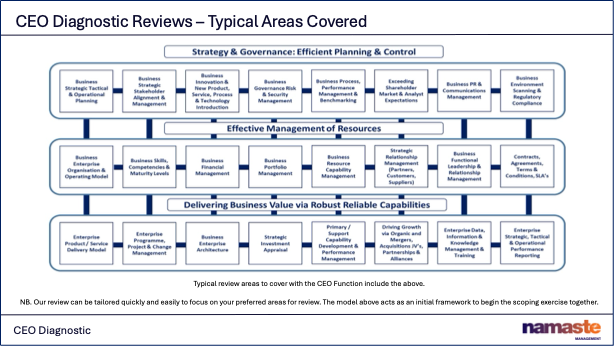
1. Strategy & Governance: Efficient Planning & Control
This top layer examines how effectively the CEO sets direction, ensures governance, and balances innovation with accountability. It explores key dimensions such as:
- Strategic, tactical, and operational planning
- Stakeholder alignment and strategic communication
- Innovation and new product, service, and technology introduction
- Governance, performance, and security management
- Market, analyst, and shareholder expectation management
- External environment scanning and regulatory compliance
Value delivered: clarity on the organisation’s strategic alignment, risk posture, and leadership effectiveness in driving governance and stakeholder trust.
2. Effective Management of Resources
This layer assesses how the organisation deploys its financial, human, and relational capital to deliver sustained performance. It reviews:
- Enterprise organisation and operating model
- Leadership competencies and maturity
- Financial and portfolio management
- Resource and capability planning
- Strategic partner and stakeholder relationship management
- Functional leadership integration and contractual frameworks
Value delivered: actionable insights into organisational agility, leadership capability, and the efficiency of enterprise resource utilisation.
3. Delivering Business Value via Robust Reliable Capabilities
The final layer focuses on how the enterprise creates value through operational excellence, adaptability, and strategic execution. It evaluates:
- Product and service delivery model
- Programme, project, and change management
- Enterprise architecture and investment appraisal
- Growth strategies through M&A, partnerships, and alliances
- Data, knowledge, and performance management
Value delivered: assurance that the business model, delivery mechanisms, and supporting capabilities are robust, scalable, and aligned to long-term growth objectives.
Why It Matters
The Aspire ID8 CEO Diagnostic transforms complex business performance data into clear strategic insights and a prioritised action plan. It enables CEOs to:
- Benchmark enterprise maturity and leadership effectiveness
- Identify systemic weaknesses and growth barriers
- Align leadership teams around a unified transformation roadmap
- Drive measurable performance improvement and sustainable value creation
By combining structured diagnostics, stakeholder engagement, and actionable recommendations, Aspire helps CEOs move from insight to impact – strengthening governance, agility, and enterprise value.