
Chief Marketing Officers (CMOs) stand at the crossroads of brand, customer, and enterprise growth. As customer expectations evolve and technology accelerates, marketing’s role has shifted from communication to orchestration – from managing campaigns to driving connected, data-informed ecosystems of growth.
The modern CMO blends creativity with analytics, brand purpose with performance, and human insight with AI. They are responsible not only for demand generation but for shaping reputation, loyalty, and enterprise value.
The following eight challenges define the 2025 marketing frontier – and the responses enabling CMOs to lead with influence, precision, and impact.
For Your Readiness Check, Guide to Scoring and Next Steps:
- Rate each statement (1 = Strongly Disagree to 5 = Strongly Agree).
- Section Score: Add your three ratings, divide by 3.
- Overall Score: Average all section scores.
- Guidance, per section and overall:
- Below 3.0 → Priority for action.
- 3.0–3.5 → Emerging capability; strengthen through targeted initiatives.
- 3.5–4.5 → Solid foundation; refine and scale.
- 4.5–5.0 → Best-in-class readiness; benchmark against peers.
Use this tool regularly to track progress, align with your leadership team, and ensure operational readiness in a volatile environment.
1. Customer-Centric Growth in a Fragmented Market
The Challenge:
Customers expect seamless, personalised, and ethical engagement. Yet fragmentation across channels and inconsistent data undermine unified customer experiences.
How CMOs Are Responding:
Leaders are redefining marketing around customer ecosystems. They integrate sales, service, and product functions to deliver consistent, insight-driven experiences. Many are embedding “customer back” design principles and real-time data feedback loops into every decision.
Case Insight: A global retailer increased repeat purchases by 35% after introducing a unified customer data platform integrating marketing, service, and e-commerce interactions.
Your Readiness Check:
- Our marketing strategy starts from deep customer understanding.
- We integrate insights across channels and touchpoints.
- Experience consistency is tracked and managed as a performance metric.
2. Brand Purpose, Trust & Reputation Leadership
The Challenge:
In the age of transparency, brand purpose is no longer optional. Customers, investors, and employees expect authenticity, social responsibility, and ethical leadership.
How CMOs Are Responding:
CMOs are aligning brand purpose with corporate strategy, sustainability, and culture. They use evidence-based storytelling grounded in real performance and stakeholder outcomes – not empty slogans. Purpose and profit are positioned as mutually reinforcing.
Case Insight: A consumer goods brand restored 20% market share within two years by reorienting its brand narrative around sustainability metrics and transparent sourcing.
Your Readiness Check:
- Our brand purpose is authentic and evidence based.
- Reputation management is integrated into strategic planning.
- Purpose and performance are mutually reinforcing in communication.
3. Data, AI & Predictive Intelligence in Marketing
The Challenge:
Data overload, fragmented tech stacks, and evolving privacy regulations hinder actionable intelligence. Many teams collect data but lack the integration to turn it into foresight.
How CMOs Are Responding:
Modern CMOs are developing unified data architectures and applying AI for segmentation, prediction, and campaign optimisation. They ensure compliance and ethical use of data while enhancing performance precision through predictive analytics.
Case Insight: A financial services provider increased campaign ROI by 42% by integrating AI-driven propensity models with CRM and digital media performance data.
Your Readiness Check:
- Marketing decisions are powered by integrated, reliable data.
- AI and predictive analytics enhance targeting and measurement.
- Privacy, compliance, and ethical data use are embedded in operations.
4. Marketing Technology & Operational Excellence
The Challenge:
Complex, disconnected marketing technology stacks create inefficiency and dilute impact. Without operational due diligence, investment in tools often exceeds realised value.
How CMOs Are Responding:
Leading CMOs are conducting marketing operational due diligence – mapping tools, workflows, and data flows to assess ROI and eliminate redundancy. They establish marketing operations (MOPS) teams to drive automation, analytics, and integration across the enterprise.
Case Insight: A B2B technology firm reduced MarTech costs by 25% and improved speed-to-market by 30% through a marketing operations transformation program grounded in operational due diligence.
Your Readiness Check:
- We regularly evaluate MarTech and data stack effectiveness.
- Operational due diligence informs all major technology investments.
- Marketing operations drive consistency, scalability, and ROI.
5. Performance, ROI & Financial Alignment
The Challenge:
Marketing often faces scrutiny over spend and attribution. Without financial alignment, CMOs risk being perceived as cost centres rather than growth engines.
How CMOs Are Responding:
Progressive CMOs are collaborating closely with CFOs to create shared growth scorecards linking marketing investment to revenue, margin, and brand equity. They implement zero-based budgeting and marketing mix modelling to prove performance impact.
Case Insight: A telecom brand strengthened CFO confidence by implementing ROI dashboards that linked campaign spend to profit contribution and lifetime value uplift.
Your Readiness Check:
- Marketing ROI is quantified and visible to executive leadership.
- Finance and marketing collaborate on growth investment models.
- Budget allocation decisions are driven by performance insights.
6. Creativity, Content & Differentiated Storytelling
The Challenge:
In an AI-saturated media landscape, differentiation demands creativity with substance. Oversaturation of content can desensitise audiences.
How CMOs Are Responding:
Leaders are reasserting creativity as a strategic advantage – combining human insight, data-driven storytelling, and authentic brand voice. They use AI for scale and analytics for feedback, but human creativity for resonance and emotional connection.
Case Insight: A premium brand revived stagnant engagement by rebalancing automation with human-led creative direction, resulting in a 60% uplift in brand sentiment.
Your Readiness Check:
- Our creative output is both data-informed and human-led.
- Content strategy differentiates us meaningfully in the market.
- Creativity is recognised as a measurable strategic asset.
7. Talent, Capability & Culture in Marketing
The Challenge:
The skillset for modern marketing is shifting rapidly – from traditional communications to analytics, technology, and strategic collaboration. Talent scarcity and burnout threaten continuity.
How CMOs Are Responding:
Modern CMOs are building blended teams of data scientists, strategists, and storytellers. They invest in marketing academies, rotational programs, and AI literacy initiatives that foster adaptability, creativity, and analytical rigour.
Case Insight: A global FMCG company improved retention by 18% after launching a “Marketing 4.0” capability program to upskill teams in digital analytics and creative innovation.
Your Readiness Check:
- Our marketing team has balanced creative and analytical skills.
- Capability building is continuous and future focused.
- Our culture supports innovation, experimentation, and growth.
8. Cross-Functional Collaboration & Growth Leadership
The Challenge:
Marketing’s success now depends on integration with product, sales, finance, and technology. Fragmented collaboration leads to inconsistent strategy and diluted growth outcomes.
How CMOs Are Responding:
High-performing CMOs are leading cross-functional growth councils and embedding marketing within enterprise transformation. They act as integrators – using customer insight to connect innovation, sales, and service delivery.
Case Insight: A SaaS business doubled conversion rates after establishing a “growth office” co-led by marketing, sales, and product, uniting customer insight with execution delivery.
Your Readiness Check:
- Marketing plays a central role in enterprise growth leadership.
- Collaboration with other functions is structured and intentional.
- Customer insight drives alignment across business functions.
Deep-Dive CMO Diagnostics – Leveraging Namaste Aspire ID8
The Namaste Aspire ID8 CMO Diagnostic enables Chief Marketing Officers to rapidly assess the maturity, readiness and performance of their marketing function. Built on a proven framework and underpinned by our AI-enabled proprietary software, the review consists of three layers and 24 review areas, providing a 360-degree view of how effectively the business integrates brand, data, customer, and performance dimensions to guide strategic investment and execution excellence.
The CMO Diagnostic is typically a structured 10-day review which combines structured analysis, stakeholder engagement, and data-driven insights to deliver a practical, prioritised action plan.
The approach is structured into a 6-step approach with steps 1-5 in Phase 1 culminating in a recommended action plan to implement to address the challenges identified. Phase 2, Step 6 relates to the execution / implementation of the recommendations which naturally follows on from the Phase 1 activity.
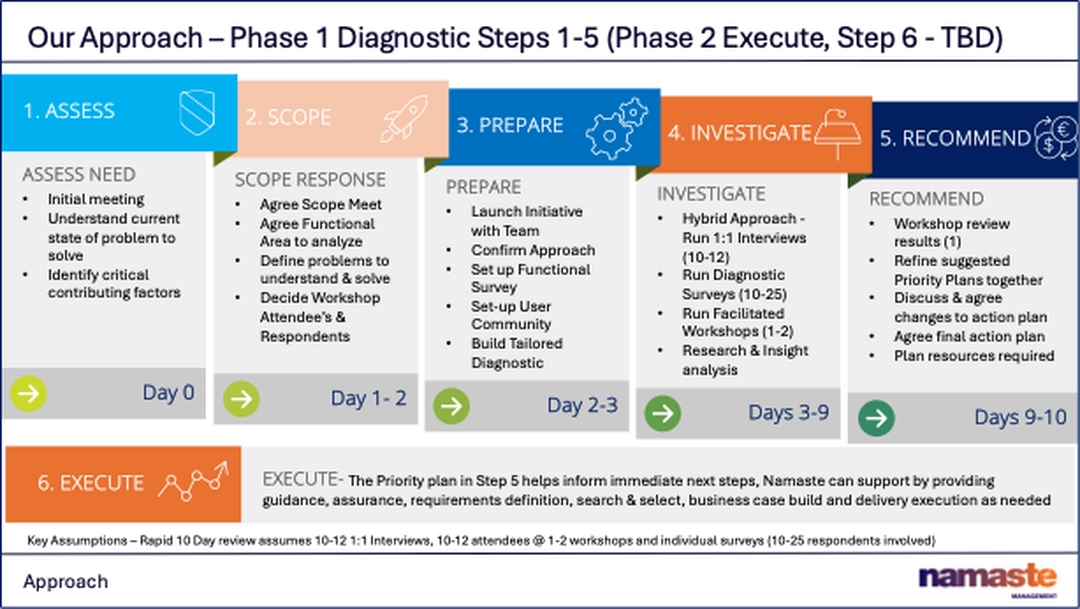
Phase 1 – Diagnostic Assessment (Steps 1–5)
1. Assess (Day 0)
Initial meeting to clarify objectives, understand current issues and challenges, and identify critical factors shaping Operations performance.
2. Scope (Days 1–2)
Agree functional areas, define issues to investigate, and confirm interviewees, workshop attendees, and survey participants.
3. Prepare (Days 2–3)
Launch the initiative, confirm the diagnostic framework, configure tailored surveys, and set up a user community.
4. Investigate (Days 3–9)
Hybrid approach combining 1:1 interviews, diagnostic surveys, and facilitated workshops. Findings are reinforced with research and benchmarking.
5. Recommend (Days 9–10)
Results reviewed in a workshop. Our AI-enabled ID8 software refines a prioritised action plan with clear ownership, resourcing, and timelines, which is then agreed by stakeholders.
Phase 2 – Execution & Change Delivery (Step 6)
6. Execute (Post-Diagnostic)
Namaste Management can then further support the CMO in delivering the agreed roadmap and priority actions, from business case development and requirements definition to programme delivery and performance tracking.
The Value Delivered
- Rapid 10-day review combining speed and depth
- 360° insight through interviews, surveys, and workshops
- Prioritised action plan aligned with strategy and risk profile
- Execution support to ensure recommendations are delivered and embedded
The Aspire ID8 CMO Diagnostic moves quickly from assessment to action, enabling operations to become a true strategic enabler of resilience, efficiency, and growth.
Namaste Management can also provide 1-2-day board level workshops or 5-day or 15-day variations on the 10-day example shared above.
Aspire ID8 CMO Diagnostic Typical Review Areas
The Aspire ID8 CMO Diagnostic provides Chief Marketing Officers with a structured, data-driven assessment of marketing function maturity and effectiveness. It helps CMOs understand how well marketing strategy, operations, and execution align with enterprise growth objectives — identifying gaps, risks, and opportunities across all key areas of marketing planning, resource management, and value delivery.
Built on a three-layer framework, the diagnostic offers a holistic review of strategic alignment, operational capability, and measurable performance — enabling CMOs to strengthen brand impact, optimise marketing ROI, and accelerate sustainable business growth.
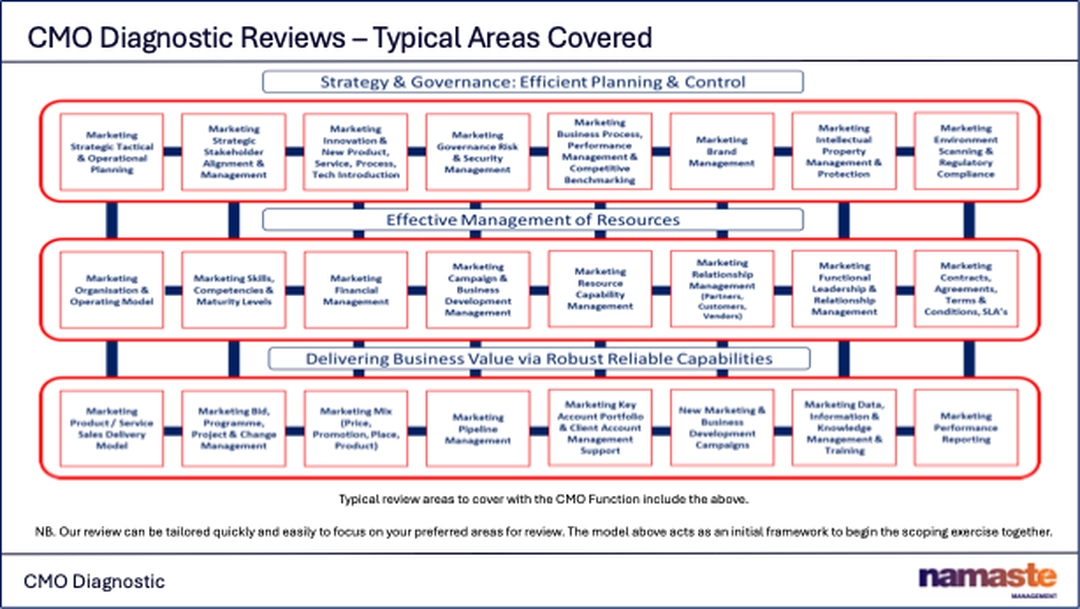
1. Strategy & Governance: Efficient Planning & Control
This top layer assesses how effectively the marketing strategy supports enterprise vision, governance, and stakeholder engagement.
It covers:
- Marketing strategy, tactical planning, and performance control
- Strategic stakeholder alignment and communication management
- Innovation in new product, service, and technology introduction
- Governance, risk, and brand security management
- Competitive benchmarking and brand performance evaluation
- Intellectual property, regulatory compliance, and environmental scanning
Value delivered: visibility into the alignment between marketing strategy, brand governance, and business goals, ensuring marketing leadership drives measurable enterprise value.
2. Effective Management of Resources
This layer evaluates how marketing resources — people, budgets, channels, and partnerships — are structured and managed to achieve strategic outcomes.
It explores:
- Marketing organisation and operating model design
- Skills, competencies, and team maturity assessment
- Financial management and marketing budget optimisation
- Campaign and business development management
- Partner, customer, and vendor relationship management
- Functional leadership, integration, and contract governance
Value delivered: actionable insight into capability gaps, efficiency improvements, and resource alignment to support scalable, high-impact marketing delivery.
3. Delivering Business Value via Robust Reliable Capabilities
This layer focuses on marketing execution, campaign performance, and the enablers of long-term customer and brand value.
It includes:
- Product and service delivery model design
- Programme, project, and change management
- Marketing mix optimisation (price, promotion, place, product)
- Pipeline and campaign performance management
- Data, analytics, and knowledge management
- Marketing performance reporting and continuous improvement
Value delivered: assurance that marketing execution is data-led, integrated, and performance-focused — driving both customer engagement and commercial outcomes.
Why It Matters
The Aspire ID8 CMO Diagnostic enables CMOs to move from campaign management to strategic growth leadership, delivering:
- A comprehensive maturity assessment across marketing strategy, execution, and ROI delivery
- Benchmarking and data insight to prioritise improvement areas
- A tailored action roadmap to enhance marketing effectiveness and efficiency
- A stronger foundation for brand-led growth and market differentiation
By combining structured diagnostics, stakeholder engagement, and best-practice frameworks, Aspire empowers CMOs to transform the marketing function into a strategic engine for enterprise value creation and customer success.