
Chief Operating Officers (COOs) stand at the crossroads of disruption and transformation. Geopolitical turbulence, rapid advances in AI, economic uncertainty, and rising ESG demands are reshaping the operating landscape. The COO agenda has never been broader – or more strategic.
The modern COO is no longer simply the steward of efficiency. The role has evolved into that of a strategic architect – balancing precision with adaptability, operational resilience with sustainable growth. By pairing executional excellence with forward-looking leadership, COOs are turning disruption into durable competitive advantage.
What follows is an integrated view of today’s seven most critical operational challenges and the innovative responses shaping resilient organisations.
For Your Readiness Check, Guide to Scoring and Next Steps:
- Rate each statement (1 = Strongly Disagree to 5 = Strongly Agree).
- Section Score: Add your three ratings, divide by 3.
- Overall Score: Average all section scores.
- Guidance, per section and overall:
- Below 3.0 → Priority for action.
- 3.0–3.5 → Emerging capability; strengthen through targeted initiatives.
- 3.5–4.5 → Solid foundation; refine and scale.
- 4.5–5.0 → Best-in-class readiness; benchmark against peers.
Use this tool regularly to track progress, align with your leadership team, and ensure operational readiness in a volatile environment.
1. Digital Transformation & AI Governance
The Challenge:
COOs must modernise core systems while scaling AI and automation. Legacy infrastructure, fragmented data, and immature governance structures slow progress. The emergence of agentic AI—autonomous goal-driven systems—amplifies both opportunity and risk. Without skilled teams and robust guardrails, costs can rise by 20% while competitive position erodes.
How COOs Are Responding:
Progressive leaders are accelerating cloud migration and replacing outdated systems with AI-enabled platforms that cut costs by 15–20%. They are establishing governance boards to oversee ethical AI use and aligning digital initiatives with business goals. Targeted upskilling programs ensure teams are equipped to deploy and manage agentic AI responsibly.
Case Insight: A European industrial manufacturer cut processing time by 18% by phasing out legacy ERP modules and embedding AI-driven predictive analytics, while its AI ethics board prevented misaligned pilot projects.
Your Readiness Check:
- We have minimised reliance on legacy systems and scaled AI/cloud adoption.
- Governance frameworks ensure ethical AI use and effective risk management.
- Digital initiatives consistently reduce costs and enhance agility.
2. Supply Chain Volatility & Geopolitical Risks
The Challenge:
Global supply networks face persistent shocks from tariffs, regional conflicts, and shifting trade policies. Eighty-five percent of COOs now see tariffs as a structural feature, not a temporary burden. Just-in-time models are increasingly fragile, threatening profitability and growth.
How COOs Are Responding:
To build resilience, COOs are diversifying sourcing strategies, embedding real-time monitoring tools, and stress-testing logistics. Scenario planning for geopolitical shifts has become standard, enabling leaders to rebalance production and distribution without losing market agility. Some are moving toward near-shoring and dual sourcing to balance efficiency with stability.
Case Insight: A global consumer goods company moved 30% of sourcing closer to key markets, reducing exposure to regional trade disputes. AI-enabled dashboards provided real-time visibility, cutting lead-time disruptions by half.
Your Readiness Check:
- Our supply chain is diversified, resilient, and monitored in real time.
- Scenario planning equips us to navigate geopolitical and regulatory shifts.
- Global operations balance opportunity with risk, without excessive vulnerability.
3. Talent Management & Workforce Dynamics
The Challenge:
Attracting, retaining, and developing talent remains a systemic issue. Hybrid and gig models increase flexibility but fracture collaboration. Skills in AI, data, and digital are scarce, while employee burnout and cultural misalignment threaten engagement and inclusivity.
How COOs Are Responding:
Leaders are reframing workforce strategy around agility. Digital upskilling and leadership development are prioritised, often in partnership with gig and learning platforms. Cross-functional teams and collaboration tools reduce silos. Diversity, equity, and well-being initiatives are embedded into the operating model, creating cultures that retain top performers while mitigating burnout.
Case Insight: A U.S. fintech scaled its AI engineering team by combining internal training with gig partnerships. Employee engagement scores rose 12% after rolling out a structured well-being program and inclusive leadership training.
Your Readiness Check:
- We excel in attracting, retaining, and upskilling talent for hybrid/gig models.
- Our culture fosters inclusivity, collaboration, and engagement across distributed teams.
- Well-being programs and leadership practices mitigate burnout and silos.
4. Rising Cost Pressures & Economic Uncertainty
The Challenge:
Inflation, market volatility, and higher financing costs compress margins and strain transformation budgets. Overly ambitious automation initiatives often stall, leaving stranded investments and unmet expectations.
How COOs Are Responding:
Top-performing COOs are reengineering processes for efficiency, deploying automation where ROI is proven, and adopting adaptive budgeting that flexes with market conditions. By focusing on operational discipline and measurable value, they balance short-term cost control with long-term transformation funding.
Case Insight: A logistics firm saved £25M annually by automating warehouse operations and applying dynamic budgeting, which helped absorb energy price shocks without halting digital investment.
Your Readiness Check:
- Automation and resource optimisation keep operational costs tightly managed.
- Adaptive budgeting strategies anticipate inflation and volatility.
- Efficiency investments consistently generate measurable ROI.
5. Cybersecurity & Resilience Threats
The Challenge:
Digitisation has expanded the attack surface, while AI-driven cyber threats escalate in sophistication. Stakeholders expect resilience frameworks that safeguard not just IT, but end-to-end operations.
How COOs Are Responding:
COOs are embedding cybersecurity and risk management across the enterprise. AI-enabled threat detection tools are scaled, while regular stress tests and simulations ensure preparedness. Resilience plans now integrate supply chain continuity, crisis response, and workforce readiness, positioning organisations to withstand and rebound from disruption.
Case Insight: An Asian telecom company thwarted a large-scale phishing attack by integrating AI-based detection tools and conducting resilience simulations, which shortened recovery time from potential outages by 40%.
Your Readiness Check:
- IT and operational systems are fortified against evolving AI-driven threats.
- Enterprise resilience and risk management are fully embedded.
- Security audits, training, and simulations are conducted regularly.
6. Sustainability & ESG Compliance
The Challenge:
Sustainability is no longer optional. Regulatory, investor, and customer expectations demand COOs operationalise ESG commitments. Many organisations struggle with fragmented ESG data, undermining credibility and limiting transparency.
How COOs Are Responding:
Forward-looking COOs are integrating sustainability into procurement, logistics, and production, while adopting data analytics for accurate reporting. Circular economy practices—such as waste-to-value models and green supply chains—unlock new efficiencies. ESG dashboards track progress, ensuring compliance while reinforcing brand equity and stakeholder trust.
Case Insight: A Latin American food producer adopted circular packaging and integrated ESG dashboards. It reduced carbon intensity by 22% while maintaining profit margins, strengthening both compliance and brand reputation.
Your Readiness Check:
- Sustainability practices are embedded across operations and supply chains.
- ESG standards are met or exceeded while balancing financial performance.
- Data analytics provide clear, reliable sustainability reporting.
7. Operational Alignment & Siloed Structures
The Challenge:
Strategy often falters in execution due to silos, duplicated efforts, and inconsistent decision-making. Remote and distributed workforces magnify these challenges, making scalability and alignment harder to achieve.
How COOs Are Responding:
COOs are redesigning operating models to bridge strategy and execution. Cross-functional squads, supported by collaboration platforms, accelerate delivery while reducing duplication. Clear performance metrics and real-time dashboards create transparency, while employee engagement programs reinforce shared accountability for results.
Case Insight: A North American asset manager eliminated duplication across teams by consolidating project management tools. Cross-functional squads accelerated new product launches by 25% while improving accountability.
Your Readiness Check:
- Strategy and execution are tightly linked, minimising inefficiency.
- Cross-functional teams and collaboration tools drive productivity.
- Employee engagement accelerates innovation and scalability.
Deep-Dive COO Diagnostics – Leveraging Namaste Aspire ID8
The Namaste Aspire ID8 COO Diagnostic enables Chief Operating Officers to rapidly assess the maturity of their operations function and define a practical, evidence-based roadmap for improvement. Built on a proven framework and underpinned by our AI-enabled proprietary software, the review consists of three layers and 24 review areas, providing a 360-degree view of how effectively operations are governed, how resources are managed, and how value is delivered through resilient and reliable capabilities.
The COO Diagnostic is typically a structured 10-day review which combines structured analysis, stakeholder engagement, and data-driven insights to deliver a practical, prioritised action plan.
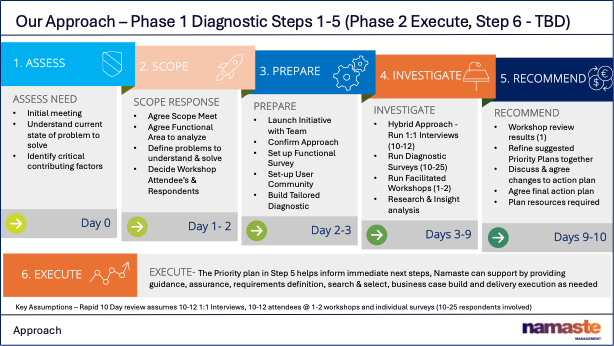
The approach is structured into a 6-step approach with steps 1-5 in Phase 1 culminating in a recommended action plan to implement to address the challenges identified. Phase 2, Step 6 relates to the execution / implementation of the recommendations which naturally follows on from the Phase 1 activity.
Phase 1 – Diagnostic Assessment (Steps 1–5)
1. Assess (Day 0)
Initial meeting to clarify objectives, understand current issues and challenges, and identify critical factors shaping Operations performance.
2. Scope (Days 1–2)
Agree functional areas, define issues to investigate, and confirm interviewees, workshop attendees, and survey participants.
3. Prepare (Days 2–3)
Launch the initiative, confirm the diagnostic framework, configure tailored surveys, and set up a user community.
4. Investigate (Days 3–9)
Hybrid approach combining 1:1 interviews, diagnostic surveys, and facilitated workshops. Findings are reinforced with research and benchmarking.
5. Recommend (Days 9–10)
Results reviewed in a workshop. Our AI-enabled ID8 software refines a prioritised action plan with clear ownership, resourcing, and timelines, which is then agreed by stakeholders.
Phase 2 – Execution & Change Delivery (Step 6)
6. Execute (Post-Diagnostic)
Namaste Management can then further support the COO in delivering the agreed roadmap and priority actions, from business case development and requirements definition to programme delivery and performance tracking.
The Value Delivered
- Rapid 10-day review combining speed and depth
- 360° insight through interviews, surveys, and workshops
- Prioritised action plan aligned with strategy and risk profile
- Execution support to ensure recommendations are delivered and embedded
The Aspire ID8 COO Diagnostic moves quickly from assessment to action, enabling operations to become a true strategic enabler of resilience, efficiency, and growth.
Namaste Management can also provide 1-2-day board level workshops or 5-day or 15-day variations on the 10-day example shared above.
Aspire ID8 COO Diagnostic Typical Review Areas
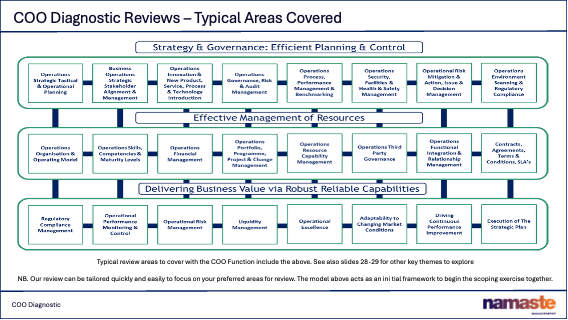
1. Strategy & Governance: Efficient Planning & Control
This layer reviews how well operations strategy, planning, and governance are aligned with business priorities. It assesses areas such as:
- Strategic, tactical, and operational planning
- Stakeholder alignment and innovation management
- Governance, risk, and audit control
- Security, facilities, and health & safety management
- Environmental scanning and regulatory compliance
Value delivered: clarity on how effectively strategy, control, and risk oversight are embedded to support long-term business goals.
2. Effective Management of Resources
Here the focus shifts to the deployment and management of people, finances, and assets. Areas reviewed include:
- Organisation design and operating model
- Workforce skills, competencies, and maturity
- Financial and project/portfolio management
- Resource capacity planning and third-party governance
- Functional integration and contractual frameworks
Value delivered: actionable insight into efficiency, capability development, and resource optimisation.
3. Delivering Business Value via Robust Reliable Capabilities
The final layer evaluates how operations deliver resilience, adaptability, and continuous improvement. Key areas include:
- Compliance and performance monitoring
- Operational and liquidity risk management
- Operational excellence and market adaptability
- Ongoing performance improvement
- Execution of the strategic plan
Value delivered: assurance that the COO function not only operates effectively today, but is agile, resilient, and capable of sustaining long-term value creation.
Why It Matters
The Aspire ID8 COO Diagnostic translates maturity assessment into a practical, prioritised action plan, supported by dashboards, benchmarking, and best-practice insights. It enables COOs to:
- Identify gaps quickly and objectively
- Benchmark against best practice and industry peers
- Create a robust roadmap for capability development
- Accelerate performance improvement and risk mitigation
In doing so, it positions the COO function as a strategic enabler of growth, resilience, and transformation.