
Chief Strategy Officers (CSOs) stand at the intersection of insight and execution. In a world defined by volatility, disruption, and digital acceleration, CSOs are being called upon to shape the long-term direction while ensuring immediate agility. The role has evolved from corporate planning to enterprise-wide orchestration of transformation and growth.
The modern CSO blends analytical precision with adaptive leadership – translating data into foresight, strategy into execution, and disruption into opportunity. This expanded remit requires deep collaboration across finance, technology, operations, and people.
What follows is an integrated view of today’s eight most critical strategic challenges and the innovative responses enabling CSOs to lead transformation, resilience, and sustainable value creation.
For Your Readiness Check, Guide to Scoring and Next Steps:
- Rate each statement (1 = Strongly Disagree to 5 = Strongly Agree).
- Section Score: Add your three ratings, divide by 3.
- Overall Score: Average all section scores.
- Guidance, per section and overall:
- Below 3.0 → Priority for action.
- 3.0–3.5 → Emerging capability; strengthen through targeted initiatives.
- 3.5–4.5 → Solid foundation; refine and scale.
- 4.5–5.0 → Best-in-class readiness; benchmark against peers.
Use this tool regularly to track progress, align with your leadership team, and ensure operational readiness in a volatile environment.
1. Strategy Execution in a Modern World
The Challenge:
Geopolitical uncertainty, economic turbulence, and rapid technological change challenge traditional planning cycles. Annual strategies often lose relevance within months, creating an execution gap between intent and impact.
How CSOs Are Responding:
Leading CSOs are embedding dynamic strategy processes that use rolling reviews, adaptive KPIs, and real-time scenario planning. They shift focus from static plans to living strategies that evolve as conditions change.
Case Insight: A global logistics group reduced strategic re-planning cycles from 12 months to 6 weeks by adopting an agile strategy management model.
Your Readiness Check:
- Our strategy processes are dynamic, data-informed, and iterative.
- Scenario planning and foresight are integrated into execution cycles.
- Strategy adjustments occur in real time, not just annually.
2. Data-Driven Strategy & AI-Enabled Foresight
The Challenge:
CSOs must convert data into foresight, yet many struggle with fragmented analytics and limited AI maturity. Without predictive insights, organisations risk reactive decision-making.
How CSOs Are Responding:
Progressive CSOs are building integrated strategy analytics functions powered by AI-driven forecasting and competitive intelligence platforms. They use advanced analytics to identify emerging trends, threats, and opportunities before competitors do.
Case Insight: A financial services firm improved forecasting accuracy by 30% through an AI-enabled strategic insights hub combining market, operational, and customer data.
Your Readiness Check:
- We use advanced analytics and AI to inform strategic decision-making.
- Data and foresight tools are central to our strategy development process.
- Predictive insights drive scenario planning and portfolio choices.
3. Business Model Innovation & Transformation Agility
The Challenge:
Disruption is redefining industries faster than legacy models can adapt. CSOs must identify new revenue streams while ensuring existing businesses evolve.
How CSOs Are Responding:
CSOs are establishing internal venture studios, innovation funds, and transformation offices that pilot, scale, or sunset business models based on performance. They apply agile principles to corporate transformation, balancing exploration and exploitation.
Case Insight: A manufacturing leader launched an internal venture lab that developed three new digital products, generating 15% of total revenue within two years.
Your Readiness Check:
- Our organisation continuously experiments with new business models.
- Innovation and transformation are embedded in our strategy framework.
- We manage both core and emerging businesses with agility and balance.
4. ESG, Sustainability & Stakeholder Capitalism
The Challenge:
Sustainability has become a strategic imperative. CSOs must reconcile stakeholder expectations, regulatory pressures, and long-term value creation.
How CSOs Are Responding:
Strategic leaders are embedding ESG metrics into strategy formulation and capital planning. They collaborate with CFOs, COOs, and CHROs to align sustainability goals with operational and financial outcomes.
Case Insight: A consumer goods group achieved a 25% reduction in carbon emissions while improving profitability through a strategy integrating ESG KPIs into board reporting.
Your Readiness Check:
- Sustainability metrics are embedded in our strategic planning process.
- Our strategy aligns stakeholder value with financial performance.
- ESG progress is measured, reported, and linked to long-term growth.
5. M&A, Partnerships & Portfolio Optimisation
The Challenge:
Inorganic growth and strategic partnerships are key levers for transformation. Yet integration risk, deal fatigue, and unclear value drivers undermine success.
How CSOs Are Responding:
CSOs are redefining M&A strategy through portfolio analytics, value creation offices, and integration playbooks. They balance acquisitions with alliances and ecosystem partnerships to accelerate innovation.
Case Insight: A tech conglomerate increased post-merger synergy realisation by 40% by introducing a strategy-led integration framework managed by the CSO office.
Your Readiness Check:
- M&A and partnership strategies are directly tied to strategic priorities.
- Post-merger integration is guided by a consistent playbook and KPIs.
- Portfolio decisions balance risk, return, and strategic fit.
6. Cross-Functional Alignment & Operating Model Integration
The Challenge:
Siloed execution undermines strategy delivery. Misalignment across finance, HR, and operations can derail even the best strategic plans.
How CSOs Are Responding:
CSOs are creating Strategy Execution Offices (SXOs) that bridge planning and delivery. They use digital performance dashboards and cross-functional governance models to ensure alignment and accountability.
Case Insight: A global retailer improved execution speed by 25% after introducing an SXO linking strategic initiatives with operational KPIs.
Your Readiness Check:
- Our strategy and execution are connected through clear governance.
- Cross-functional teams are accountable for strategic outcomes.
- Performance dashboards provide transparency on progress and impact.
7. Talent, Culture & Strategic Capability Building
The Challenge:
Strategic impact depends on talent capable of critical thinking, foresight, and execution. Many organisations lack depth in strategic capability.
How CSOs Are Responding:
CSOs are building strategy academies, rotational programs, and leadership development initiatives focused on analytical, digital, and transformation skills. They cultivate cultures that reward curiosity, collaboration, and strategic agility.
Case Insight: A global energy company launched a Strategy Academy for 800 leaders, boosting enterprise-wide engagement and decision-making speed.
Your Readiness Check:
- We actively develop strategic thinking and analytical capability.
- Our culture promotes alignment, learning, and innovation.
- Strategy leadership is distributed across levels and functions.
8. Measuring Strategic Impact & Value Realisation
The Challenge:
Many organisations struggle to link strategic initiatives to tangible outcomes. Without consistent metrics, strategic ROI remains unclear.
How CSOs Are Responding:
CSOs are adopting integrated performance frameworks linking financial, operational, and customer metrics. They use OKRs and value tracking systems to ensure strategic initiatives deliver measurable results.
Case Insight: A telecommunications firm connected strategy dashboards to ERP data, achieving 90% initiative tracking accuracy and improved board transparency.
Your Readiness Check:
- Strategic outcomes are clearly defined, measurable, and tracked.
- Value realisation is embedded into our strategy governance model.
- KPIs link directly to strategic priorities and long-term performance.
Deep-Dive CSO Diagnostics – Leveraging Namaste Aspire ID8
The Namaste Aspire ID8 CSO Diagnostic enables Chief Strategy Officers to rapidly assess the maturity of their strategy function and define a practical, evidence-based roadmap for improvement. Built on a proven framework and underpinned by our AI-enabled proprietary software, the review consists of three layers and 24 review areas, providing a 360-degree view of how effectively strategy is governed, how resources are managed, and how value is delivered through resilient and reliable capabilities.
The CSO Diagnostic is typically a structured 10-day review which combines structured analysis, stakeholder engagement, and data-driven insights to deliver a practical, prioritised action plan.
The approach is structured into a 6-step approach with steps 1-5 in Phase 1 culminating in a recommended action plan to implement to address the challenges identified. Phase 2, Step 6 relates to the execution / implementation of the recommendations which naturally follows on from the Phase 1 activity.
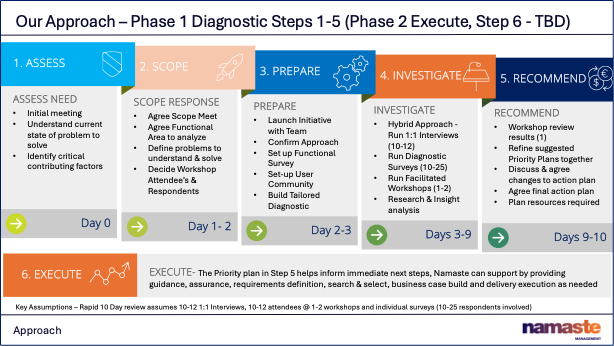
Phase 1 – Diagnostic Assessment (Steps 1–5)
1. Assess (Day 0)
Initial meeting to clarify objectives, understand current issues and challenges, and identify critical factors shaping Operations performance.
2. Scope (Days 1–2)
Agree functional areas, define issues to investigate, and confirm interviewees, workshop attendees, and survey participants.
3. Prepare (Days 2–3)
Launch the initiative, confirm the diagnostic framework, configure tailored surveys, and set up a user community.
4. Investigate (Days 3–9)
Hybrid approach combining 1:1 interviews, diagnostic surveys, and facilitated workshops. Findings are reinforced with research and benchmarking.
5. Recommend (Days 9–10)
Results reviewed in a workshop. Our AI-enabled ID8 software refines a prioritised action plan with clear ownership, resourcing, and timelines, which is then agreed by stakeholders.
Phase 2 – Execution & Change Delivery (Step 6)
6. Execute (Post-Diagnostic)
Namaste Management can then further support the COO in delivering the agreed roadmap and priority actions, from business case development and requirements definition to programme delivery and performance tracking.
The Value Delivered
- Rapid 10-day review combining speed and depth
- 360° insight through interviews, surveys, and workshops
- Prioritised action plan aligned with strategy and risk profile
- Execution support to ensure recommendations are delivered and embedded
The Aspire ID8 CSO Diagnostic moves quickly from assessment to action, enabling operations to become a true strategic enabler of resilience, efficiency, and growth.
Namaste Management can also provide 1-2-day board level workshops or 5-day or 15-day variations on the 10-day example shared above.
Aspire ID8 CSO Diagnostic Typical Review Areas
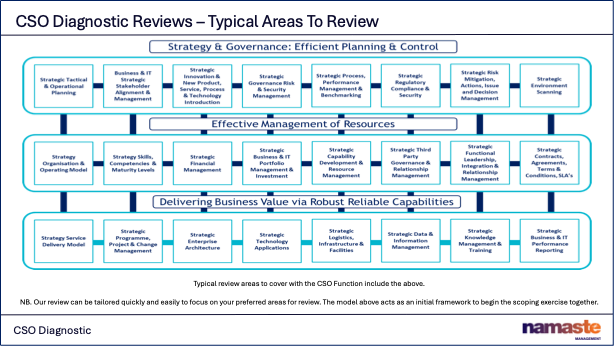
The Aspire ID8 CSO Diagnostic provides Chief Strategy Officers with a structured, evidence-based assessment of how effectively enterprise strategy is formulated, governed, and executed. It evaluates the maturity of strategic planning, resource management, and delivery capabilities across the organisation — ensuring that strategy translates into measurable performance and sustained business value.
Using a three-layer framework, the diagnostic delivers a clear, data-driven view of strategic alignment, operational readiness, and execution effectiveness, helping the CSO lead transformation with confidence and precision.
1. Strategy & Governance: Efficient Planning & Control
This top layer assesses how well strategic intent is defined, governed, and aligned with organisational priorities.
It explores:
- Strategic, tactical, and operational planning processes
- Cross-functional stakeholder alignment and collaboration
- Innovation, product, and technology introduction
- Governance, risk, and security oversight
- Performance measurement and benchmarking
- Regulatory compliance, environmental scanning, and issue management
Value delivered: insight into the strength of strategic alignment, governance structures, and risk management frameworks that underpin long-term success.
2. Effective Management of Resources
This layer examines how effectively the organisation’s people, capital, and partnerships are managed to execute strategy and realise planned benefits.
It reviews:
- Organisational design and operating model for strategy delivery
- Leadership skills, competencies, and maturity
- Strategic financial and investment management
- Portfolio and resource management
- Third-party governance and collaboration
- Contractual and relationship management frameworks
Value delivered: clarity on how well resources and capabilities are aligned to strategic priorities, ensuring agility, accountability, and execution discipline.
3. Delivering Business Value via Robust Reliable Capabilities
The final layer focuses on the systems, tools, and processes that enable consistent strategy execution and measurable value delivery.
It covers:
- Strategy service delivery model
- Programme, project, and change management
- Enterprise architecture and technology enablement
- Data and information management
- Knowledge management, analytics, and reporting
Value delivered: assurance that strategic initiatives are delivered effectively, with robust governance, transparency, and traceability from design to execution.
Why It Matters
The Aspire ID8 CSO Diagnostic enables Chief Strategy Officers to move beyond vision-setting to measurable strategy execution. It provides:
- A data-driven maturity assessment across strategy formulation, governance, and delivery
- Benchmarking and insight dashboards to highlight performance gaps and opportunities
- A prioritised action roadmap to accelerate implementation and impact
- A framework to strengthen strategic alignment, execution discipline, and enterprise agility
By combining structured diagnostics, stakeholder engagement, and best-practice analysis, Aspire helps CSOs ensure strategy is not just designed — but delivered — as a sustainable, measurable source of competitive advantage.