
Chief Procurement Officers (CPOs) are now pivotal to enterprise performance, resilience, and transformation. Once viewed as cost optimisers, they are now value architects – balancing efficiency, sustainability, and risk in a global context of volatility and technological acceleration.
The modern CPO blends commercial acumen with digital intelligence and strategic foresight. They connect supplier ecosystems with enterprise strategy, ensuring that procurement decisions enhance competitiveness, resilience, and purpose. Operational due diligence, risk visibility, and supplier collaboration have become the true differentiators of high-performing procurement functions.
What follows is a deep dive into eight defining challenges facing today’s CPOs – and the strategic responses shaping the next era of procurement excellence.
For Your Readiness Check, Guide to Scoring and Next Steps:
- Rate each statement (1 = Strongly Disagree to 5 = Strongly Agree).
- Section Score: Add your three ratings, divide by 3.
- Overall Score: Average all section scores.
- Guidance, per section and overall:
- Below 3.0 → Priority for action.
- 3.0–3.5 → Emerging capability; strengthen through targeted initiatives.
- 3.5–4.5 → Solid foundation; refine and scale.
- 4.5–5.0 → Best-in-class readiness; benchmark against peers.
Use this tool regularly to track progress, align with your leadership team, and ensure operational readiness in a volatile environment.
1. Supply Chain Resilience & Risk Management
The Challenge:
Global supply networks remain fragile amid geopolitical shifts, inflation, and climate disruptions. Traditional cost-driven sourcing strategies are inadequate for today’s volatility.
How CPOs Are Responding:
CPOs are embedding multi-dimensional risk management into procurement strategy. They use predictive analytics, dual sourcing, and nearshoring to mitigate disruption. Operational due diligence – evaluating supplier capacity, resilience, and contingency capabilities – is now a core requirement in all sourcing decisions.
Case Insight: A pharmaceutical company reduced critical supply interruptions by 60% after introducing operational due diligence into all tier-one supplier assessments.
Your Readiness Check:
- Supply risk is monitored through real-time analytics and dashboards.
- Operational due diligence forms part of every supplier selection process.
- Resilience metrics influence sourcing and investment decisions.
2. Cost Optimisation & Value Creation
The Challenge:
Procurement is expected to deliver savings while supporting growth and innovation. Many organisations struggle to move beyond transactional cost reduction toward strategic value delivery.
How CPOs Are Responding:
High-performing CPOs adopt “total value of ownership” approaches that combine cost, quality, innovation, and risk metrics. They align procurement goals with enterprise value drivers and leverage category intelligence, should-cost modelling, and supplier-led innovation.
Case Insight: A manufacturing group achieved 15% cost savings and 20% process efficiency improvement by deploying value-engineering workshops with key suppliers.
Your Readiness Check:
- Procurement balances cost reduction with strategic value creation.
- Category strategies align with enterprise growth priorities.
- Supplier collaboration contributes measurable innovation and performance.
3. Digital Procurement & AI-Driven Decision-Making
The Challenge:
Despite digital investment, many procurement teams remain data-poor and insight-light. Disconnected systems prevent visibility across spend, risk, and performance.
How CPOs Are Responding:
CPOs are digitising the full source-to-pay (S2P) cycle and deploying AI-driven insights for spend analytics, supplier risk prediction, and compliance monitoring. Operational data integration ensures that decisions are evidence-based and real-time.
Case Insight: A global logistics firm reduced manual transaction volume by 50% and increased spend visibility by 90% after implementing an AI-enabled procurement analytics suite.
Your Readiness Check:
- Procurement data is unified and accessible across systems.
- AI and automation enhance sourcing, contracting, and risk visibility.
- Digital tools are embedded in day-to-day procurement decision-making.
4. ESG, Sustainability & Ethical Sourcing
The Challenge:
Procurement sits at the heart of ESG delivery – from emissions and labour standards to supplier diversity and circular economy practices. Yet compliance alone does not ensure impact.
How CPOs Are Responding:
Leading CPOs treat sustainability as value creation, not cost. They integrate ESG metrics into sourcing scorecards, supplier onboarding, and performance reviews. Operational due diligence now includes ESG audits and traceability assessments to validate supplier claims.
Case Insight: A global retailer achieved carbon neutrality across its supplier base by embedding sustainability KPIs into contracts and conducting operational ESG due diligence.
Your Readiness Check:
- ESG metrics are integrated into supplier evaluation and performance.
- We conduct operational ESG due diligence on high-impact suppliers.
- Procurement drives measurable environmental and social outcomes.
5. Strategic Supplier Relationships & Ecosystem Collaboration
The Challenge:
Transactional supplier management limits innovation and agility. Value increasingly comes from strategic partnerships – yet few organisations manage them with governance and intent.
How CPOs Are Responding:
Modern CPOs are moving from supplier management to supplier collaboration. They establish joint business plans, innovation forums, and shared data environments. Operational due diligence ensures mutual capability alignment and readiness for innovation partnerships.
Case Insight: A technology manufacturer co-developed three new product platforms with suppliers after launching a joint innovation framework anchored in operational readiness reviews.
Your Readiness Check:
- Strategic suppliers are managed through joint performance frameworks.
- Collaboration drives co-innovation and shared risk management.
- Operational capability assessments inform partnership selection.
6. Procurement Operating Model & Talent Transformation
The Challenge:
Procurement must evolve from transactional processing to strategic enablement. Legacy structures, unclear roles, and limited analytical skills hinder progress.
How CPOs Are Responding:
CPOs are redesigning procurement operating models around category leadership, data analytics, and business partnering. They invest in skill-building programs covering digital fluency, negotiation, sustainability, and operational due diligence competencies.
Case Insight: An energy company boosted procurement ROI by 25% through a talent upskilling program focused on strategic sourcing and supplier risk analysis.
Your Readiness Check:
- Our operating model enables agility and strategic alignment.
- Procurement teams possess strong analytical and negotiation skills.
- Operational and financial literacy are embedded in procurement training.
7. Governance, Compliance & Risk Transparency
The Challenge:
Expanding global operations and tightening regulations increase compliance complexity. Manual oversight cannot keep pace with scale and risk exposure.
How CPOs Are Responding:
CPOs are deploying digital compliance platforms and supplier risk scoring systems to maintain visibility across the supply base. Operational due diligence verifies compliance maturity, governance standards, and data integrity before contracts are signed.
Case Insight: A multinational industrial group avoided regulatory penalties by introducing an automated compliance dashboard linked to supplier operational audits.
Your Readiness Check:
- Procurement compliance is automated, transparent, and auditable.
- Operational due diligence validates supplier governance practices.
- Compliance data feeds executive risk and performance dashboards.
8. Measuring Procurement Impact & Enterprise Alignment
The Challenge:
Procurement’s contribution often remains under-recognised because metrics focus on savings, not enterprise value. Without visibility into strategic outcomes, credibility suffers.
How CPOs Are Responding:
Forward-thinking CPOs build value scorecards that connect procurement outcomes to revenue growth, innovation, and resilience. They align reporting with finance and operations, ensuring procurement is seen as a driver of enterprise success.
Case Insight: A global transport group elevated procurement to board-level reporting status after integrating its value delivery dashboard with corporate performance metrics.
Your Readiness Check:
- Procurement impact is measured beyond cost savings.
- Value reporting aligns with enterprise strategy and financial KPIs.
- Procurement is recognised as a strategic contributor to transformation.
Deep-Dive CPO Diagnostics – Leveraging Namaste Aspire ID8
The Namaste Aspire ID8 CPO Diagnostic enables Chief Procurement Officers to rapidly assess the maturity, readiness and impact of their procurement function. Built on a proven framework and underpinned by our AI-enabled proprietary software, the review consists of three layers and 24 review areas, providing a 360-degree view of how effectively the business integrates commercial excellence, digital maturity, and ESG performance into a unified roadmap for procurement transformation.
The CPO Diagnostic is typically a structured 10-day review which combines structured analysis, stakeholder engagement, and data-driven insights to deliver a practical, prioritised action plan.
The approach is structured into a 6-step approach with steps 1-5 in Phase 1 culminating in a recommended action plan to implement to address the challenges identified. Phase 2, Step 6 relates to the execution / implementation of the recommendations which naturally follows on from the Phase 1 activity.
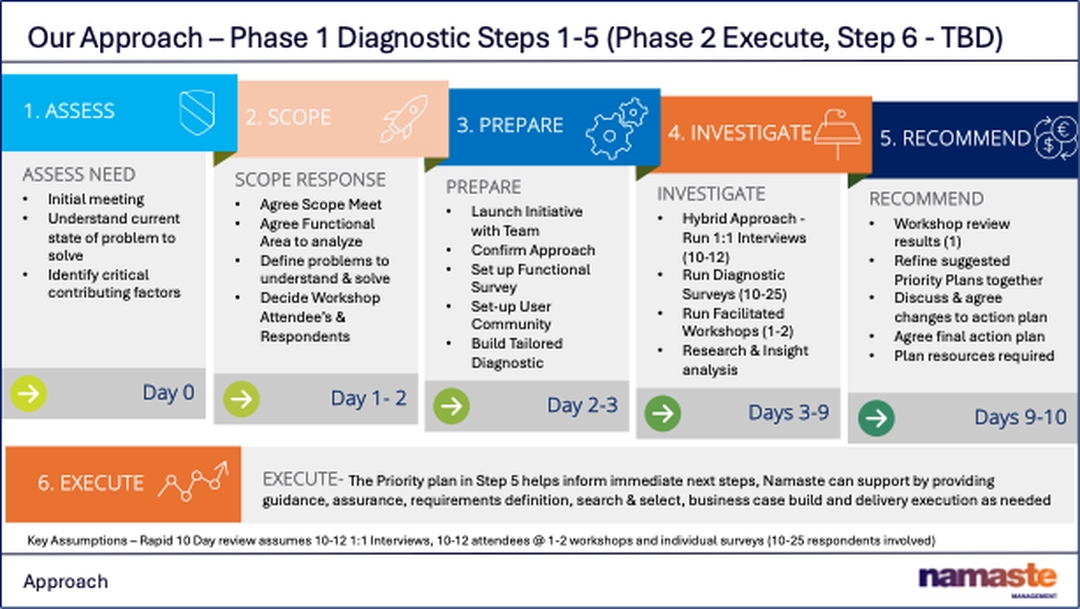
Phase 1 – Diagnostic Assessment (Steps 1–5)
1. Assess (Day 0)
Initial meeting to clarify objectives, understand current issues and challenges, and identify critical factors shaping Operations performance.
2. Scope (Days 1–2)
Agree functional areas, define issues to investigate, and confirm interviewees, workshop attendees, and survey participants.
3. Prepare (Days 2–3)
Launch the initiative, confirm the diagnostic framework, configure tailored surveys, and set up a user community.
4. Investigate (Days 3–9)
Hybrid approach combining 1:1 interviews, diagnostic surveys, and facilitated workshops. Findings are reinforced with research and benchmarking.
5. Recommend (Days 9–10)
Results reviewed in a workshop. Our AI-enabled ID8 software refines a prioritised action plan with clear ownership, resourcing, and timelines, which is then agreed by stakeholders.
Phase 2 – Execution & Change Delivery (Step 6)
6. Execute (Post-Diagnostic)
Namaste Management can then further support the CPO in delivering the agreed roadmap and priority actions, from business case development and requirements definition to programme delivery and performance tracking.
The Value Delivered
- Rapid 10-day review combining speed and depth
- 360° insight through interviews, surveys, and workshops
- Prioritised action plan aligned with strategy and risk profile
- Execution support to ensure recommendations are delivered and embedded
The Aspire ID8 CPO Diagnostic moves quickly from assessment to action, enabling operations to become a true strategic enabler of resilience, efficiency, and growth.
Namaste Management can also provide 1-2-day board level workshops or 5-day or 15-day variations on the 10-day example shared above.
Aspire ID8 CPO Diagnostic Typical Review Areas
The Aspire ID8 CPO Diagnostic provides Chief Procurement Officers with a structured, evidence-based framework to assess the maturity, efficiency, and value contribution of the procurement and supply chain function. It helps CPOs evaluate the effectiveness of strategy, governance, resource utilisation, and operational capability — ensuring procurement delivers cost efficiency, supplier resilience, and sustainable business value.
Built around three integrated layers, the diagnostic gives a comprehensive view of how procurement strategy aligns with corporate goals, how resources and partnerships are managed, and how well the organisation delivers commercial and operational outcomes.
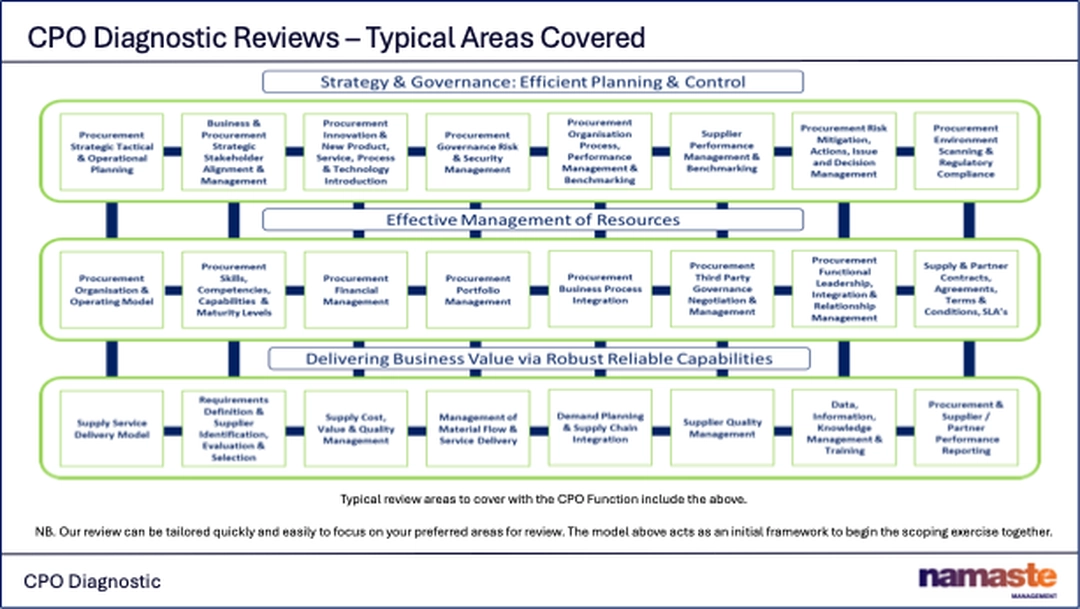
1. Strategy & Governance: Efficient Planning & Control
This layer examines how well procurement strategy, governance, and performance management support organisational objectives and regulatory expectations.
It assesses:
- Strategic, tactical, and operational procurement planning
- Business–procurement stakeholder alignment and governance
- Innovation in sourcing, product, and technology introduction
- Risk and security management frameworks
- Supplier performance benchmarking and regulatory compliance
- Environmental scanning and risk mitigation strategies
Value delivered: clarity on how effectively procurement strategy and governance frameworks underpin corporate objectives, risk management, and sustainability commitments.
2. Effective Management of Resources
This layer evaluates the people, processes, and systems that enable procurement to operate efficiently and deliver value.
It reviews:
- Procurement organisation and operating model
- Skills, competencies, and capability maturity
- Financial management and spend control
- Portfolio and business process integration
- Third-party governance, negotiation, and relationship management
- Functional leadership, team integration, and contractual management
Value delivered: insight into the maturity, efficiency, and agility of procurement operations, enabling stronger supplier performance and internal collaboration.
3. Delivering Business Value via Robust Reliable Capabilities
The third layer focuses on the operational and analytical capabilities that drive procurement performance and business outcomes.
It includes:
- Service delivery and supplier selection models
- Cost, value, and quality management processes
- Demand planning and supply chain integration
- Supplier quality management and performance tracking
- Data, analytics, and knowledge management systems
- Procurement performance measurement and reporting
Value delivered: assurance that procurement operations are efficient, data-driven, and aligned to business performance — delivering measurable savings, resilience, and supplier value.
Why It Matters
The Aspire ID8 CPO Diagnostic enables Chief Procurement Officers to move from tactical sourcing to strategic value creation. It provides:
- A comprehensive maturity assessment across strategy, operations, and capability dimensions
- Benchmarking and analytics to highlight opportunities for improvement
- A prioritised action roadmap to optimise spend, strengthen governance, and enhance supplier relationships
- A platform for driving sustainable procurement excellence and enterprise resilience
By combining structured diagnostics, stakeholder engagement, and best-practice benchmarking, Aspire empowers CPOs to transform procurement from a cost-control function into a strategic enabler of efficiency, innovation, and long-term value creation.